Can You Put an Air Fryer on a Cutting Board? Safety Guide
Quick Answer
You should generally avoid putting a running air fryer directly on a cutting board. Wood and bamboo can discolor or warp from prolonged heat, while plastic can soften or deform. A thick, stable, heat-resistant board might work only if its manufacturer and your air fryer manufacturer both approve that setup. A dedicated heat-resistant countertop surface is the safer choice, consistent with Consumer Reports’ air fryer safety guidance.
Important Safety Checks
- Check heat resistance: Never assume a cutting board can tolerate prolonged appliance heat.
- Avoid plastic boards: Heat can cause softening, bending, or permanent surface damage.
- Protect wooden boards: Concentrated heat can affect wood fibers, finishes, and glued joints.
- Maintain ventilation: Keep the air fryer vents and manufacturer-required clearances unobstructed.
- Use stable support: The appliance must remain level with all its feet properly supported.
- Follow the manual: Your specific air fryer instructions take priority over general advice.
My Recommendation
- Best approach: Use a level, heat-resistant counter or a manufacturer-approved protective mat that supports the entire appliance.
An air fryer can make everyday cooking easier, but finding the right place for it isn’t always simple. If your countertop is limited, a spare cutting board might seem like a convenient solution.
I prefer separating cutting surfaces from appliance stands. In this guide, I’ll explain the risks, compare common board materials, and show you safer ways to protect your counter.
Why Does the Surface Under an Air Fryer Matter?
An air fryer is a countertop cooking appliance that circulates heated air around food. Its heating element and fan create the high cooking temperatures needed for crisp results.
Although the cooking chamber contains most of that heat, the appliance’s exterior, underside, and exhaust areas can become warm or hot. The amount of heat reaching the counter depends on the model and its design.
This distinction matters because a material that works well for cutting vegetables may not withstand prolonged appliance heat.
How Hot Does an Air Fryer Get?
Many household air fryers operate at cooking temperatures around 180°F to 400°F (82°C to 204°C). Some models offer settings outside this range.
However, the selected cooking temperature is not the same as the temperature underneath the appliance. You cannot determine base temperature from the display alone.
Consumer Reports has measured high temperatures around air fryer exteriors and rear vents. Those findings reinforce the importance of protecting nearby materials.
- Heating element: Produces the heat used for cooking.
- Internal fan: Circulates heated air through the cooking chamber.
- Exterior housing: Can become hot depending on insulation and appliance design.
- Exhaust vent: Releases heated air that may affect nearby walls and cabinets.
- Support feet: Help position the appliance and maintain its intended clearance from the counter.
A cutting board underneath the appliance may receive heat for an entire cooking cycle. Repeated exposure can gradually damage some materials.
Can You Put an Air Fryer on a Wooden Cutting Board?
 Save
A wooden cutting board is not automatically a safe platform for an operating air fryer. Its suitability depends on heat exposure, board construction, stability, and manufacturer approval.
Wood does not melt like ordinary plastic, but it can still experience heat-related damage. A wooden board may also contain adhesives or finishes with different temperature limitations.
What Can Happen to Wood Under an Air Fryer?
- Discoloration: Prolonged heat may darken the surface or leave marks.
- Warping: Uneven heating and moisture changes can make the board curve.
- Joint problems: Heat may stress the glue lines in laminated boards.
- Finish deterioration: Protective oils, waxes, or other finishes may change under heat.
- Stability problems: A warped board can become an unsafe appliance platform.
A thick hardwood board may remain stable under conditions that damage a thin board. Still, thickness alone does not establish a safe operating temperature.
For everyday cooking, I would reserve wooden boards for food preparation. There is little benefit in exposing an expensive chopping board to unnecessary heat.
Is a Butcher Block Safe Under an Air Fryer?
A butcher block is a substantial wooden cutting surface, often made from joined hardwood strips. Its weight and thickness can provide excellent stability during food preparation.
Those features do not make every butcher block heatproof. The wood species, adhesive, finish, and manufacturer’s instructions all matter.
A built-in butcher block countertop also differs from a removable board. Check the countertop and appliance instructions before operating an air fryer on either surface.
If your board develops heat marks or minor surface damage, see this guide on how to refinish a cutting board. Refinishing may improve cosmetic damage, but it cannot reliably restore compromised structural joints.
Can You Put an Air Fryer on a Plastic Cutting Board?
I would not use an ordinary plastic cutting board beneath a running air fryer. Most standard kitchen cutting boards are designed for food preparation, not continuous appliance heat.
Plastic boards vary in their composition and heat tolerance. Common materials include polypropylene and polyethylene, each with different performance characteristics.
What Are the Main Risks?
- Softening: Heat can reduce rigidity and affect appliance stability.
- Warping: The board may develop a permanent bend or uneven surface.
- Surface damage: Appliance feet may leave marks or indentations.
- Melting: Excessive temperatures can cause serious deformation.
- Cleaning difficulties: Damaged surfaces can become harder to clean thoroughly.
Even a board labeled dishwasher-safe may not be suitable for supporting hot appliances. Dishwasher resistance and continuous contact with appliance heat are different requirements.
My recommendation is simple: Keep ordinary plastic boards away from an operating air fryer’s underside.
Can You Put an Air Fryer on a Bamboo Cutting Board?
Bamboo cutting boards share several potential heat-related problems with wooden boards. They can discolor, warp, and experience damage around their bonded sections.
Many bamboo boards contain multiple strips held together with adhesive. Repeated heating can place stress on those joints, particularly when moisture changes occur.
Does Bamboo Handle Heat Better Than Wood?
There is no universal answer because construction and finish matter more than the material name alone. Some bamboo boards are sturdy, but that does not make them suitable appliance stands.
Look for the following warning signs:
- Separation between bamboo strips.
- Changes in the board’s flatness.
- Unusual discoloration beneath appliance feet.
- Cracking around the edges.
- Changes in surface coating or finish.
If you already use bamboo for chopping, keep it away from concentrated heat. Proper drying and conditioning will help with ordinary board maintenance.
For maintenance advice, read how to oil a bamboo cutting board. Remember that oiling does not turn bamboo into a heat-resistant appliance stand.
Which Cutting Board Materials Are Safest Under an Air Fryer?
 Save
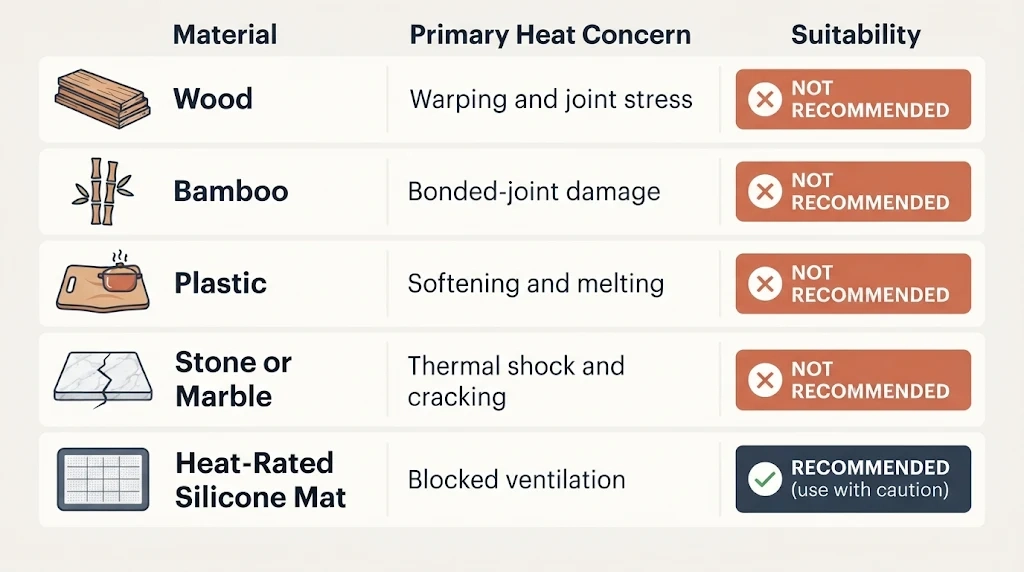
No ordinary cutting board material should be considered automatically safe beneath a running air fryer. The best choice is a surface specifically approved for the appliance’s operating conditions.
This comparison shows the practical differences between common materials. The ratings are qualitative guidance, not measured heat-resistance certifications.
| Material | Main Heat Concern | For Running Air Fryers | Recommendation |
|---|---|---|---|
| Wood | Warping, finish damage, joint stress | Not automatically suitable | Avoid unless approved |
| Bamboo | Warping and bonded-joint damage | Not automatically suitable | Avoid unless approved |
| Plastic | Softening, melting, deformation | Generally unsuitable | Avoid |
| Stone or Marble | Thermal shock, cracking, finish issues | Depends on product design | Verify before use |
| Heat-Rated Silicone Mat | Inadequate support or blocked ventilation | Potentially suitable if approved | Check compatibility and dimensions |
Stone may appear attractive because it tolerates some forms of heat. However, natural stone can crack from thermal stress, and decorative boards may have vulnerable finishes or feet.
Learn more about stone surfaces in this guide: Are stone cutting boards good?
What Should You Put Under an Air Fryer Instead?
The safest starting point is a flat, stable, heat-resistant countertop that meets your appliance manufacturer’s instructions. Some air fryers also permit suitable protective accessories.
Here are the alternatives I would consider before sacrificing a cutting board.
1. A Heat-Resistant Silicone Mat
A purpose-made silicone mat can help protect certain countertops from heat and scratches. However, its temperature rating must match the intended use.
Look for firm, nonslip construction and enough area to support the appliance correctly. Do not choose a thick, soft mat that allows the feet to sink in or blocks ventilation underneath.
2. A Manufacturer-Approved Countertop Protector
Some kitchen appliance manufacturers provide placement guidance or recommend specific accessories. These are preferable to guessing whether a general-purpose board will work.
Check the manual and the manufacturer’s customer support resources. Never assume that an accessory designed for a hot pan is automatically suitable under an operating appliance.
3. A Suitable Heat-Resistant Countertop
Many household countertops can accommodate air fryers when the appliance instructions permit direct placement. Material, surface finish, seams, and installation details still affect heat tolerance.
For example, a stone countertop may handle ordinary warmth while a nearby sealant or resin remains more sensitive. Follow both countertop and air fryer manufacturer guidance.
How Do You Set Up an Air Fryer Safely?
 Save
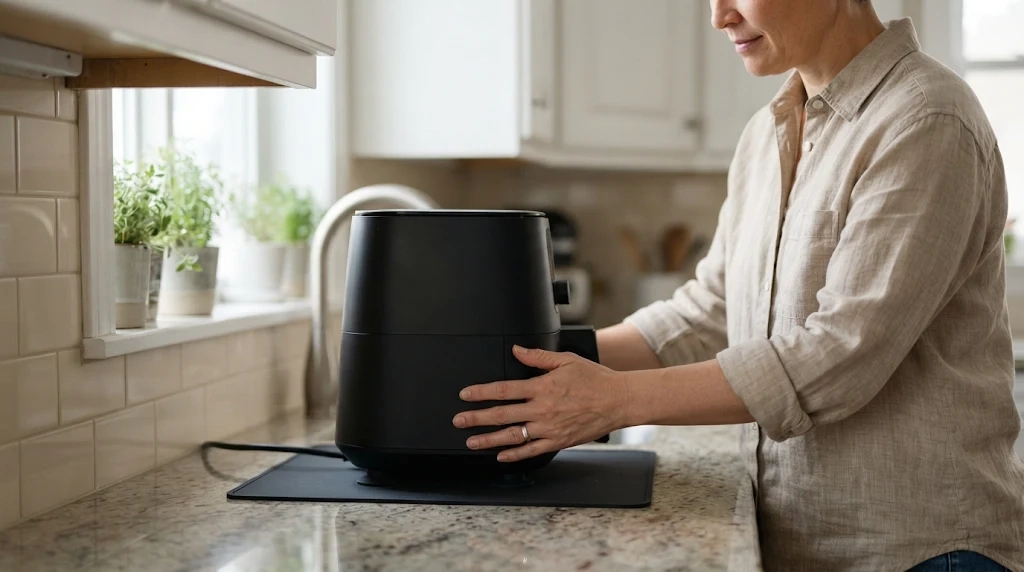
Safe positioning involves more than protecting the surface underneath. Airflow, power connections, stability, and surrounding space all deserve attention.
Step-by-Step Air Fryer Placement
- Read your manual. Identify permitted surfaces, ventilation requirements, and minimum clearances.
- Choose a level location. Keep the appliance away from counter edges and unstable platforms.
- Inspect the surface. Ensure it is clean, dry, undamaged, and heat-resistant.
- Check the appliance feet. Make sure every foot rests securely on the intended support.
- Allow ventilation. Leave the required space behind, above, and beside the appliance.
- Protect the power cord. Keep it away from hot exhaust, heated surfaces, and water.
- Run the appliance as instructed. Watch for unusual smells, movement, or signs of surface damage.
- Allow complete cooling. Unplug the appliance when appropriate and wait before moving or cleaning it.
Some Cosori manuals specify 5 inches (13 cm) of space behind and above certain models. Other manufacturers use different clearance measurements.
Therefore, do not treat one manufacturer’s measurements as universal. Follow the instructions supplied with your exact appliance.
Why Is Ventilation Important?
Air fryers need clear airflow to operate correctly. Restricting an intake or exhaust vent can affect cooking performance and increase overheating risks.
Philips air fryer manuals instruct users to choose a stable, heat-resistant surface and avoid obstructing the appliance’s airflow.
See the Philips website for model-specific product support and manuals.
What Happens If You Already Put an Air Fryer on a Cutting Board?
If you have already used a cutting board underneath your air fryer, there is no need to assume it has been ruined. Inspect both the board and surrounding counter before using the setup again.
Stop using the board as an appliance stand until you establish that the arrangement is safe.
Signs of Heat Damage
- Dark marks: New brown or black areas may indicate overheating.
- Changed shape: Warping can make a board unstable.
- Softened plastic: Deformation suggests the board experienced excessive heat.
- Open joints: Gaps between wood or bamboo strips may indicate structural damage.
- Unusual odor: A burning or melting smell requires immediate attention.
If you smell burning or notice smoke, turn the appliance off and disconnect power only when it is safe to do so. Follow the manufacturer’s emergency guidance.
If a board has melted, charred, split, or developed unstable joints, replace it rather than treating cosmetic repairs as a safety solution.
Can You Repair a Heat-Damaged Cutting Board?
Minor discoloration on an otherwise sound wooden board may sometimes be improved through appropriate refinishing. Structural defects are a different problem.
Do not reuse a board for food preparation if its surface has melted, exposed damaged adhesive, or developed cracks that cannot be cleaned properly.
I would never continue placing an air fryer on a board that already shows heat damage. A replacement cutting board costs less than the possible consequences of an unstable cooking appliance.
Common Air Fryer Placement Mistakes to Avoid
Several everyday habits can increase the chance of heat damage or appliance accidents. Most are easy to prevent once you understand the risks.
- Using a plastic cutting board: Standard chopping boards may deform under concentrated heat.
- Blocking the vents: Objects near the exhaust can interfere with airflow.
- Cooking directly beneath cabinets: Hot exhaust and moisture may damage surrounding materials.
- Using a towel as insulation: Ordinary fabric can create fire or ventilation hazards.
- Placing the appliance on an unstable board: Movement while removing the basket can increase spill and burn risks.
- Ignoring the power cord: Heat exposure may damage electrical insulation.
- Moving the appliance while hot: Hot baskets and components increase burn risks.
For more information about preventing appliance-related burns, review the air fryer guidance from Consumer Reports.
Do You Really Need a Heat Mat Under an Air Fryer?
Not every air fryer requires a separate heat mat. Whether you need one depends on the appliance design, the countertop material, and the manufacturer’s instructions.
A suitable mat can provide extra protection against marks or scratches. It cannot compensate for inadequate ventilation or an unstable appliance.
When a Mat May Be Useful
- Your countertop manufacturer recommends an approved protective barrier.
- Your air fryer manufacturer permits an insulating or protective mat.
- The accessory is rated for the expected heat exposure.
- The mat is firm, flat, nonslip, and adequately sized.
- The appliance’s vents and support feet remain unobstructed.
If those conditions cannot be met, choose another location instead. Safety matters more than fitting the appliance into a particular corner.
Recommended Heat-Resistant Kitchen Accessories
If you want to protect your countertop, these established products are worth comparing. They are heat-resistant kitchen accessories, but their published ratings do not independently certify them as stands for operating air fryers.
Always confirm compatibility with your specific appliance before purchasing or using one underneath it.
🏆 Best Large Heat-Resistant Trivet
ThermoWorks 9 x 12-Inch Silicone Hotpad/Trivet
★★★★☆ 4.5/5 editorial suitability
This rectangular silicone trivet measures approximately 9.28 by 12.25 inches and is rated by ThermoWorks for temperatures up to 600°F. Its nonslip design makes it appealing for protecting surfaces from hot cookware. I would consider it for ordinary kitchen heat protection, but confirm appliance-specific approval before using it under an operating air fryer.
💰 Best Compact Hot-Pan Trivet
Lodge Deluxe Silicone Trivet
★★★★☆ 4/5 editorial suitability
The Lodge Deluxe Silicone Trivet has a compact round design measuring about 7.25 inches across. Lodge states that it protects surfaces from heat up to 525°F. I would choose it for hot cookware and serving dishes, not as a stand for a full-size operating air fryer.
Editor’s note: These suitability scores are editorial judgments based on published product features, not laboratory test results or verified customer review averages. Heat ratings describe the stated accessory limits, not approval for supporting an operating air fryer.
Affiliate disclosure: As an Amazon Associate, we may earn from qualifying purchases made through eligible links, at no additional cost to you.
Frequently Asked Questions
Can I put an air fryer on a wooden chopping board?
It is generally better not to place a running air fryer on a wooden chopping board. Heat can damage the wood, finish, or bonded joints over time. Use a stable, heat-resistant surface approved by the appliance manufacturer instead. A thick wooden board is not automatically heatproof.
Can I put an air fryer on a plastic cutting board?
Ordinary plastic cutting boards are not recommended beneath operating air fryers. Exposure to heat may cause softening, warping, or melting. These changes can also affect appliance stability. A board being dishwasher-safe does not mean it is approved for continuous appliance heat.
Can I put an air fryer on a marble cutting board?
A marble cutting board may tolerate some heat, but it is not automatically suitable beneath an air fryer. Thermal shock, finishes, protective feet, and structural stability all matter. Check the marble product’s heat guidance and your air fryer manual before considering this arrangement.
What is the best surface to put an air fryer on?
The best surface is level, stable, dry, and heat-resistant, with enough surrounding space for proper ventilation. Follow the air fryer manufacturer’s surface and clearance requirements. If the countertop needs protection, use only an appropriately rated accessory that does not interfere with the appliance’s feet or vents.
Will an air fryer damage a wooden countertop?
An air fryer may damage some wooden countertops through concentrated heat or hot exhaust, depending on the appliance and countertop finish. Other wooden surfaces may be suitable under manufacturer-approved conditions. Check both product manuals and maintain the required ventilation clearance.
Final Verdict: Should You Put an Air Fryer on a Cutting Board?
For most kitchens, I recommend keeping cutting boards and air fryer stands separate. Wooden, bamboo, and plastic cutting boards serve food preparation better than prolonged appliance heat exposure.
A heat-resistant material is not enough on its own. The support must also be stable, appropriately sized, and compatible with the appliance’s ventilation requirements.
As of 2026, my advice is to start with the manufacturer’s placement instructions rather than choosing a surface based on appearance or thickness.
My final recommendation: Use a manufacturer-approved, heat-resistant countertop setup. Protect your cutting boards for chopping, and give your air fryer the stable, ventilated space it needs.
Before your next cooking session, inspect the counter, check the appliance feet, and confirm that the exhaust has enough clearance. Those simple checks can help prevent unnecessary damage and reduce avoidable safety risks.

