Can You Bring a Cutting Board on a Plane? TSA Rules & Packing Guide (2026)
Quick Answer
Yes, you can generally bring a cutting board on a plane in either carry-on or checked baggage. The Transportation Security Administration (TSA) specifically allows plastic and small wooden cutting boards in most situations. However, unusually large or heavy boards may face additional scrutiny, and TSA officers make the final decision at security checkpoints.
What you need to know
- Plastic cutting boards: Generally permitted in carry-on and checked luggage.
- Small wooden boards: Usually accepted when they present no security concerns.
- Large butcher blocks: Checked baggage is the safer choice because of their size and weight.
- Kitchen knives: Do not pack ordinary kitchen knives in your carry-on bag.
- International flights: Check the security rules of every country and airport on your route.
- Final approval: Airport security officers decide whether a particular board can pass screening.
Best packing approach
- Carry-on: Choose a compact, lightweight board with smooth edges.
- Checked luggage: Wrap larger boards and position them between soft clothing.
- Before flying: Confirm airline baggage dimensions and weight limits.
Bringing your favorite cutting board on vacation might sound unusual, but it makes sense for travelers who enjoy cooking. Whether you’re moving, visiting family, or preparing meals in a rental kitchen, knowing airport rules can prevent problems.
I recommend checking the board’s material, weight, and dimensions before packing. This guide explains the TSA rules for 2026, how different boards compare, and how to protect your kitchen equipment during travel.
Does TSA Allow Cutting Boards on Airplanes?
Yes. TSA generally permits plastic cutting boards and small wooden cutting boards through airport security in the United States.
A cutting board is a flat surface used to prepare and chop food. Unlike a kitchen knife, an ordinary cutting board does not have a blade.
However, its size, weight, shape, and construction can affect security screening. That distinction matters when deciding what to bring.
What does the official TSA policy say?
TSA’s permitted-items guidance specifically addresses cutting boards. It explains that plastic and small wooden boards are generally acceptable, subject to the checkpoint officer’s judgment.
The agency also warns that otherwise permitted items can require additional screening. Officers can refuse an item that presents security concerns.
- Material: Plastic and small wooden boards have explicit support in TSA guidance.
- Size: An unusually large board may be difficult to accommodate or screen.
- Weight: A thick, heavy wooden slab may receive closer inspection.
- Condition: Broken corners or unusually sharp metal features may raise concerns.
- Screening: Officers may inspect the board separately from other belongings.
For the latest guidance, visit TSA Security Screening before departure. Checking the official source is more dependable than relying on an old travel forum.
Can You Bring a Cutting Board in Carry-On Luggage?
 Save
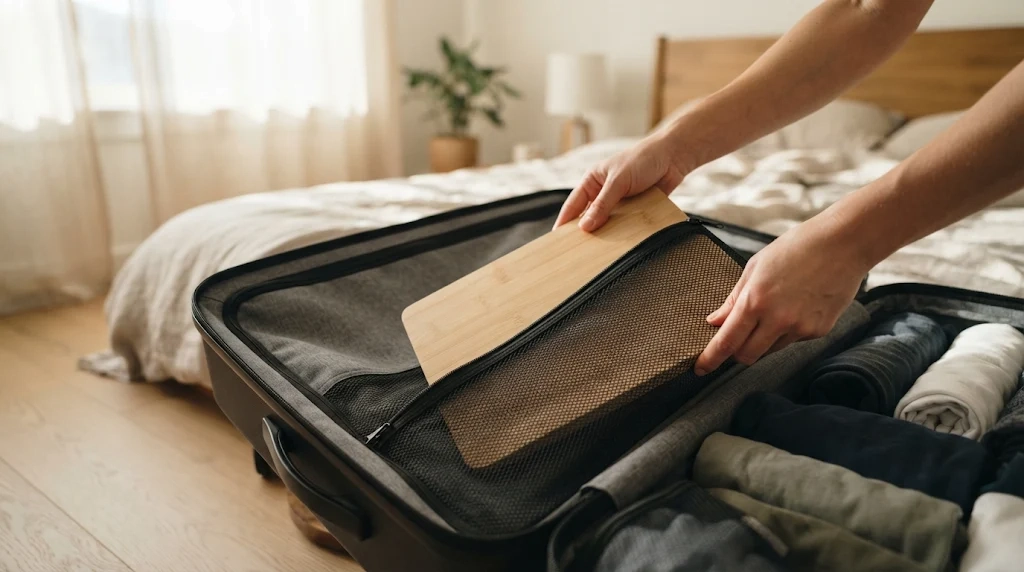
Yes, a small plastic or wooden cutting board is generally suitable for carry-on luggage. It must also fit within your airline’s permitted baggage dimensions.
For example, a lightweight board measuring approximately 10 by 14 inches may fit easily inside a standard cabin bag. This is a practical packing example, not an official TSA size limit.
Which cutting boards work best for carry-on travel?
I would prioritize a thin, compact board without bulky handles. It takes less room and is easier to remove if security staff request a separate inspection.
- Thin plastic boards: Lightweight, inexpensive, and convenient for travel.
- Small bamboo boards: Compact models can work, although approval is not guaranteed.
- Small hardwood boards: Generally practical when their size and weight remain reasonable.
- Flexible cutting mats: Easy to fit into a bag without taking much space.
Can TSA reject a wooden cutting board?
Yes. A wooden cutting board is not automatically prohibited, but TSA officers can reject items that create security concerns.
A large, thick butcher block may be less suitable than a thin kitchen board. If yours is particularly heavy, I would pack it in checked baggage.
Can You Pack a Cutting Board in Checked Baggage?
Yes. Checked baggage is generally the more convenient option for heavy or oversized cutting boards that fit airline luggage allowances.
Checked luggage also provides more room for protective padding. This is particularly useful when transporting expensive hardwood boards or kitchen gifts.
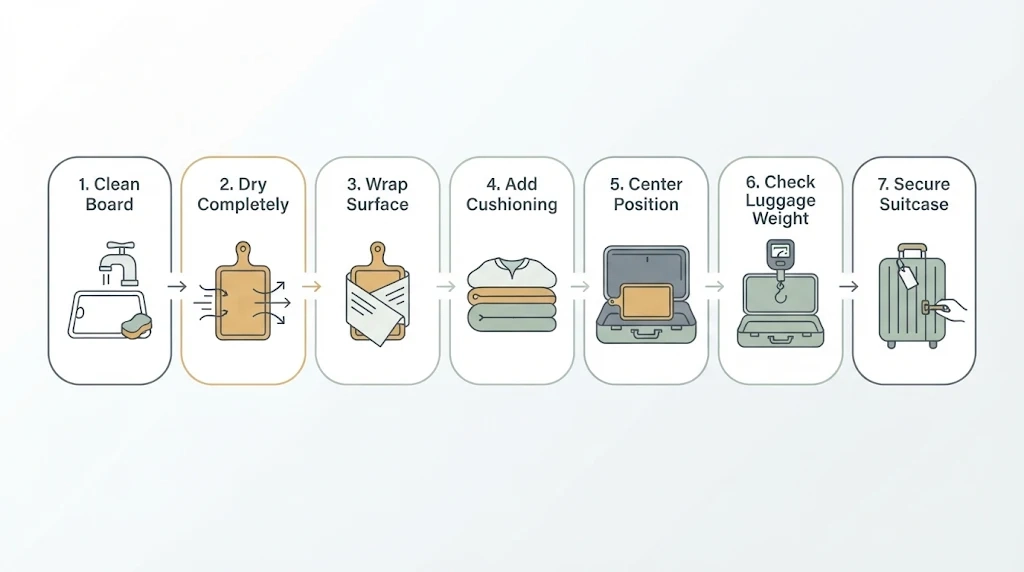
How should you pack a cutting board in a suitcase?
 Save
- Clean the board: Remove food particles, grease, and visible residue.
- Dry it completely: Pay attention to grooves, handles, and edges.
- Protect the surface: Wrap the board with clean cloth or suitable protective material.
- Add cushioning: Place folded clothing around the board.
- Choose a stable position: Keep it away from fragile belongings.
- Check baggage weight: Include the board when calculating your suitcase’s total weight.
- Close the suitcase securely: Make sure the board cannot shift excessively during handling.
I prefer placing a wooden board near the center of a suitcase. Clothing on both sides creates a simple protective layer.
For additional care tips, read this guide on how to prevent a cutting board from warping. Proper drying and storage remain important during travel.
Carry-On vs. Checked Baggage: Which Is Better?
The better choice depends on your board’s size, material, weight, and value. Small plastic boards favor carry-on travel, while large wooden boards generally suit checked luggage.
| Feature | Carry-On Baggage | Checked Baggage |
|---|---|---|
| Small plastic board | Generally allowed | Generally allowed |
| Small wooden board | Generally allowed | Generally allowed |
| Large wooden board | Greater screening risk | Usually the better option |
| Heavy butcher block | Not recommended | Subject to airline limits |
| Access during flight | Available in cabin baggage | Unavailable until collection |
| Main concern | Security approval and cabin size | Weight, handling, and damage |
These recommendations reflect practical packing considerations, not guaranteed security clearance. The airline and security authority each control different parts of your journey.
Do Different Cutting Board Materials Affect TSA Approval?
Yes, material can matter because boards vary in thickness, weight, construction, and edge design. TSA explicitly mentions plastic and small wooden boards, while other materials may need case-by-case assessment.
Wooden cutting boards
Small wooden boards are generally accepted by TSA. Maple, walnut, cherry, and similar hardwoods are common kitchen materials.
Solid wood can be heavier than plastic, especially in thick end-grain designs. Consider checking larger boards rather than taking them through security.
If you’re choosing a hardwood board, see whether cherry wood is suitable for cutting boards. Material choice affects both usability and maintenance.
Plastic cutting boards
Plastic is among the easiest materials to pack for air travel. Many plastic boards are lightweight and slim enough for small suitcases.
Polypropylene and high-density polyethylene are commonly used in kitchen cutting boards. Choose a smooth, undamaged model that is easy to clean.
Bamboo cutting boards
Bamboo boards are generally lightweight compared with bulky butcher blocks. However, their exact acceptance remains subject to security screening.
Before packing, inspect the edges for damage. Avoid transporting a cracked board that could worsen during luggage handling.
Glass, stone, and metal cutting boards
Glass, stone, and metal boards deserve more caution because they can be heavy, rigid, or fragile. Their carry-on acceptance should not be assumed from TSA’s guidance for plastic and small wooden boards.
For glass or stone, checked baggage may reduce cabin-screening uncertainty but creates a greater need for protective packaging. Airline restrictions and security decisions still apply.
What Size Cutting Board Can You Bring on a Plane?
TSA does not publish a universal cutting board dimension limit in its general cutting-board guidance. Instead, practical restrictions come from security assessments and airline baggage allowances.
Use the following measurements as packing examples, not official TSA-approved sizes.
| Example Board Size | Typical Use | Suggested Packing |
|---|---|---|
| 8 × 10 inches | Compact food preparation | Carry-on |
| 10 × 14 inches | Small everyday board | Carry-on if it fits |
| 12 × 18 inches | Medium kitchen board | Check airline dimensions |
| 18 × 24 inches | Large preparation surface | Prefer checked baggage |
A board may fit inside your suitcase yet still require closer security inspection. There is no particular dimension that guarantees approval.
Check your airline’s published cabin-baggage policy before leaving home. Size limits vary by airline, ticket type, and aircraft.
Can You Bring a Cutting Board and Kitchen Knife Together?
 Save
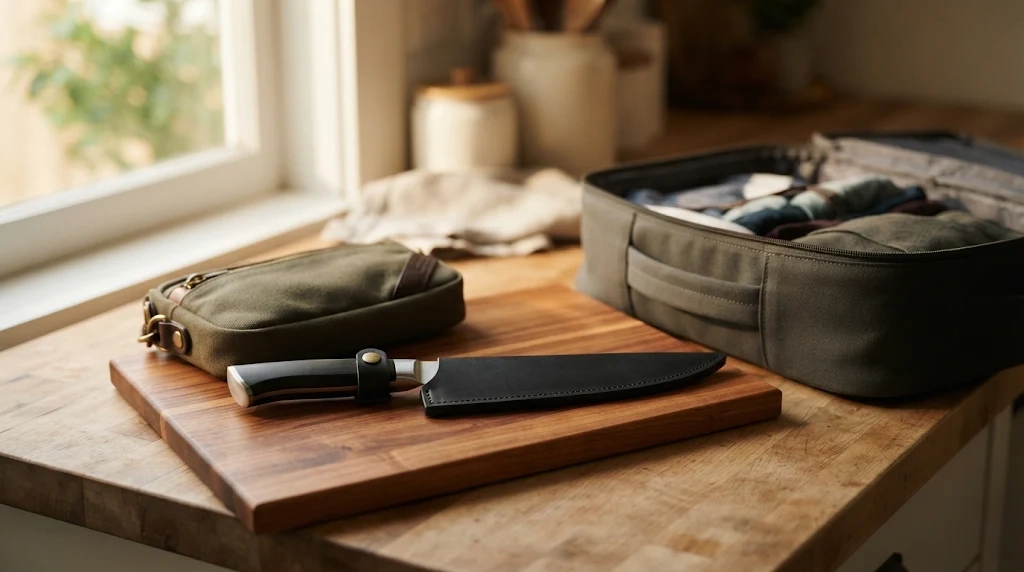
You can pack a cutting board with kitchen knives in checked baggage, subject to applicable rules. Ordinary kitchen knives generally cannot pass through a TSA checkpoint in carry-on luggage.
This is an important distinction. Permission to carry a cutting board does not extend to every kitchen tool stored beside it.
How should you pack kitchen knives safely?
- Use checked luggage: Pack ordinary kitchen knives in the hold rather than the cabin.
- Cover each blade: Use a suitable sheath, knife guard, or secure protective wrapping.
- Prevent movement: Position sharp tools where they cannot shift freely.
- Separate board and blade: Avoid leaving an exposed knife directly against the board.
- Check destination rules: Additional restrictions may apply outside the United States.
TSA advises travelers to sheath or securely wrap sharp objects in checked baggage. The purpose is to protect baggage handlers and inspectors.
You can review the current requirements through the TSA permitted and prohibited items directory.
How Do You Protect a Wooden Cutting Board During Air Travel?
The most effective approach is to transport the board clean, dry, and securely cushioned. Moisture and careless handling can damage wooden boards even when airport security permits them.
Should you oil a wooden cutting board before flying?
Conditioning may help an unfinished wooden board stay in good condition, but it is not a TSA requirement. Follow the manufacturer’s guidance for the specific finish.
When appropriate, apply a thin coat of food-grade mineral oil and wipe away excess. Let the board become dry to the touch before packing.
What should you avoid?
- Wet wrapping: Do not seal a damp wooden board inside plastic.
- Loose storage: Avoid leaving the board unsecured in an oversized suitcase.
- Excessive pressure: Keep heavy, hard objects from pressing against thin boards.
- Exposed corners: Pad edges that could strike other luggage contents.
- Unnecessary attachments: Remove detachable blades or accessories and pack them according to their own rules.
For a longer trip, keep the board away from leaking toiletries or damp clothing. Dry storage helps preserve its shape.
Can You Bring a Cutting Board on an International Flight?
Possibly, but TSA rules only govern relevant screening in the United States. Other countries apply their own aviation security regulations.
Even if a board passes your departure checkpoint, another airport may evaluate it differently during a connecting flight.
What should international travelers check?
- Departure security: Review the requirements of the airport where your trip begins.
- Transit airports: Check whether connecting passengers undergo additional screening.
- Destination security: Review local rules if you will carry the board on a return flight.
- Airline baggage: Confirm cabin and checked-baggage allowances.
- Wood-related restrictions: Check customs and agricultural rules for unfinished or untreated wooden items.
Wooden boards may face additional questions when they are unfinished, contain bark, or show evidence of pests. Import requirements depend on the destination and the item’s condition.
The U.S. Customs and Border Protection travel guidance is a useful starting point for travelers entering the United States. Destination-specific authorities should also be consulted.
What Happens if TSA Does Not Allow Your Cutting Board?
If an officer determines that your cutting board cannot pass security, you cannot insist on taking it into the restricted area. Approval remains subject to the screening authority.
Depending on airport procedures and available time, you may have several practical choices.
- Return to check-in: Ask your airline whether the item can be placed in checked baggage.
- Give it to someone: Leave it with a person who is not traveling.
- Arrange shipping: Explore available shipping options outside security.
- Voluntarily surrender it: This may be necessary if no other option is practical.
None of these alternatives is guaranteed to be available at every airport. Allow extra time if you are traveling with unusually bulky kitchen equipment.
Best Cutting Boards for Air Travel
If you’re buying a cutting board specifically for travel, I would focus on compact dimensions and low weight. The following real product lines offer useful starting points for comparing designs.
These are feature-based recommendations rather than laboratory-tested ratings. Check current product specifications and customer reviews before purchasing.
Affiliate disclosure: As an Amazon Associate, this website may earn from qualifying purchases.
🏆 Best for compact travel
OXO Good Grips Utility Cutting Board
★★★★☆ 4.5/5 editorial suitability
OXO’s utility-board design offers a practical plastic cutting surface with grip-focused features. I would shortlist a compact version for travel because plastic is easy to pack and maintain.
💰 Best lightweight option
Dexas Flexible Cutting Mats
★★★★☆ 4.5/5 editorial suitability
Flexible plastic mats take relatively little suitcase space and are useful for simple food preparation. I favor this format for short stays where a bulky board would be unnecessary.
🌳 Best wooden option
John Boos Maple Cutting Board
★★★★☆ 4.0/5 editorial suitability
John Boos offers hardwood cutting boards in various designs and dimensions. I would choose a smaller maple model for travel, reserving thick butcher blocks for checked transport.
Frequently Asked Questions
Can I bring a wooden cutting board through TSA security?
Yes, TSA generally allows small wooden cutting boards in carry-on baggage. However, the board’s size, weight, and overall characteristics may affect screening. TSA officers have final authority, so checked baggage is a sensible alternative for a large or unusually heavy wooden board.
Can I take a bamboo cutting board on a plane?
A small bamboo cutting board may be acceptable, but TSA’s general guidance specifically mentions plastic and small wood boards. Acceptance of a particular bamboo board is not guaranteed. Choose a compact design and check with TSA before departure if its size or construction is unusual.
Can I carry a cutting board in my backpack?
Yes, a small cutting board can generally travel inside a backpack used as carry-on luggage, provided it passes security screening. The backpack must also meet your airline’s baggage requirements. Position the board securely so it does not damage other belongings or make inspection difficult.
Are large cutting boards allowed in checked luggage?
Large cutting boards can generally travel in checked luggage when they comply with airline baggage restrictions and applicable security rules. Check the dimensions and weight before packing. Protect wooden or fragile boards with cushioning, and avoid placing excessive pressure on the board’s edges.
Can I bring a cutting board on a flight to another country?
You may be able to bring one, but international security and customs rules vary. TSA permission does not guarantee acceptance at a foreign airport. Check your airline’s baggage policy, security requirements at connecting airports, and any customs restrictions concerning wooden products at your destination.
Final Verdict: Should You Bring a Cutting Board on a Plane?
Yes, bringing a cutting board on a plane is generally possible, especially if it is a small plastic or wooden board. TSA’s guidance supports these common designs, although final approval belongs to airport security officers.
For everyday travel, I would choose a compact plastic board or flexible cutting mat. These options are easier to pack and create fewer space or weight concerns.
If you’re transporting a heavy hardwood board, checked baggage is generally more practical. Wrap it carefully, confirm airline baggage limits, and keep it completely dry.
Before your next flight: Check TSA guidance, confirm airline requirements, and choose the packing method that best matches your cutting board. A few minutes of preparation can prevent an inconvenient surprise at security.

