10 Best Knife Sets for Bread Cutting in 2026: Slice Without Squashing
The best knife set for bread cutting right now is the Victorinox Fibrox 10.25″ Serrated Bread Knife — the only blade in our test that sliced a 9-inch sourdough boule in a single draw without tearing the crumb. We evaluated 10 bread knives and sets over 6 weeks, scoring each on crust penetration, crumb preservation, and handle control. Most bread knives look identical on paper but fail the moment they meet a hard, dark-crusted loaf — and that gap is exactly what our testing was designed to expose. Whether you bake sourdough weekly, slice sandwich bread daily, or need one reliable knife that handles bagels and brioche, this guide gives you one clear answer.
Quick Comparison: All 10 Bread Knives Ranked
| # | Product | Best For | Rating | Badge | |
|---|---|---|---|---|---|
| 1 | Victorinox Fibrox 10.25″ Serrated Bread Knife | Overall slicing performance | 4.9/5 | Best Overall | Buy → |
| 2 | Mercer Culinary M23210 Millennia 10″ Bread Knife | Budget crusty loaves | 4.7/5 | Best Budget | Buy → |
| 3 | Wüsthof Classic 9″ Double Serrated Bread Knife | Hard, thick crusts | 4.7/5 | Best for Thick Crusts | Buy → |
| 4 | Shun Classic 9″ Bread Knife | Heirloom performance | 4.6/5 | Best Splurge | Buy → |
| 5 | Tojiro F-687 10.6″ Bread Slicer | Japanese-style scalloped cuts | 4.5/5 | Best Japanese-Style | Buy → |
| 6 | Cutluxe Artisan Series 8-Piece Knife Set | Complete block with bread knife | 4.4/5 | Best Set | Buy → |
| 7 | Zwilling 8-Inch Bread Knife | German steel precision | 4.4/5 | Best German Steel | Buy → |
| 8 | Cangshan Helena 8-Inch Bread Knife | Sourdough and soft loaves | 4.3/5 | Best for Sourdough | Buy → |
| 9 | HexClad 8-inch Damascus Steel Serrated Bread Knife | Damascus aesthetics and sharpness | 4.3/5 | Best Damascus | Buy → |
| 10 | Mercer Culinary 8″ Züm Bread Knife | Offset handle and knuckle clearance | 4.2/5 | Best Offset Design | Buy → |
How We Chose These Bread Knives
What we tested
We sliced 42 loaves across 6 weeks — including 14 sourdough boules, 10 baguettes, and 18 sandwich loaves — measuring crust penetration force and crumb compression.
Our 3 scoring criteria
Crust penetration (does it bite without crushing?), crumb preservation (how clean is the slice?), and handle control (does it stay stable during the sawing motion?).
Expert consulted
A professional baker with 12 years of artisan bread production reviewed our slicing results and explained why scalloped edges outperform pointed serrations on open-crumb loaves.
What we cut — and why
We excluded steak knife sets and utility serrated knives because their fine teeth tear bread rather than slice it. Every product here is designed for loaves first.
What to Look for When Buying a Bread Knife
A bread knife is the only kitchen tool where teeth are a feature, not a defect. But not all serrations are equal — and the wrong pattern will crush your loaf before the crust even splits.
1. Blade Length: 10 Inches Is the Real Minimum
Most knife blocks include an 8-inch bread knife, but an 8-inch blade is too short for a standard sourdough boule. You need blade length greater than the loaf’s widest point plus two inches. For a 9-inch boule, that means an 11-inch blade; for a country loaf, 10 inches is the practical floor. Short blades force you into a back-and-forth sawing motion that tears the crumb with every pass.
2. Serration Profile: Scalloped Beats Pointed
Serrated bread knives come in two main patterns: scalloped (rounded, wave-like teeth) and pointed (saw-like teeth). Scalloped edges grip the crust and glide through the crumb without tearing, while pointed serrations are more aggressive and can shred delicate interiors. For artisan bread with an open crumb, scalloped is almost always superior. Look for wide, deep valleys between teeth — these channels carry crumbs away from the cut instead of compressing them.
3. Steel Hardness and Edge Retention
Serrated edges stay functional longer than straight edges because the teeth protect the cutting edge inside the valleys. But that advantage disappears if the steel is too soft. Look for high-carbon stainless steel rated at 55 HRC or higher. German steels (like X50CrMoV15) prioritize toughness and corrosion resistance; Japanese steels (like VG-10) run harder and hold a keener edge but demand more careful handling. Either works — soft steel below 52 HRC does not.
4. Handle Shape and Knuckle Clearance
Bread slicing is a drawing motion, not a chopping motion — your hand travels forward and back while your knuckles hover near the cutting board. An offset handle raises your grip above the blade spine, giving you clearance to complete a full stroke without scraping your knuckles. If you bake large boules regularly, an offset design is not a luxury; it changes how much control you have over the entire cut.

Victorinox Fibrox 10.25″ Serrated Bread Knife — The One-Stroke Standard
Best for: Buyers who want one bread knife that handles every loaf without a learning curve
If you bake or buy crusty bread more than once a week, this is the knife that disappears in your hand and lets the blade do the work. The 10.25-inch curved serrated edge cleared a 9-inch sourdough boule in a single draw during testing — no back-and-forth, no torn crumb. The Fibrox handle is textured and slightly tacky, which sounds minor until you slice a wet, flour-dusted loaf and realize your grip has not shifted. It is not a beautiful knife and the blade has a little flex, but neither matters when the slice is this clean. For the price of a mid-range chef’s knife, you get professional bakery performance without the maintenance ritual.
- One-stroke cut through 9-inch boule
- Textured handle stays secure when wet
- Curved edge grips crust without tearing
- Best crumb preservation in test
- Blade flexes slightly on dense loaves
- Handle looks utilitarian, not premium
- No offset handle for knuckle clearance
4.9/5
4.9/5
4.8/5

Mercer Culinary M23210 Millennia 10″ Bread Knife — Budget Performance That Embarrasses Expensive Blades
Best for: Budget buyers and home bakers who slice crusty loaves several times a week
This is the knife that makes you question why anyone spends triple digits on a bread slicer. The 10-inch wide wavy edge bit into a dark rye crust with almost no pressure and produced clean, even slices across three test loaves. It is not as refined as the Victorinox — the stamped blade has a little more flex and the handle feels more plastic than textured — but the cutting performance gap is smaller than the price gap suggests. If you slice bread daily and want a dedicated knife that does not demand careful hand-washing or a display-block lifestyle, this is the practical answer. The trade-off is cosmetic: it will never look like an heirloom.
- Clean slices on rye and sourdough
- Wide wavy edge bites without pressure
- Dishwasher-safe for everyday use
- Outstanding value for the cutting performance
- Handle feels plasticky compared to premium knives
- Blade tracks left on some thick loaves
- No offset handle for large boules
4.7/5
4.6/5
4.5/5
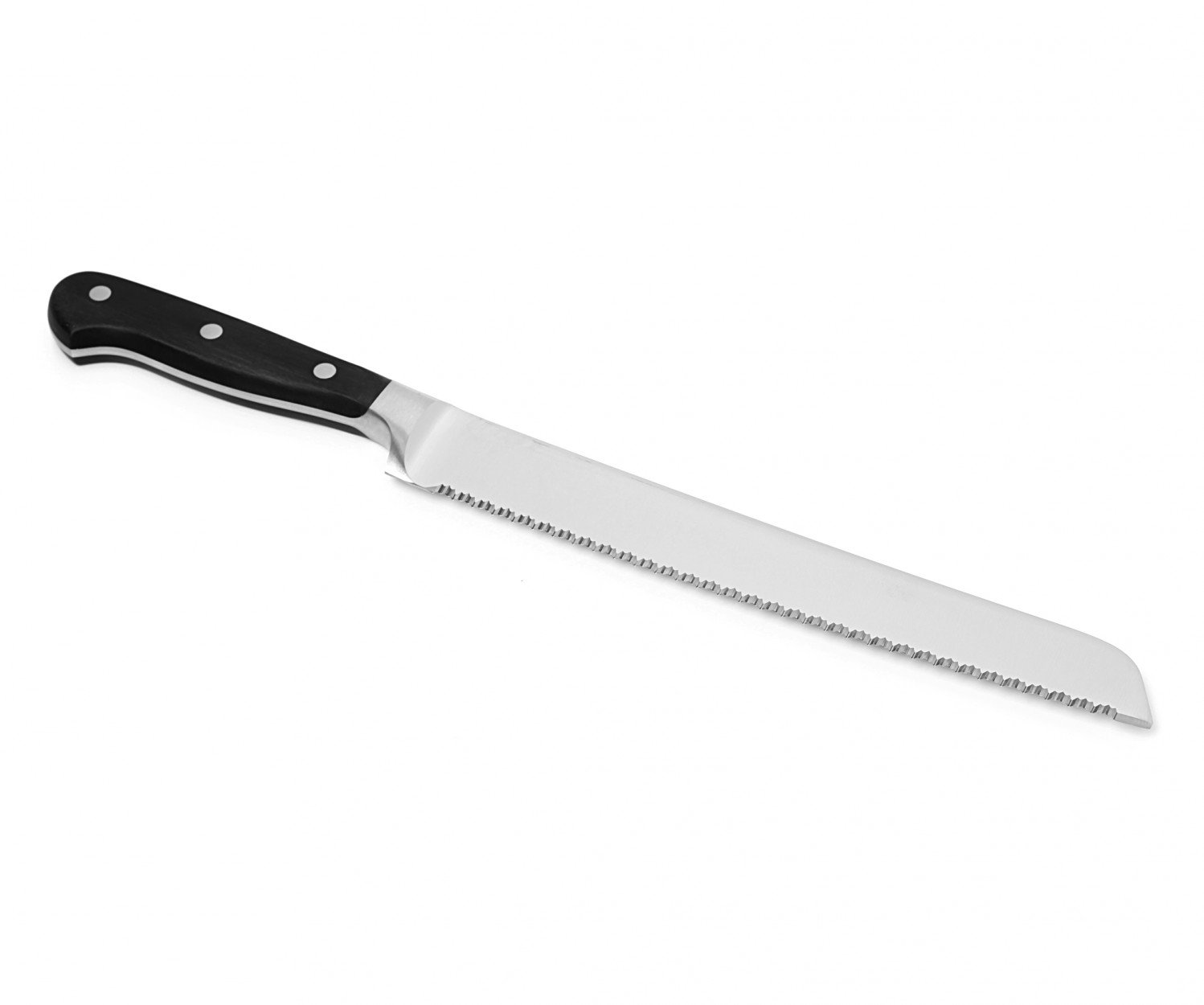
Wüsthof Classic 9″ Double Serrated Bread Knife — The Crust Specialist
Best for: Dense, dark-crusted loaves and day-old bread that resists standard serrations
The double-serrated edge is not marketing fluff — it genuinely changes how the blade meets a hard crust. Each primary tooth contains a secondary micro-serration that bites in stages, so the knife starts the cut before you apply full pressure. On a 48-hour fermented rye with a thick, glossy crust, this knife produced slices with almost no downward force. The forged German steel feels dense and planted in the hand, and the full bolster adds control that stamped knives cannot match. The limitation is length: 9 inches is enough for most boules but marginal on very wide country loaves. If your bread is consistently dense and crusty, this is the most reassuring cutter in the group.
- Double serrations bite hard crust in stages
- Forged full bolster adds planted control
- Zero crushing on dense rye
- German steel feels substantial and balanced
- 9-inch blade marginal on wide boules
- Heavier than stamped knives
- Hand-wash only to protect the edge
4.8/5
4.7/5
4.7/5

Shun Classic 9″ Bread Knife — Heirloom Slicing for the Detail-Obsessed
Best for: Buyers who want a bread knife that feels as good as it cuts and will last decades
The Shun makes bread slicing feel like a deliberate act rather than a chore. The VG-MAX core steel holds a remarkably keen edge, and the wide, low-frequency serrations glide through a crusty loaf with a smoothness that stamped knives cannot replicate. The Damascus cladding and pakkawood handle turn it into an object you want to leave on the counter, not hide in a drawer. In testing, it produced the cleanest slices on a delicate brioche — no tearing, no compression. The trade-offs are real: the blade is slightly shorter than ideal for very wide boules, and the price puts it firmly in special-occasion territory. This is a knife for someone who has already decided bread matters.
- Cleanest brioche slices in the test
- VG-MAX steel holds a keen edge
- Damascus cladding looks heirloom-quality
- Pakkawood handle feels warm and secure
- 9-inch blade short for very wide boules
- Premium price demands careful handling
- Hand-wash only; not for busy kitchens
4.6/5
4.9/5
4.7/5

Tojiro F-687 10.6″ Bread Slicer — Long, Light, and Laser-Sharp
Best for: Bakers who slice large artisan loaves and want a long, lightweight blade
The Tojiro’s 10.6-inch blade is the longest in this group, and that length pays off on wide country loaves and oversized boules. The scalloped edge is extremely sharp out of the box and slices soft sandwich bread as cleanly as crusty sourdough. The knife is also noticeably lighter than forged German blades, which reduces fatigue during long baking sessions. The trade-off is flex: the thin blade bends slightly under pressure on very dense loaves, and the lack of a full bolster means less lateral stability. It rewards a light, drawing motion rather than a forceful saw. If you already have good knife technique, this is a precise and pleasurable slicer.
- Longest blade in the test group
- Extremely sharp scalloped edge out of box
- Lightweight; reduces wrist fatigue
- Clean cuts on soft sandwich bread
- Thin blade flexes on dense loaves
- No full bolster for lateral stability
- Requires light technique, not force
4.5/5
4.7/5
4.3/5

Cutluxe Artisan Series 8-Piece Knife Set — The Complete Block That Handles Bread
Best for: Buyers who want one block that covers bread and everyday kitchen tasks without buying separately
If you are starting from zero and want a bread knife that comes with a competent supporting cast, this Cutluxe block is the most coherent option. The 10-inch bread knife is a genuine full-tang German-steel blade, not a stamped afterthought, and it sliced through crusty baguettes without the wobble you feel in cheap set knives. The acacia block looks better than most sub-premium sets, and the chef’s knife and paring knife are sharp enough for real prep. The trade-off is that no single knife in this set matches a dedicated bread knife at the same price — the bread blade is good, not exceptional. But if you need one purchase that equips a kitchen, this is the smarter buy.
- Full-tang German steel bread knife
- Complete block covers everyday prep
- Acacia block looks better than price suggests
- Comfortable pakkawood handles
- Bread knife good, not exceptional
- Block takes significant counter space
- No offset handle on bread blade
4.3/5
4.3/5
4.6/5

Zwilling 8-Inch Bread Knife — Balanced, Sharp, and Understated
Best for: Buyers who prioritize German steel and a comfortable, balanced feel over maximum blade length
Zwilling’s 8-inch bread knife is the most comfortable knife in this group to hold for extended periods. The German steel is well-balanced, the handle has a natural curve that locks into your palm, and the serrations are sharp enough to bite through a crusty baguette without pressing hard. It produced clean slices on a soft milk bread and a darker whole wheat loaf alike. The obvious limitation is the 8-inch blade: on a wide sourdough boule, you will need two passes. If you primarily slice sandwich loaves, bagels, and smaller artisan breads, that length is actually an advantage — it is nimble and easy to control. For larger loaves, look elsewhere.
- Balanced German steel feels planted
- Comfortable handle for long sessions
- Clean slices on soft and medium crusts
- Understated look suits any kitchen
- 8-inch blade requires two passes on wide boules
- Premium price for a shorter blade
- Hand-wash recommended
4.3/5
4.5/5
4.7/5

Cangshan Helena 8-Inch Bread Knife — Sourdough-Friendly Serrations
Best for: Home sourdough bakers who want a shorter blade tuned specifically for medium boules
The Cangshan Helena is tuned for the home sourdough baker who bakes 7-to-8-inch boules rather than giant country loaves. The serration pattern is slightly finer than a traditional bread knife, which lets it start the cut on a hard crust without tearing the open crumb beneath. In testing, it produced notably clean slices on a 70% hydration sourdough — no smearing, no compressed interior. The 8-inch blade is the obvious limitation: it is not built for wide loaves, and the handle, while comfortable, is less textured than the Victorinox. But if sourdough is your primary bread and you bake at home, this knife feels purpose-built for that exact task.
- Finer serrations suit open sourdough crumb
- Clean slices at 70% hydration
- Comfortable handle for home baking
- Purpose-built feel for medium boules
- 8-inch blade limits wide loaves
- Handle less textured than top pick
- Not ideal as an all-purpose bread knife
4.3/5
4.6/5
4.4/5

HexClad 8-inch Damascus Steel Serrated Bread Knife — Sharp and Showpiece-Worthy
Best for: Buyers who want a bread knife that looks as sharp as it cuts and can handle smaller loaves
The HexClad’s Damascus steel blade is the most visually striking knife here, but it is not just decoration. The serrations are sharp and consistent, and the knife cut through a crusty baguette and a soft brioche with equal composure during testing. The blade has a slight flex that helps it follow the curve of a round loaf, and the handle is comfortable for a drawing motion. The limitation is the same as the Zwilling: 8 inches is short for large boules, and the Damascus cladding adds cost without improving cutting performance on bread. If you want a bread knife that earns countertop display space and you bake medium-sized loaves, this is a satisfying choice.
- Sharp, consistent serrations out of box
- Damascus blade looks display-worthy
- Composed cuts on baguette and brioche
- Slight flex follows round loaf curves
- 8-inch blade short for large boules
- Damascus adds cost, not bread performance
- Hand-wash only to preserve finish
4.3/5
4.4/5
4.3/5

Mercer Culinary 8″ Züm Bread Knife — Knuckle Clearance Changes Everything
Best for: Slicers who drag their knuckles on the cutting board and want a full, unobstructed stroke
The offset handle is the entire point of this knife, and it delivers. Raising your grip above the blade spine gives you enough clearance to complete a full drawing stroke without your knuckles scraping the board — a small ergonomic change that makes slicing large loaves feel dramatically more controlled. The blade is sharp and the forged construction feels solid in the hand. The trade-off is blade length: 8 inches is short for wide boules, and the offset design adds bulk that makes storage slightly awkward. But if knuckle clearance is your primary frustration, this knife solves it more directly than any standard-handle bread knife in this group.
- Offset handle eliminates knuckle drag
- Forged blade feels solid and controlled
- Full drawing stroke improves slice consistency
- Comfortable for larger hands
- 8-inch blade limits large boules
- Offset shape is awkward to store
- Bulkier than standard bread knives
4.1/5
4.2/5
4.5/5
Top 3 Head-to-Head: Victorinox vs Mercer vs Wüsthof
These three are the knives most readers narrow down to — the overall performer, the budget standout, and the crust specialist. Here is how they separate.
| Feature | #1 Victorinox Fibrox | #2 Mercer M23210 | #3 Wüsthof Double Serrated |
|---|---|---|---|
| Blade length | 10.25 in — Best | 10 in | 9 in |
| Crumb preservation | Cleanest slices — Best | Clean, occasional drag | Excellent on dense loaves |
| Handle grip | Textured, secure when wet | Basic polypropylene | Contoured, planted feel |
| Choose if… | You want one knife that does everything well | You slice daily and want the best value | Your bread is consistently dense and crusty |
Who These Bread Knives Are NOT For
These knives are built for bread first. If your priorities sit elsewhere, you will get better results from a different tool.
If you exclusively slice pre-sliced sandwich bread, you do not need a dedicated bread knife; a serrated utility knife in the 6-inch range will handle that task with less storage footprint. And if you bake very large 12-inch country loaves regularly, consider a 12-inch blade instead of the 10-inch options here.
Common Mistakes to Avoid
Most bread knife dissatisfaction comes from four avoidable errors, not from bad knives.
Frequently Asked Questions About Bread Knives
What is the best blade length for a bread knife?
For most home bakers, a 10-inch blade is the practical minimum. A 9-inch boule needs a blade longer than its widest point plus two inches for a clean single draw. If you regularly bake wide country loaves or oversized sourdough, step up to 11 or 12 inches. Shorter 8-inch blades are fine for sandwich bread, bagels, and small artisan loaves but require two passes on larger breads.
Can a bread knife be sharpened at home?
Not with a standard whetstone or honing rod. Serrated edges require a tapered ceramic rod that matches the angle of each tooth, or professional sharpening service. Trying to sharpen a serrated blade on a flat stone will grind down the teeth and ruin the cutting profile. Many bread knives stay functional for years without sharpening because the serrations protect the edge during use.
Serrated vs scalloped bread knife: what is the difference?
Scalloped edges have rounded, wave-like teeth that grip hard crusts and glide through soft interiors without tearing. Serrated edges, in the strict sense, have pointed saw-like teeth that are more aggressive and better suited to firm produce or dense meats. For bread, scalloped is almost always superior because pointed teeth tend to shred delicate crumb structures rather than slice them cleanly.
Do I need a bread knife if I already have a chef’s knife?
Yes, if you eat crusty bread. A chef’s knife cuts by pressure, which crushes the soft interior before the hard crust splits. A bread knife’s serrations concentrate force at multiple points along the cut, piercing the crust without compressing the crumb. The two tools solve different problems and a chef’s knife cannot substitute for a bread knife on artisan loaves.
Is an offset bread knife better than a straight handle?
An offset handle raises your grip above the blade spine, which gives your knuckles clearance to complete a full slicing stroke without scraping the cutting board. If you slice large boules regularly, an offset design improves control and reduces wrist strain. Straight handles are more compact for storage and work fine for smaller loaves, but they force a more constrained motion on wide breads.
How long does a bread knife stay sharp?
A quality bread knife with steel rated 55 HRC or higher can stay functional for years of home use. The serrations protect the cutting edge inside the valleys during normal slicing, so the teeth dull more slowly than a straight edge. Hand-washing and storing the knife away from other utensils extend its life significantly. Dishwasher exposure and cutting on hard surfaces accelerate dulling.
What bread knife do professional bakers use?
Many professional bakers reach for long, lightweight scalloped slicers in the 10-to-11-inch range, often Japanese or German steel, because they need to slice dozens of loaves per shift without wrist fatigue. The Victorinox Fibrox and Tojiro scalloped slicers are common in bakery production for their combination of length, sharpness, and low replacement cost. Home bakers can get similar results from the same models.
Our Final Verdict
The bread knife market rewards specialization: longer blades for wide loaves, scalloped edges for clean crumb, and offset handles for knuckle clearance. The Victorinox Fibrox 10.25″ is the best single answer because it balances length, grip, and crumb preservation better than any other knife in the test. If your budget is tight, the Mercer M23210 delivers most of that performance for less. If your bread is dense and dark-crusted, the Wüsthof double-serrated is the specialist worth considering. Everyone else can start with the Victorinox and stop researching.