10-Inch Chef Knife Size: Dimensions & Uses
Quick Answer
A 10-inch chef knife has a blade nominally 10 inches long, equivalent to 25.4 cm, measured separately from the handle. It offers extra reach for large vegetables, big batches, and long slicing cuts, but it needs more cutting-board space and may be harder to control than an 8-inch knife. For most everyday home cooking, 8 inches is the more versatile starting point; choose 10 inches when its extra length serves a clear purpose.
What Does a 10-Inch Chef Knife Actually Measure?
 Save
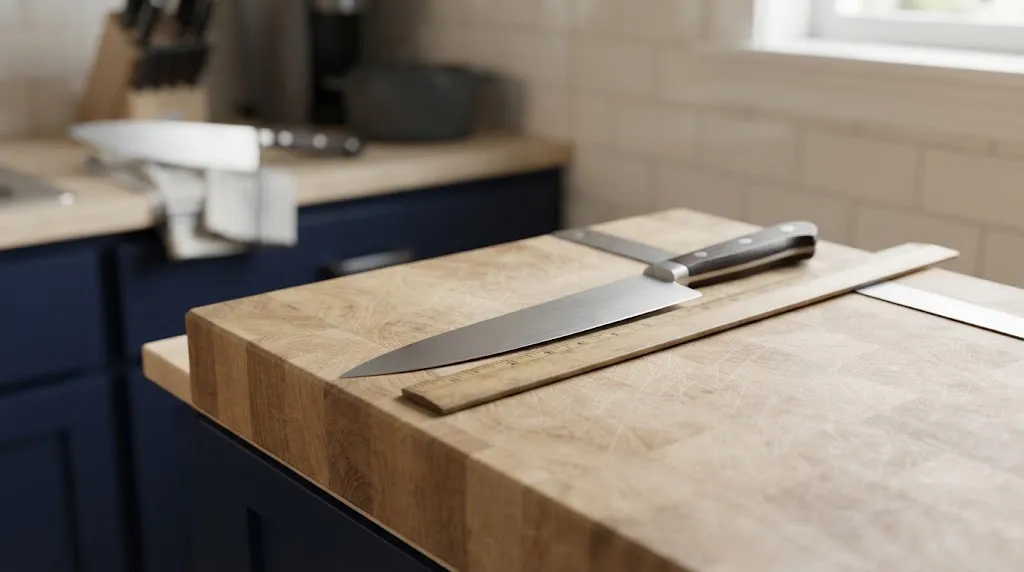
SaveA 10-inch chef knife is a general-purpose kitchen knife sold with a nominal blade length of 10 inches, or 25.4 centimeters. The measurement refers to the blade, not the complete knife from the tip to the end of its handle.
The overall length is greater because the handle adds several inches. Exact dimensions vary by manufacturer, blade shape, and handle design, so check the individual knife’s specifications if you need to know whether it will fit a drawer, knife block, or storage sheath.
Blade length versus overall length
When comparing knives, distinguish three measurements:
- Blade length: The nominal length used to identify the knife’s size.
- Overall length: The distance from the blade tip to the end of the handle.
- Blade height: The distance from the cutting edge to the spine at a particular point. This affects knuckle clearance and how much food the blade can accommodate.
Manufacturers may use slightly different measurement conventions. A listed 10-inch blade should therefore be treated as a size category rather than a guarantee that every model measures exactly 10 inches using the same method.
For a concrete example, the official specifications for the WÜSTHOF Classic 10-inch chef’s knife list a 10-inch blade and a 4.5-inch handle. Those are model-specific dimensions, not universal measurements for every knife in this size class.
How Big Is a 10-Inch Chef Knife Compared With Other Sizes?
A 10-inch chef knife is longer than the 8-inch size commonly chosen for general home cooking. The difference is two inches, or 5.08 centimeters, of nominal blade length. That additional reach becomes noticeable when cutting wide ingredients or making long slicing strokes.
The following comparison provides a practical starting point for choosing a blade length.
| Nominal blade size | Metric equivalent | Typical use case |
|---|---|---|
| 6 inches | 15.2 cm | Compact work, smaller ingredients, and tight workspaces |
| 8 inches | 20.3 cm | Versatile everyday chopping, slicing, and dicing |
| 10 inches | 25.4 cm | Large ingredients, longer cuts, and higher-volume preparation |
These are nominal size categories, not exact measurements for every knife. The most useful distinction is how much blade you can comfortably control while working with the ingredients and board you use most often.
What Is a 10-Inch Chef Knife Best Used For?
A 10-inch chef knife is most useful when the extra blade length helps you complete a cut with fewer repositioning movements. It remains a general-purpose knife, but its size is especially noticeable during large-scale food preparation.
Cutting large vegetables and fruit
Large cabbages, watermelons, squash, and other bulky produce can be awkward to cut with a shorter blade. A longer cutting edge can reach farther across an ingredient, making it easier to complete a controlled slicing motion without repeatedly changing the knife’s position.
However, blade length does not make every hard ingredient safe to cut. Dense squash should be stabilized on a flat surface, and the knife should never be forced through food that is too hard or unstable to cut securely.
Preparing food in larger batches
When preparing ingredients for several meals, a 10-inch blade can be useful for cutting large quantities of vegetables, slicing wide ingredients, or working through repeated long strokes. The extra reach may reduce interruptions caused by repositioning the knife.
For small quantities of garlic, herbs, shallots, or other compact ingredients, the advantage is less obvious. A longer blade does not automatically make fine cutting faster, particularly if its size makes precise movements uncomfortable.
Slicing large cuts of boneless meat
A 10-inch chef knife can help with long, continuous cuts through suitable boneless meat. Its extra length gives the cook more cutting edge to work with, which can be useful when preparing large portions.
It is not a substitute for a specialized carving or slicing knife in every situation. Nor should it be used to chop through bones, frozen food, or other materials that can damage its cutting edge.
Is a 10-Inch Chef Knife Too Big for Everyday Cooking?
Not necessarily. A 10-inch chef knife can handle ordinary kitchen tasks, but whether it feels practical depends on the knife’s weight, balance, handle, cutting technique, and the available work surface. Some cooks appreciate the extra reach, while others find an 8-inch blade easier to maneuver.
Consider the following situations before choosing the longer size:
- You prepare large quantities regularly: The extra reach may be useful when cutting wide produce or preparing several meals at once.
- You have a spacious cutting board: More room allows you to guide the blade without running out of working space.
- You prefer longer cutting strokes: The blade can accommodate a longer draw or slicing movement when the ingredient and technique permit it.
- You mostly prepare small ingredients: An 8-inch or shorter knife may feel more manageable for detailed work.
- You are learning basic knife skills: A comfortable, controllable knife is generally a better starting point than choosing a longer blade simply because it appears more capable.
Hand size can influence comfort, but it should not be the only deciding factor. A person with smaller hands may handle a well-balanced 10-inch knife comfortably, while someone with larger hands may prefer a shorter blade because of its weight or shape.
10-Inch vs. 8-Inch Chef Knife: Which Should You Choose?
The 8-inch knife is a practical starting point for most home kitchens because it balances cutting reach with maneuverability. A 10-inch knife makes more sense when its extra length solves a recurring problem rather than merely adding size.
Choose an 8-inch knife when versatility matters most
An 8-inch chef knife can handle most routine chopping, slicing, dicing, and mincing without demanding as much room as a longer blade. It is often easier to manage on a modest cutting board and is a reasonable first choice for cooks who want one main kitchen knife.
If you regularly prepare onions, carrots, peppers, herbs, and boneless meat in ordinary household quantities, the shorter blade is unlikely to feel limiting for most tasks.
Choose a 10-inch knife when you need more reach
A 10-inch model is worth considering if you frequently work with large ingredients, prepare substantial batches, or prefer long slicing strokes. The benefit is most apparent when the entire cutting edge can be used comfortably and safely.
There is no need to upgrade solely because a longer blade is available. If your current 8-inch knife already handles your routine comfortably, an additional two inches may not improve your results enough to justify changing sizes.
Key Insight
A longer blade increases reach, not automatic cutting ability. A sharp, comfortable 8-inch knife can be more useful than an awkward 10-inch knife when the ingredients are small or the working area is limited.
How Much Cutting-Board Space Does a 10-Inch Knife Need?
A 10-inch blade benefits from a broad, stable cutting board with enough room for both the ingredient and the knife’s full movement. There is no single minimum board size that works for every knife and cutting technique, but a cramped board can make a long blade harder to position.
Check the working area, not just the board’s advertised dimensions. You need room to stabilize the food, move the knife through the cut, and keep the blade away from the counter edge. The board should sit securely without rocking or sliding.
Before buying, consider these practical points:
- Board width: Make sure the ingredient and blade can sit comfortably without overhanging the working edge.
- Counter clearance: Leave space for the handle and your hand to move naturally.
- Storage: Measure the drawer, knife block, or sheath against the knife’s overall length, not its blade size alone.
- Weight and balance: If possible, hold the knife before buying. Two knives with the same nominal length can feel substantially different.
For a compact kitchen, an 8-inch knife may offer a better balance between useful reach and the space available. A larger counter and board make it easier to take advantage of a 10-inch blade.
How Can You Handle a 10-Inch Chef Knife Safely?
 Save
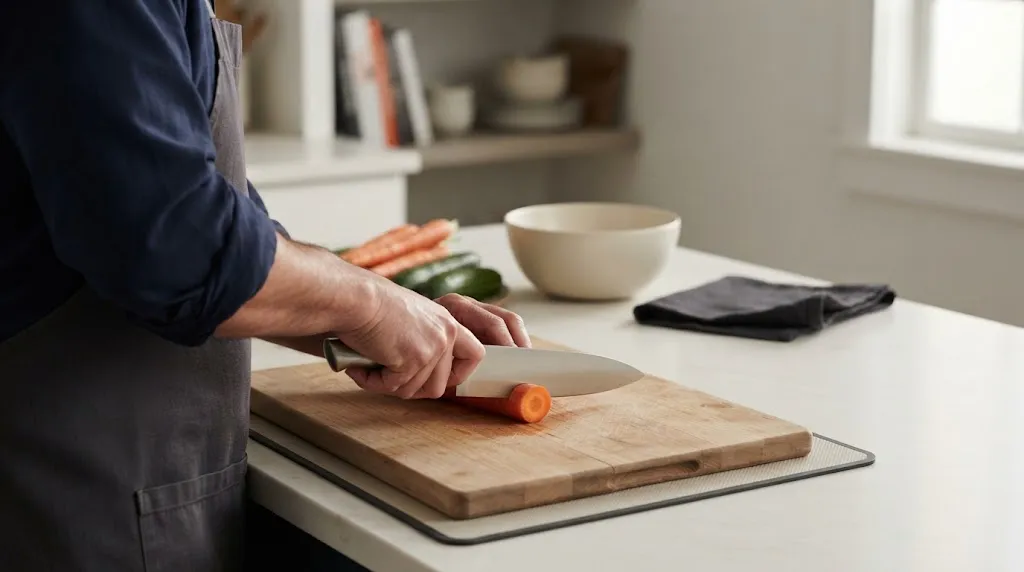
SaveA longer blade requires deliberate control, especially near its tip. Use a stable board, keep the food from rolling, and avoid rushing while learning how the knife moves across the ingredient.
- Secure the cutting board. Place it on a stable surface and use a damp, nonslip layer underneath if necessary.
- Stabilize the ingredient. Create a flat side when appropriate so the food does not roll during cutting.
- Keep your guiding hand clear. Curl your fingertips inward into a claw grip, keeping the knife against the knuckles that guide the cut.
- Use controlled strokes. Move the blade through the food without excessive force or abrupt changes of direction.
- Maintain a clear workspace. Keep other people, utensils, and clutter away from the blade’s path.
Do not attempt to compensate for an uncomfortable knife by gripping it more tightly or pushing harder. If you cannot guide the tip and edge confidently, stop and consider whether a shorter blade better suits the task.
For more help with grip, cutting motion, and other fundamentals, see the existing guide to essential knife skills for beginners.
What Should You Check Before Buying a 10-Inch Chef Knife?
Blade length is only one part of a knife’s usability. A model that looks suitable on paper may feel unwieldy if its weight, handle shape, or balance does not suit your grip.
- Weight: A heavier knife may feel substantial during large cuts but tiring during extended preparation.
- Balance: Pay attention to how the blade and handle feel together rather than assuming that longer means better balanced.
- Handle comfort: The handle should allow a secure grip without forcing your fingers into an awkward position.
- Blade profile: A more curved edge suits rocking cuts, while a flatter profile may suit cooks who favor pushing the blade forward.
- Maintenance: Check the manufacturer’s guidance for cleaning, sharpening, and storage. Follow any care instructions specific to the knife’s steel and construction.
- Actual dimensions: Confirm blade and overall length before choosing storage or deciding whether the knife fits your workspace.
Do not assume that every 10-inch chef knife is heavier or harder to use than every 8-inch model. Design and construction matter, and a longer blade’s actual handling characteristics depend on the specific knife.
Frequently Asked Questions
Is a 10-inch chef knife really 10 inches long?
It is sold as a 10-inch blade, equivalent to 25.4 cm. The handle is not included in that nominal blade measurement, and the manufacturer’s measuring convention can affect the exact result.
Is a 10-inch chef knife better than an 8-inch knife?
Neither size is universally better. An 8-inch knife is a versatile everyday choice, while a 10-inch model offers more reach for large ingredients and high-volume preparation.
Can beginners use a 10-inch chef knife?
Yes, if they can control it comfortably and practice safe cutting technique. Many beginners will find an 8-inch knife easier to manage while learning basic skills, but comfort and control matter more than a fixed rule about experience.
Is a 10-inch chef knife suitable for small kitchens?
It can be, provided the cutting board, counter, and storage space accommodate the knife. If the blade feels cramped or difficult to maneuver, a shorter knife may be more practical.
Can you use a 10-inch chef knife to slice meat?
Yes. It can slice suitable boneless meat and handle long cutting strokes. A dedicated carving or slicing knife may be preferable for certain serving tasks, and a chef knife should not be used to chop through bones.
How should you store a 10-inch chef knife?
Choose a secure knife block, suitable sheath, or drawer insert that accommodates the knife’s complete length. Store it so the cutting edge is protected and the blade cannot move freely against other utensils.
Conclusion
A 10-inch chef knife has a nominal blade length of 25.4 cm and provides extra reach for large ingredients, long slices, and high-volume food preparation. Its size is useful when your cutting technique, board, and workspace allow you to control the full blade comfortably.
For most everyday home cooking, an 8-inch knife remains a sensible starting point because it balances reach and maneuverability. Choose 10 inches when you regularly need the additional length, not simply because a larger knife seems more capable. Before deciding, consider the actual blade dimensions, overall length, weight, handle comfort, and available storage. The right knife is the one that fits your cooking tasks and that you can guide safely and confidently.

