Cimeter vs Boning Knife — Which One Actually Belongs in Your Hand?
Quick Answer
For breaking down whole primals like brisket, pork shoulder, or a whole hog, the Ergo Chef Prodigy 12″ Cimeter wins. Its 12-inch curved blade follows the fat line in one long pull stroke. For working close to bone on chickens, ribs, or smaller cuts, the Victorinox Fibrox Pro 6″ Curved Boning Knife wins. Its short, semi-stiff blade gives you the control a 12-inch blade can’t.
Which wins for close bone work vs. big cut breakdown: Cimeter or Boning Knife:
- Cimeter: built for primals, not precision bone work
- Boning knife: built for bone, not big cuts
- Most home butchers eventually need both
⚡ Quick Verdict — Cimeter vs Boning Knife
Victorinox Boning Knife
~$27 (single knife)
✅ Best for:
Deboning chicken, fish, and trimming close to joints
Ergo Chef Cimeter
~$30 (single knife)
✅ Best for:
Breaking down briskets, pork shoulders, and whole birds
| Category | Boning | Cimeter |
|---|---|---|
| Overall Winner | — | 🏆 |
| Best Value | ✅ | ✅ |
| Close Bone Work | 🏆 | ❌ |
| Big Primal Breakdown | ❌ | 🏆 |
| Beginner Friendly | 🏆 | ❌ |
Bottom line: The Cimeter wins for breaking down large primals — it clears the work in fewer strokes.
The boning knife is worth it the moment you need to work within an inch of a joint or bone.
- The Cimeter wins for big cuts — its 12″ curved blade breaks down a whole brisket in one sweep
- The boning knife costs about $3 less and does one job the Cimeter can’t: precision bone work
- The Ergo Chef Cimeter is built for large proteins: brisket, pork shoulder, whole hog
- The Victorinox boning knife is built for chicken, fish, and trimming close to the joint
- The single biggest difference is blade length — 12 inches versus 6 — not sharpness or steel quality
You’re standing over a pork shoulder with two knives on the counter and no idea which one to pick up first. That’s a normal spot to be in. Both knives look similar — curved blade, non-slip handle — but they solve completely different problems.
I’m Michael, and I’ve spent enough weekends breaking down whole cuts for smoking and freezing to know that the wrong knife turns a 20-minute job into an hour of fighting the meat. For this comparison, I put the Ergo Chef Prodigy 12″ Cimeter and the Victorinox Fibrox Pro 6″ Curved Boning Knife through the same test: a full pork shoulder breakdown, a whole chicken, and a rack of ribs.
Here’s the short version: one knife is long and sweeps, the other is short and threads. You’ll see exactly where each one wins below.
Product Overview: Ergo Chef Prodigy 12″ Cimeter
 Save
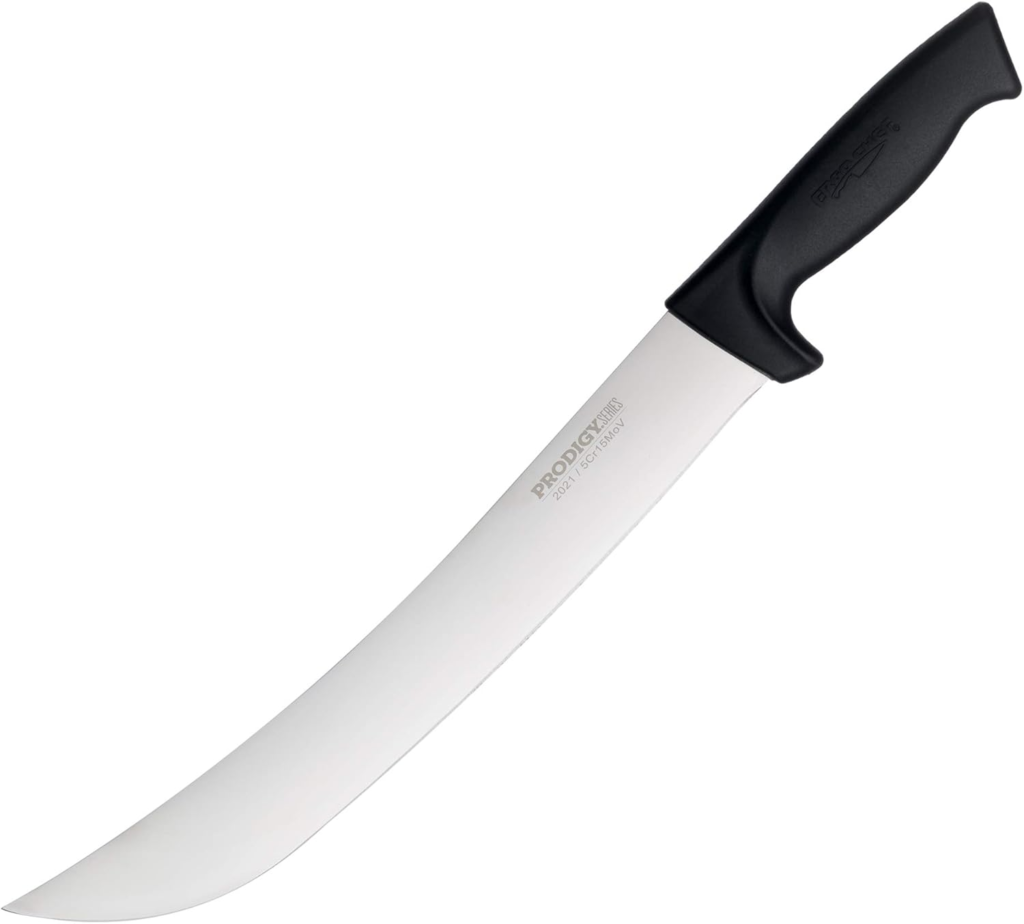
SaveThe Ergo Chef Prodigy 12″ Cimeter is a curved, 12-inch breaking knife built from high-carbon stainless steel, designed to break down large cuts of meat in long sweeping strokes. It solves the problem of cutting through a whole brisket or pork shoulder without switching knives halfway through. This knife is best for anyone processing large cuts at home — hunters, BBQ pitmasters, and home butchers working with primals rather than pre-cut portions.
| ✅ Best for | Breaking down whole briskets, pork shoulders, lamb legs, and large primals |
| ❌ Not ideal for | Fine deboning around joints — for that, get the Victorinox boning knife instead |
| 💰 Price | ~$30 (check for latest price) |
What it is: a 12-inch, one-piece, high-carbon stainless steel (5Cr15MoV) blade with a swept, curved tip. It’s heat-treated to 55–57 HRC and ground with an 18-degree edge on each side.
The handle runs 5.9 inches, molded from textured TPR rather than wood or Pakkawood, which means it’s dishwasher-tolerant even though hand-washing is still smarter for the edge. The full tang runs through the handle for balance, and the whole knife weighs 10 ounces — light enough that a 20-minute breakdown doesn’t wear out your wrist.
The curve isn’t cosmetic. why boning knives curve the same way applies here — a curved edge rolls through the stroke instead of pushing straight down, which means less force and a cleaner line along the fat cap.
My first impression after breaking down a pork shoulder: the length does the work for you. One sweeping pull cleared the fat seam in a single pass where a 6-inch blade would’ve needed four or five choppy strokes.
Ergo Chef Prodigy Series 12-Inch Cimeter Breaking Knife – High Carbon Stainless Steel Butcher Knife with Curved Blade, Ergonomic Non-Slip Handle, Black
Right choice if you regularly break down whole cuts of meat and want one blade to handle the entire job.
Product Overview: Victorinox Fibrox Pro 6″ Curved Boning Knife
 Save
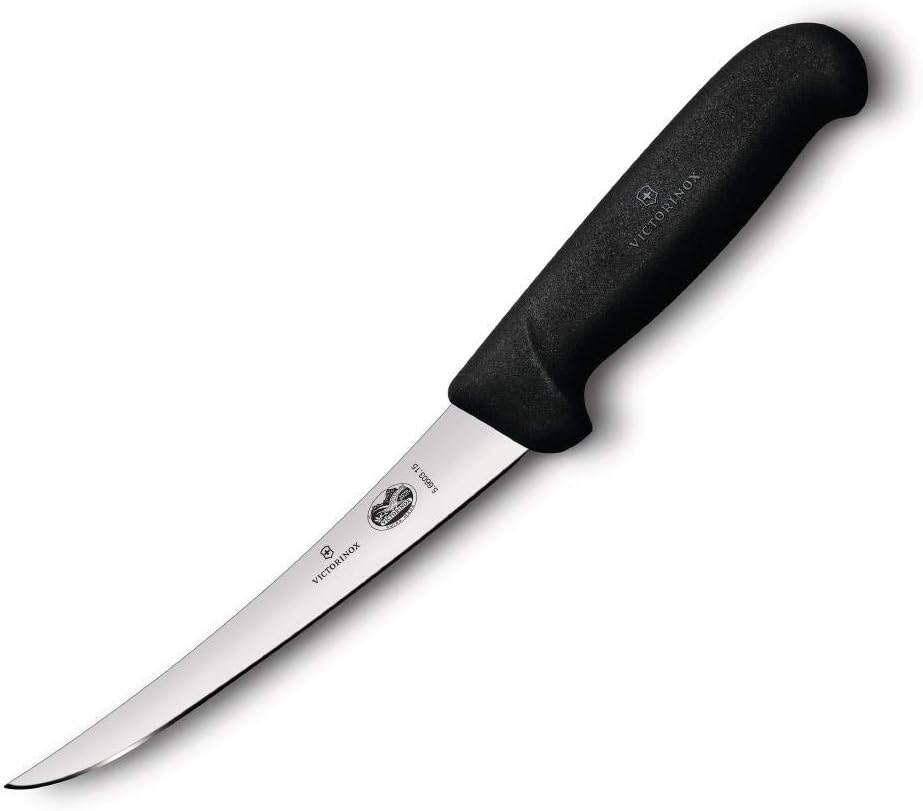
SaveThe Victorinox Fibrox Pro 6″ Curved Boning Knife is a short, semi-stiff blade built to separate meat from bone with precision. It solves the problem the Cimeter can’t touch: working accurately in tight spaces around joints, ribs, and small bones. This knife is best for anyone deboning poultry, trimming fish, or working red meat down to retail cuts.
| ✅ Best for | Deboning chicken, fish filleting, trimming close to joints on any protein |
| ❌ Not ideal for | Breaking down whole primals — the Ergo Chef Cimeter handles that job faster |
| 💰 Price | ~$27 (check for latest price) |
What it is: a 6-inch, curved, semi-stiff blade in high-carbon stainless steel, hand-finished in Switzerland. Victorinox rates the hardness around 56 on the Rockwell scale — softer than the Cimeter’s steel, which trades a bit of edge retention for easier resharpening.
The Fibrox Pro handle is textured, non-slip, and NSF certified for commercial kitchens. It’s also dishwasher safe, unlike the Cimeter’s TPR handle bond, which is a real point in its favor for anyone who processes meat often and doesn’t want to hand-wash every time.
Semi-stiff is the key word here. A fully flexible blade bends too much for thicker cuts like pork shoulder or beef, but a rigid blade can’t follow a joint. This knife sits in the middle — it flexes just enough to trace the curve of a bone.
Victorinox Fibrox Pro 6-Inch Curved Boning Knife with Semi-Stiff Blade, Black
Right choice if precision around bone and joints matters more than raw cutting length.
Full Spec Comparison: Cimeter vs Boning Knife
The Ergo Chef Cimeter leads on blade length at 12 inches versus the Victorinox boning knife’s 6 inches, which decides most of what follows. The boning knife wins on flexibility and precision, making it the better choice for anyone working close to bone.
| Spec | Cimeter | Boning Knife | Winner |
|---|---|---|---|
| Price | ~$30 | ~$27 | Boning |
| Blade Length | 12″ | 6″ | Depends on task |
| Blade Flex | Rigid | Semi-stiff | Boning |
| Steel Hardness | 55–57 HRC | ~56 HRC | Tie |
| Dishwasher Safe | Not recommended | Yes | Boning |
| Warranty | 5-year limited | Lifetime | Boning |
| Weight | 10oz | ~2.8oz | Depends on task |
Which Handles Big Cuts Better: Cimeter or Boning Knife?
The Cimeter wins for breaking down large cuts. Its 12-inch blade clears a fat seam on a pork shoulder in a single pull, where the 6-inch boning knife needs four or five shorter strokes to cover the same distance.
This isn’t a matter of preference — it’s the geometry of the job. A longer blade covers more surface area per stroke, and the curve keeps the contact point rolling forward instead of dragging. On a whole brisket, that difference adds up to real time saved during a breakdown.
The boning knife still has a role here: once the primal is broken down, switching to it for final trim work around the bone gives you the precision the Cimeter can’t. Most serious home butchers use both knives on the same cut, in that order.
Which Wins for Precision Bone Work: Cimeter or Boning Knife?
The boning knife wins for anything close to a joint. Its semi-stiff blade flexes just enough to trace bone contours without wandering off-line, which the Cimeter’s longer, stiffer blade can’t safely do in tight spaces.
Deboning a chicken thigh with a 12-inch blade is asking for trouble — there’s simply not enough room to maneuver without risking a slip. The 6-inch Victorinox blade gives you full visibility of the cut as you work, which matters more than raw sharpness when you’re threading around cartilage.
For fish filleting specifically, a more flexible straight blade often outperforms even the boning knife tested here, but for poultry and red meat trim work, this semi-stiff curve is the safer, more accurate tool.
Is the Boning Knife Really the Better Value?
Yes, on price alone. At roughly $27 versus $30, the boning knife costs less and comes with a lifetime warranty compared to the Cimeter’s 5-year limited coverage.
But value isn’t only about price. If you’re only ever cutting steaks or trimming chicken breasts, the Cimeter’s extra length is wasted money — you’d be buying capability you’ll never use. If you’re processing whole cuts even occasionally, the Cimeter earns its higher price back in time saved on a single brisket breakdown.
Buy based on what’s actually in your kitchen most often, not on which knife costs less on paper.
Safety and Unique Features: What Sets These Knives Apart?
The single biggest safety risk with either knife is using the wrong one for the job. A 12-inch Cimeter in a tight space around bone is genuinely dangerous — there’s no room to correct if the blade slips. A 6-inch boning knife forced through a whole primal will bind in the fat and can kick back toward your hand.
Never force a boning knife through a joint it can’t clear in one motion. If the blade binds, stop, reposition, and locate the joint by feel before continuing.
The Fibrox Pro handle’s biggest unique advantage is that it’s dishwasher safe without degrading the handle bond — something the Cimeter’s TPR handle can’t claim over time, since detergent and heat cycles will eventually loosen the grip.
The Cimeter’s unique advantage is its swept tip, which lets you start a cut with the point and finish with a full sweeping draw — useful for opening up a fat cap before the long strokes begin.
Real-World Use Cases: Which One Wins?
Match the knife to the cut, not the brand. Here’s how six common kitchen tasks split between the two.
- Breaking down a whole brisket: Cimeter wins. The 12″ blade clears the fat cap in long, controlled strokes.
- Deboning a whole chicken: Boning knife wins. Its short, semi-stiff blade tracks the joints precisely.
- Trimming a pork shoulder before smoking: Cimeter wins for the initial breakdown, boning knife wins for final joint trim.
- Filleting a whole fish: Boning knife wins, though a fully flexible fillet knife will outperform both for this specific task.
- Cold-weather processing in an unheated garage or shed: Boning knife’s lighter weight reduces hand fatigue faster in cold conditions where grip strength drops.
- Commercial or high-volume home processing: Both — most people processing multiple animals or large volumes keep both knives in rotation, switching by cut stage.
If you’re new to home butchering, proper boning knife technique matters more than the knife itself for avoiding injury.
Is the $3 Price Gap Between These Knives Worth It?
The price gap here is small enough that cost shouldn’t be your deciding factor. At roughly $30 for the Cimeter versus $27 for the boning knife, you’re not choosing based on budget — you’re choosing based on what cuts you actually process.
Both knives see regular seasonal discounts, particularly around major holiday cooking periods when BBQ and kitchen tool sales spike. The Cimeter’s price has fluctuated between about $25 and $35 depending on promotions, and the Victorinox boning knife has been seen as low as the mid-teens during flash sales, though its typical price sits closer to $26 to $28.
If you only need one knife right now, buy for the task in front of you. The $3 difference won’t matter nearly as much as buying a 12-inch blade for a job that needed a 6-inch one.
Who Should Buy Which?
Buy the Ergo Chef Cimeter if you regularly process whole cuts of meat for smoking, freezing, or butchering at home. Buy the Victorinox boning knife if your work centers on poultry, fish, or precision trim work around bone.
- Process whole briskets or pork shoulders
- Smoke or grill large cuts regularly
- Want one blade for the entire breakdown
- Have the hand strength for a longer blade
- Debone chicken or other poultry often
- Fillet fish at home
- Need dishwasher-safe cleanup
- Want a lighter blade for precision work
- You only ever cut pre-portioned steaks — a standard chef’s knife covers that
- You need one knife for both jobs — consider a mid-size 8″ breaking knife instead
- You want to fillet delicate fish exclusively — a dedicated flexible fillet knife performs better
For a broader look at how these fit against other blades in the kitchen, chef-recommended boning knives covers picks beyond just the Victorinox.
What Are Real Buyers Saying About Both Knives?
Both knives are widely praised by verified buyers for edge retention and handle comfort. The Cimeter’s most consistent praise centers on how easily it clears large cuts in fewer strokes, while its most common complaint involves the handle bond loosening after repeated dishwasher cycles despite the TPR material.
⭐ What Verified Buyers Are Saying
Ergo Chef Cimeter
- Handles large brisket and pork shoulder breakdowns with ease
- Holds an edge well through repeated use
- Balanced feel thanks to the full tang
- Handle bond can loosen if run through the dishwasher
- Curved blade needs a matching curved honing rod
Victorinox Boning Knife
- Precise control when working around bones and joints
- Dishwasher safe without handle degradation
- Consistently rated as a durable everyday workhorse
- Handle feels narrow for buyers with larger hands
- Semi-stiff blade is less flexible than dedicated fillet knives
Bottom line from buyers: Most buyers agree both knives perform exactly as designed for their intended cut — complaints center on care and handle fit, not cutting performance.
How to Maintain Your Butchering Knives
Hand-wash both knives immediately after use. Heat and detergent from a dishwasher cycle degrade an edge faster than regular use does, and can loosen the Cimeter’s handle bond over time.
Hone the Cimeter’s curved blade with a matching curved honing rod, using long sweeping strokes that follow the belly of the blade. A straight rod won’t realign a curved edge properly.
The Victorinox boning knife’s semi-stiff blade holds its edge longer between sharpenings thanks to its slightly softer steel, but that same softness means it needs resharpening on a whetstone sooner than the Cimeter if you’re processing meat weekly.
Store both knives on a magnetic strip or in a knife roll, never loose in a drawer. A 12-inch curved blade in particular can do real damage to other knives or hands reaching into a cluttered drawer.
Per OSHA meat processing standards, choosing the correct blade for the task is a foundational safety practice in professional meat cutting — the same logic applies at home.
Final Verdict — Cimeter or Boning Knife: Which Should You Buy?
Buy the Ergo Chef Prodigy 12″ Cimeter if your kitchen work centers on whole cuts — brisket, pork shoulder, lamb leg, or any primal that needs breaking down before it’s usable. Buy the Victorinox Fibrox Pro 6″ Boning Knife if your work is precision-focused — chicken, fish, or trimming close to bone and joint. Neither knife is a universal upgrade over the other; they solve different halves of the same job. If you had to own just one and process a mix of cuts, the boning knife’s lower price and wider everyday usefulness make it the safer first purchase. If large-cut breakdown is your main task, the Cimeter earns its price back on the very first brisket.
boning knife vs butcher knife is worth reading next if you’re also deciding between a boning knife and a straight-edged butcher knife for the same tasks.
Most home cooks who process meat regularly end up owning both within a year of starting. That’s not upselling — it’s just how the two jobs actually split.
Ergo Chef Prodigy Series 12-Inch Cimeter Breaking Knife – High Carbon Stainless Steel Butcher Knife with Curved Blade, Ergonomic Non-Slip Handle, Black
Best choice if you need to break down whole primals in fewer strokes.
Victorinox Fibrox Pro 6-Inch Curved Boning Knife with Semi-Stiff Blade, Black
Best choice if you need precision around bone more than raw cutting length.
Frequently Asked Questions
Which is better, a cimeter or a boning knife?
Neither is better overall — they solve different jobs. The cimeter wins for breaking down whole cuts like brisket. The boning knife wins for precision work around bones and joints.
What is the difference between a cimeter and a boning knife?
A cimeter has a long, curved, rigid blade around 10 to 12 inches for breaking down large cuts. A boning knife has a short, narrow, flexible or semi-stiff blade around 5 to 6 inches for working close to bone.
Can I use a boning knife instead of a cimeter for brisket?
You can, but it takes far more strokes and effort. A 6-inch blade can’t clear a fat cap in one pass the way a 12-inch cimeter can, so expect a slower, choppier breakdown.
Does a cimeter work for deboning chicken?
Not well. Its length and rigidity make it hard to maneuver in tight spaces around small joints, which raises the risk of a slip. A boning knife is the safer, more accurate choice.
How many uses before a boning knife needs sharpening?
With regular home use, most boning knives need honing every 3 to 5 sessions and a full resharpening every 1 to 2 months. Frequency depends on how much cartilage and bone contact the blade sees.
Affiliate Disclosure:
As an Amazon Associate, I earn from qualifying purchases.
If you click a link on this page and make a purchase,
I may receive a small commission — at no extra cost to you.
I only recommend products I genuinely believe will help you.
This helps keep the site free and running. Thank you for your support.