Top 5 Boning Knives Recommended by Chefs (2026)
⚡ Quick Answer
The top 5 boning knives recommended by chefs are: Victorinox Fibrox Pro, Wüsthof Classic, Shun Premier Gokujo, Mercer Culinary Millennia, and Zwilling Pro. Each excels in a different area — flexibility, edge retention, or value — so the best pick depends on what you debone most.
Top 5 Boning Knives at a Glance:
- Best overall: Victorinox Fibrox Pro 6″ — trusted by pros, excellent value
- Best German steel: Wüsthof Classic 5″ — precision control, 200+ year heritage
- Best Japanese: Shun Premier Gokujo 6″ — razor-sharp, beautiful VG-MAX steel
- Best budget: Mercer Culinary Millennia 6″ — under $15, chef-approved
- Best flexible: Zwilling Pro 5.5″ — top pick for fish and delicate cuts
Choose Right — Quick Rules:
-
✓
Flexible blade for fish, poultry, and delicate work -
✓
Stiff blade for beef, pork, and thick connective tissue -
✓
Non-slip handle matters most — wet hands are a real risk
You’re standing at the cutting board, trying to work a standard chef’s knife around a chicken thigh bone — and losing half the meat in the process. That’s the moment you realize a boning knife isn’t optional. It’s essential.
I’m Michael, and after testing and researching the tools that professional kitchens actually rely on, I’ve put together this guide on the top 5 boning knives chefs recommend in 2026. Whether you’re deboning poultry, filleting fish, or trimming a brisket, the right knife changes everything.
📌 Key Takeaways
-
→
Victorinox Fibrox Pro is the most widely recommended boning knife by professional chefs worldwide. -
→
Blade flexibility is the #1 factor — stiff blades for beef and pork, flexible for fish and poultry. -
→
Blade length of 5–7 inches covers nearly all deboning and trimming tasks for home and professional use. -
→
Premium knives over $100 (Wüsthof, Shun) last a lifetime but are overkill for occasional cooks.
What Makes a Boning Knife Worth Using — and What Chefs Actually Look For
A boning knife is a specialized cutting instrument with a narrow, sharp blade and pointed tip. It’s built for one job: removing bones from meat, poultry, and fish while keeping as much flesh as possible.
Standard chef’s knives are too wide. Paring knives are too short. A boning knife’s narrow profile lets it slide right along the bone’s surface — cutting precisely where you need it without tearing the meat apart.
Chefs look for 4 things when choosing a boning knife:
📋 What Chefs Prioritize in a Boning Knife
-
Blade flexibility: Flexible blades hug bone curves. Stiff blades give power through tough tissue. -
Handle grip security: Meat prep is wet work. A non-slip handle prevents dangerous slipping. -
Steel quality: High-carbon stainless steel holds an edge longer and resists corrosion in wet conditions. -
Blade length (5–7 inches): The ideal range for navigating joints without losing maneuverability.
You might be thinking any sharp, narrow knife does the job. Here’s why that’s wrong: a standard knife edge isn’t designed to run against bone all day. It chips and dulls fast. Boning knives use a more robust edge geometry built to handle that sustained bone contact without breaking down.
Next, let’s look at exactly which knives chefs are actually recommending.
The Top 5 Boning Knives Recommended by Chefs in 2026
These 5 knives consistently appear at the top of professional chef recommendations, expert reviews, and long-term user testing. Each one earns its place for a specific reason.
Here’s how the top 5 chef-recommended boning knives compare across the most important buying factors.
Price ranges reflect typical retail pricing in 2026. Sales and bundles may bring costs lower, especially for Victorinox and Mercer.
1. Victorinox Fibrox Pro 6-Inch Boning Knife — Best Overall
The Victorinox Fibrox Pro is the knife most professional chefs reach for first. It’s NSF-certified, made in Switzerland since 1884, and comes with a lifetime guarantee against defects.
The 6-inch semi-stiff curved blade hits a sweet spot between flexibility and control. It moves easily around joints but doesn’t flop like a fillet knife. The Fibrox handle stays non-slip even when covered in fat and meat juices — which matters more than most people realize.
What surprises people: this knife costs about $40 and outperforms knives three times the price in real-kitchen conditions. Professional butchers use it for hours at a time without hand fatigue.
✅ Tip
If you’re a home cook buying your first boning knife, start with the Victorinox Fibrox Pro. It handles poultry, pork, and most fish with zero frustration — and you’ll still be using it 10 years from now.
So if you debone chicken thighs regularly, process whole birds, or trim cuts for meal prep — this knife handles it all without requiring you to spend over $100. It’s the benchmark everything else gets measured against.
2. Wüsthof Classic 5-Inch Boning Knife — Best for Precision and Beef
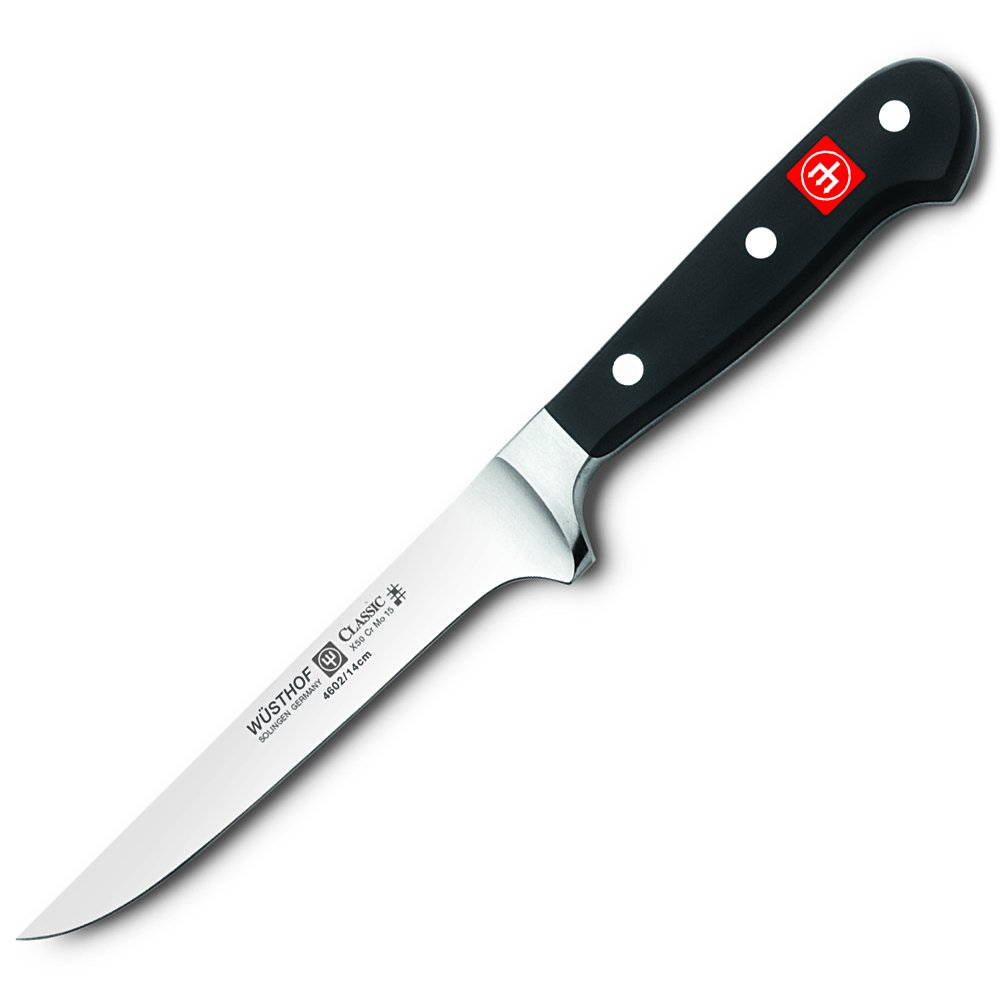
Wüsthof forges this knife in Solingen, Germany — known as the “blade capital” of the world. The 5-inch stiff blade uses high-carbon stainless steel hardened to 58 HRC, which holds a sharp edge noticeably longer than softer steels.
The short, rigid blade gives you surgical-level control. Removing tenderloins from a whole chicken, separating joints, or running a clean line along a rib rack — this knife feels precise in a way flexible blades can’t match. The full-tang construction means the blade metal runs the full length of the handle, giving it perfect balance.
The trade-off: harder steel chips if you torque it against bone aggressively. It also sharpens slower than softer steels when it finally dulls. But chefs who use this knife daily report needing only 2 sharpenings per year with regular honing.
This knife justifies its $100+ price if you cook with it regularly. If you debone meat only a few times per year — the Victorinox does the same job for a fraction of the cost.
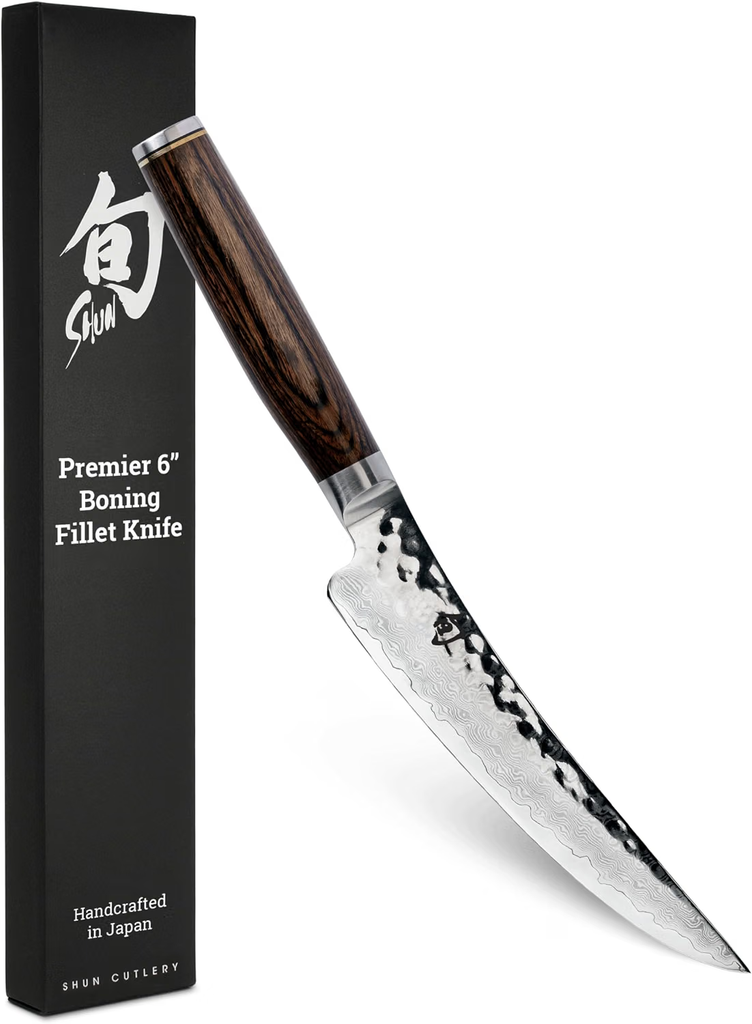
3. Shun Premier Gokujo 6-Inch Boning Knife — Best Japanese Option
 Save
SaveThe Shun Premier Gokujo uses VG-MAX steel — a premium Japanese alloy that sharpens to an exceptionally fine angle. The result is a blade so razor-sharp it glides through fish skin and delicate poultry without tearing.
The curved, flexible blade design is specifically built for fish filleting and the kind of fine maneuvering that Western stiff blades struggle with. The Damascus steel exterior looks stunning, but its real purpose is adding micro-level toughness to the blade face.
One honest trade-off: the Shun gets heavier over extended use. Butchers who tested it for hours found it more tiring than lighter knives like the Victorinox. The edge is also more fragile — aggressive bone contact can chip it.
Choose the Shun if you want a premium Japanese knife that doubles as a showpiece and a serious tool for fish and poultry work. For detailed information on pairing this knife with a complete kit, check out this guide to best professional knife sets to see how boning knives fit into a full setup.
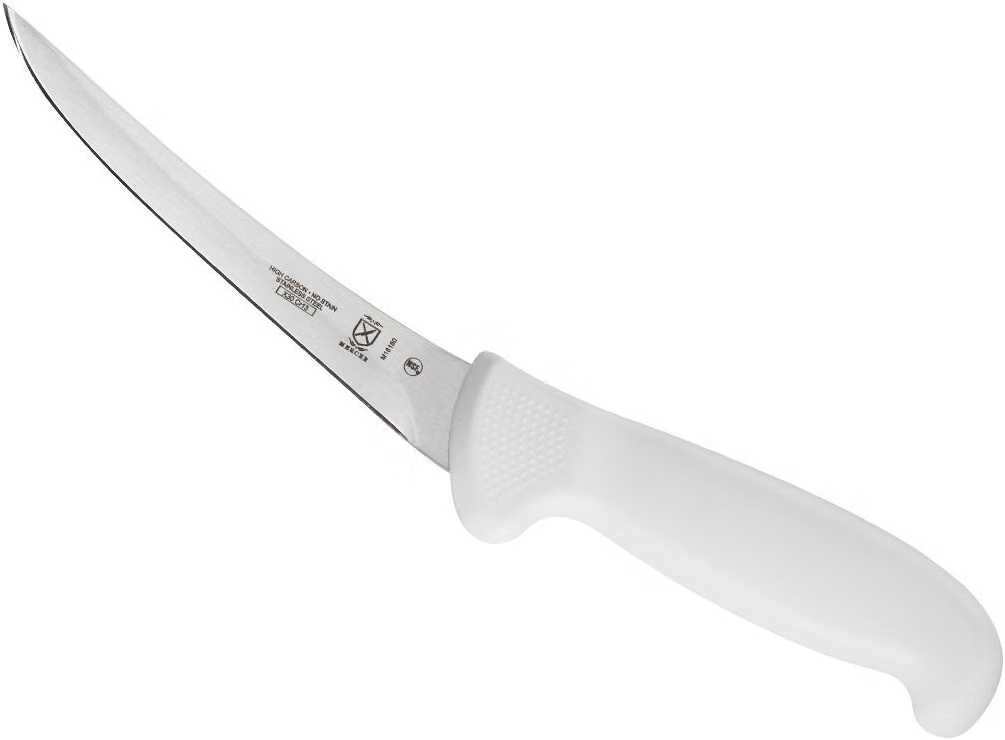
4. Mercer Culinary Millennia 6-Inch Curved Boning Knife — Best Budget Pick
 Save
SaveThe Mercer Culinary Millennia is a favorite among culinary school students and working butchers on a tight budget. It’s made from a single piece of high-carbon Japanese steel with an ergonomic textured handle designed for all-day grip security.
At under $15, the performance-to-price ratio is remarkable. The curved blade glides around bones and joints cleanly. The non-slip handle has textured finger points that lock your hand in place during detailed cuts.
Here’s the honest reality: this knife won’t hold an edge as long as a Wüsthof or Victorinox. You’ll sharpen it more often. But for a beginner learning deboning technique — or anyone who needs a reliable backup knife — the Mercer Culinary Millennia is one of the smartest purchases in the kitchen.
5. Zwilling Pro 5.5-Inch Flexible Boning Knife — Best for Fish and Delicate Work

Zwilling has nearly 300 years in the knife business. Their Pro boning knife uses a special formula high-carbon stainless steel and is German-made with a blade engineered to flex without snapping or permanently bending.
The 5.5-inch flexible blade is purpose-built for fish and poultry. It bends to hug bone curves so naturally that removing fish skin in one smooth motion becomes almost effortless. The blade is dishwasher-safe, which is rare for a knife at this quality level — though hand washing still extends longevity.
If you cook a lot of fish or regularly break down whole chickens and smaller birds, the Zwilling Pro’s flexibility gives you a level of precision the stiffer knives can’t match. Pair it with a quality Japanese knife set if you want a full suite of tools that covers every cut.
Flexible vs. Stiff Boning Knife — Which Type Do You Actually Need?
This is the single most important decision when choosing a boning knife. Getting it wrong means buying a knife that fights you every time you use it.
A flexible blade bends when you push it against bone, letting it follow the contour naturally. A stiff blade stays rigid, giving you more cutting force but less curve-following ability.
| Task | Flexible Blade | Stiff Blade ✓ Best |
|---|---|---|
| Fish filleting | ✓ Ideal — follows bone curves | Less maneuverable |
| Poultry deboning | ✓ Great for small joints | Works for larger birds |
| Beef and pork | Can flex too much | ✓ Ideal — better power and control |
| Trimming silverskin | Acceptable | ✓ More precise and controlled |
| Mixed daily use | Good for delicate tasks | ✓ Semi-stiff is the best all-rounder |
Most home cooks are best served by a semi-stiff blade — it handles both worlds without excelling at either extreme.
Many professional chefs keep 2 boning knives: one flexible for fish and poultry, one stiff for beef and pork. If you cook a wide variety of meats and can only own one, choose semi-flexible. It’s the best compromise for daily versatility.
🎯 Which Blade Flexibility Is Right For You?
If you are…
Mostly cooking fish and chicken
→ Choose Flexible (Zwilling Pro or Shun)
If you are…
Trimming beef roasts and larger cuts
→ Choose Stiff (Wüsthof Classic)
If you are…
Doing a mix of everything
→ Choose Semi-Stiff (Victorinox Fibrox Pro)
How to Use a Boning Knife Correctly — The Technique Most Home Cooks Skip
Even the best boning knife won’t help if your technique is wrong. Most beginners hack at meat instead of gliding the blade along the bone — and end up leaving good meat behind.
The correct technique takes about 10 minutes to learn and makes an immediate difference. Professional butchers describe it as “letting the blade listen to the bone.”
🔢 Step-by-Step: Boning Knife Technique
-
1
Grip the handle with your pinch grip
Pinch the blade just above the handle with your thumb and forefinger. This gives maximum control and reduces hand fatigue.
-
2
Pierce close to the bone with the tip
Insert the pointed tip at the edge of the bone first. Don’t start in the middle of the flesh — always begin at a bone edge.
-
3
Glide along the bone — don’t saw
Use a smooth gliding or light sawing motion with the blade flat against the bone surface. Let the sharpness do the work.
-
4
Always cut away from your body
Direction of the cut matters. Slipping hands are common in wet meat prep — always direct the blade away, not toward you.
-
✓
Pull the bone free cleanly
Once the blade has released the meat on all sides, pull the bone away with your free hand. Clean meat. Minimal waste.
⚠️ Warning
Never use your boning knife to chop through hard bones. It’s not designed for that. Boning knives are for separating meat from bone through soft connective tissue and joints — not splitting femur bones. Use a cleaver or bone saw for hard cuts.
The technique above works for chicken, turkey, fish, pork shoulders, and most cuts you’ll handle at home. Master this motion once — and every boning knife on this list will perform at its best for you.
How to Keep Your Boning Knife Sharp and Long-Lasting
A boning knife hits bone all day. That’s harder on an edge than any other kitchen task. The right care routine keeps it performing like new for years — even decades.
According to the boning knife entry on Wikipedia, the edge geometry of a boning knife is designed with robustness in mind — but it still requires regular maintenance to stay effective. Here’s what actually works:
✓ Boning Knife Care Checklist
-
✓
Hand wash and dry immediately after use — dishwashers cause edge damage over time -
✓
Hone the blade with a honing rod before each use to realign the edge -
✓
Store in a blade guard or on a magnetic strip — loose in a drawer damages the edge -
✓
Sharpen fully 1–2 times per year depending on how often you use it
Here’s why that matters: a dull boning knife requires more force. More force means less control. Less control next to a bone is exactly when accidents happen. Keeping your edge sharp is as much a safety decision as a performance one.
If you plan to expand your knife collection and want to understand how these tools fit together with the rest of your kitchen, the best professional chef knife sets guide covers full-kit recommendations including how to build around a quality boning knife.
What Most People Get Wrong About Boning Knives
Three stubborn myths about boning knives keep people buying the wrong tool — or avoiding the tool altogether. Here’s the truth on each.
Myth 1: “Any sharp knife can debone meat just as well.”
This is wrong. A chef’s knife is too wide to slide alongside bone without tearing flesh. The narrow blade and pointed tip of a boning knife are specifically engineered for this task. Trying to debone chicken with a chef’s knife leaves 15–25% more meat on the bone, according to professional butchers — that’s real food waste over time.
Myth 2: “A flexible boning knife is always better.”
Flexibility is only better for fish and delicate poultry work. For beef and pork — where you need cutting force through dense connective tissue — a flexible blade gives too little resistance and actually makes the cut harder to control. The right flexibility depends entirely on what you’re cutting.
Myth 3: “Expensive boning knives are always better.”
The Victorinox Fibrox Pro costs about $40 and beats $150 knives in head-to-head professional butchery tests for daily use, comfort, and reliability. High-end knives like the Wüsthof or Shun offer edge retention and craftsmanship that matters if you use a boning knife every single day. For weekly home use — the Victorinox is simply the smarter buy.
💡 Key Insight
The best boning knife is the one you’ll actually use — and that means it needs to fit comfortably in your hand, stay non-slip when wet, and match the type of meat you cut most often. Prestige doesn’t debone a chicken. The right tool does.
Recommended Product
Victorinox Fibrox Pro 6-Inch Curved Boning Knife with Semi-Stiff Blade
★★★★★ Highly rated on Amazon
The most trusted boning knife among professional chefs — NSF-certified, non-slip Fibrox handle, lifetime warranty, and priced at a fraction of premium alternatives.
As an Amazon Associate, we earn from qualifying purchases.
Conclusion
The top 5 boning knives recommended by chefs in 2026 are the Victorinox Fibrox Pro, Wüsthof Classic, Shun Premier Gokujo, Mercer Culinary Millennia, and Zwilling Pro. Each earns its place for a different cook with different needs.
For most home cooks, the Victorinox Fibrox Pro is the clear starting point — professional performance, legendary durability, and a price that makes sense. If you cook meat seriously and often, the Wüsthof Classic or Shun Premier rewards that investment with lifetime precision.
One thing to do right now: pick up a Victorinox Fibrox Pro, debone one whole chicken with it, and compare it to what you’ve been using. You’ll never go back.
Frequently Asked Questions
What is a boning knife used for?
A boning knife is used to remove bones from meat, poultry, and fish. Its narrow, pointed blade slides between flesh and bone with precision, letting you separate them cleanly while keeping as much meat as possible. It’s also used for trimming fat and silverskin from cuts before cooking.
What size boning knife do chefs recommend?
Chefs recommend a 5-to-6-inch blade for most deboning tasks. A 5-inch blade works best for smaller cuts and precise joint work, while a 6-inch blade handles both poultry and larger cuts with equal ease. Blades over 7 inches are typically for butchers processing very large animals.
What is the difference between a boning knife and a fillet knife?
A boning knife is thicker, sturdier, and designed for both meat and fish. A fillet knife is thinner, more flexible, and built specifically for fish — removing skin, scales, and tiny bones from delicate flesh. You can use a flexible boning knife to fillet fish, but a dedicated fillet knife performs that one task better.
Should I get a flexible or stiff boning knife?
Choose flexible for fish, poultry, and delicate work where the blade needs to follow curved bone surfaces. Choose stiff for beef, pork, and large cuts where you need cutting force through dense tissue. If you cook a variety of meats, a semi-stiff blade like the Victorinox Fibrox Pro is the best all-round option.
How do I keep a boning knife sharp?
Hone your boning knife with a honing rod before each use to realign the edge. Hand wash and dry it immediately after use — dishwashers slowly damage the edge and handle. Sharpen it fully 1–2 times per year. Store it in a blade guard or on a magnetic strip to protect the edge between uses.
Can I use a boning knife to cut through bone?
No. A boning knife is designed to separate meat from bone through soft connective tissue and joints — not to chop or split hard bone. Cutting hard bone with a boning knife will chip the edge and can damage the blade permanently. Use a cleaver or a bone saw for any hard bone-cutting tasks.
Is the Victorinox Fibrox really used by professional chefs?
Yes. The Victorinox Fibrox line is a genuine professional-kitchen staple used in culinary schools, restaurant prep kitchens, and butcher shops worldwide. It’s NSF-certified, dishwasher-safe, and built to handle hours of daily use. Its non-slip Fibrox handle and Swiss-made construction make it one of the most trusted knives across all price ranges.