Boning Knife vs Honesuki Knife: Which One Do You Actually Need?
A boning knife is a flexible, curved Western blade designed for beef, pork, and fish. A honesuki is a rigid, triangular Japanese boning knife built specifically for breaking down poultry. Choose a boning knife for general meat work. Choose a honesuki if you regularly debone chicken, duck, or other birds.
You’re standing in the kitchen with a whole chicken in front of you. Your chef’s knife feels clumsy. Your paring knife is too small. You know you need a dedicated boning tool — but which one?
I’m Michael, and I’ve tested both knives on everything from chicken thighs to beef ribs. The difference between a boning knife and a honesuki is bigger than most people expect. Get it right and butchering becomes easy. Get it wrong and you’ll be fighting the food every step of the way.
Let’s break down exactly what each knife does, where each one wins, and which is the better buy for your kitchen.
- A Western boning knife is flexible and curved — ideal for beef, pork, lamb, and fish.
- A honesuki is rigid and triangular — purpose-built for breaking down poultry.
- The honesuki’s “reverse tanto tip” gives it unmatched precision around joints.
- For a single knife that handles most tasks, the Western boning knife is more versatile.
- If you cook a lot of chicken or duck, a honesuki will make the job noticeably faster.
What Is a Boning Knife?
 Save
SaveA Western boning knife is a long, narrow blade designed to separate meat from bone. It typically measures 5 to 7 inches. The blade is thin enough to slip along bones without tearing the meat.
Most Western boning knives are slightly curved and flexible. That flex lets you follow the contour of bones — especially important when working with curved ribs or the shoulder blade of a lamb. Stiff versions also exist for heavy-duty work like beef brisket or pork leg.
A boning knife is a narrow, pointed Western kitchen blade used to trim, debone, and separate raw meat from bones and connective tissue.
Steel choice matters here. German steel boning knives — like those from Wüsthof or Victorinox — use softer, tougher steel that handles flex and abuse well. They’re easy to sharpen and very forgiving. You can learn more about the different types of boning knives to understand which profile suits your cutting style.
What Is a Honesuki Knife?
 Save
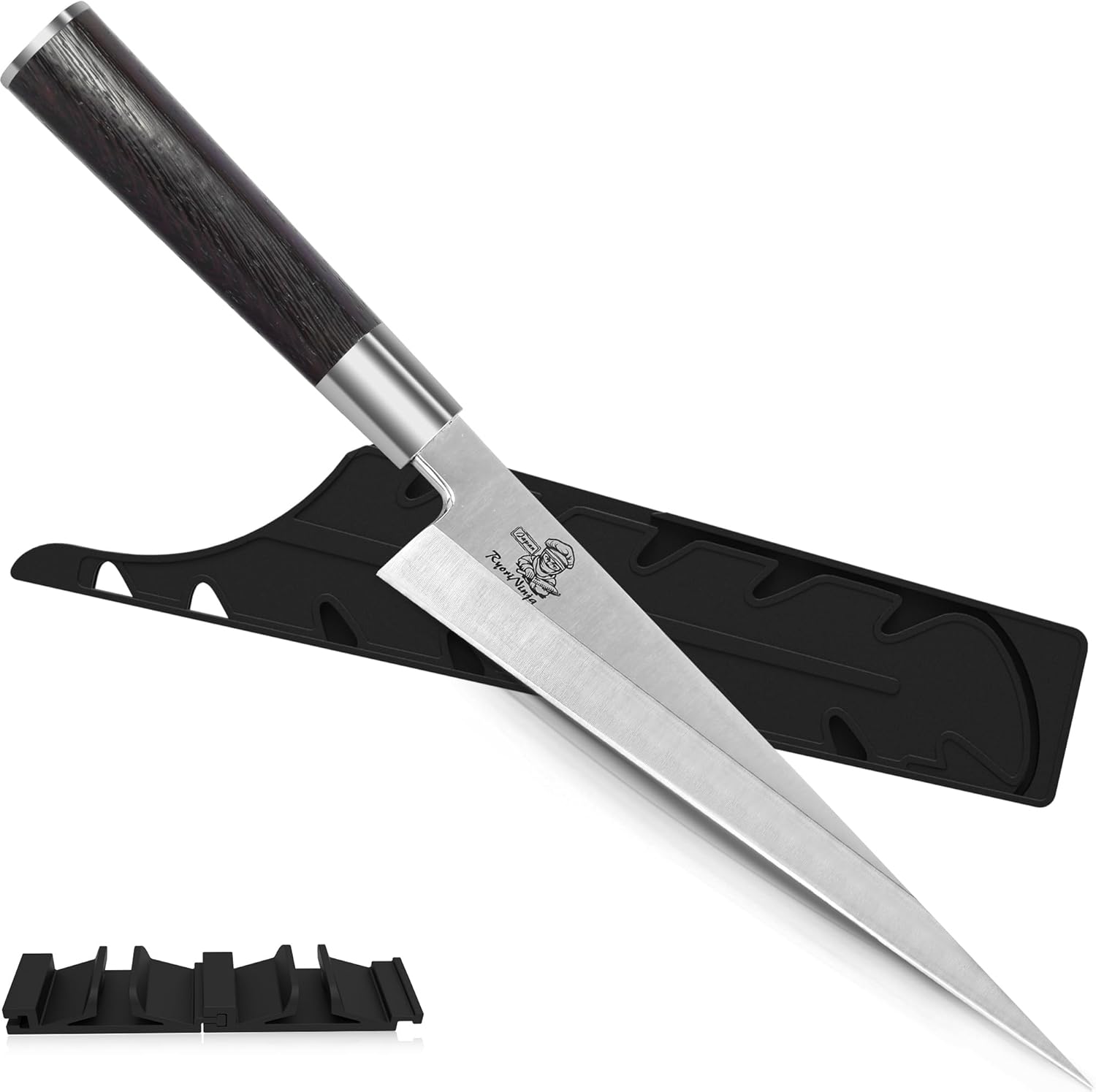
SaveA honesuki is a traditional Japanese boning knife with a distinctive triangular blade shape. The name comes from Japanese — “hone” (骨) means bone, and “suki” means to remove or pry away. So it literally translates as “bone remover.”
The honesuki was developed for yakitori — the Japanese art of breaking a whole chicken into 10 or more distinct cuts with speed and precision. A skilled yakitori chef uses the honesuki to separate breast, thigh, drumstick, wings, oysters, and cartilage with minimal waste.
What makes it unique is the “reverse tanto tip.” The blade’s point angles sharply downward, which strengthens the tip and allows it to pierce through tight joint spaces without slipping. Unlike a Western boning knife, the honesuki is stiff — not flexible. That rigidity is exactly what you want when you’re popping a joint or scraping meat cleanly off bone.
A honesuki is a rigid, triangular Japanese boning knife designed specifically for breaking down and deboning poultry.
Honesuki blades typically run 145 to 180mm (around 5.7 to 7 inches). They come in two traditional styles: honesuki-kaku (the eastern Kanto style with a squarer shape) and honesuki-maru (the western Kansai style with a more rounded edge). Modern makers like Chubo Knives and Tojiro also produce double-bevel versions that are easier for home cooks to sharpen.
Boning Knife vs Honesuki: Key Differences at a Glance
These two knives share the same job description — removing meat from bone — but they approach the task in very different ways. Here’s a direct comparison.
| Feature | Western Boning Knife | Honesuki (Japanese) |
|---|---|---|
| Blade shape | Narrow, slightly curved | Triangular, pointed tip |
| Flexibility | Flexible or semi-stiff | Rigid (stiff) |
| Bevel | Double bevel (both sides) | Single or asymmetric bevel |
| Best for | Beef, pork, lamb, fish | Chicken, duck, poultry |
| Steel origin | German or stainless steel | Japanese VG10, white #2, AUS-10 |
| Handle style | Western bolstered handle | Wa (Japanese) or Western |
| Spine thickness | Thin to medium | Thick (~2mm average) |
| Learning curve | Low — beginner-friendly | Medium — technique matters |
| Price range | $20 to $150+ | $60 to $300+ |
| Can cut through bone? | No (soft cartilage only) | No — joints and cartilage only |
Which Knife Is Better for Chicken?
For chicken, the honesuki wins — and it’s not close. The rigid, triangular blade is built exactly for this task. The thick spine lets you apply leverage to pop joints. The pointed reverse tanto tip slides into tight spaces between the thigh and body without tearing.
A Western boning knife can break down a chicken, but the flexible blade tends to bend at the wrong moment. You end up fighting for control instead of moving confidently through the bird. With a honesuki, you learn the bird’s anatomy once and the knife does the rest.
When using a honesuki, use the heel of the blade to articulate joints and the pointed tip to trace along bones. Don’t try to flex the blade — its rigidity is a feature, not a flaw.
The honesuki also handles duck, quail, game birds, and even small game like rabbit very well. For poultry-heavy kitchens — or anyone who buys whole chickens regularly — a honesuki saves both time and money.
Which Knife Is Better for Beef and Pork?
For red meat, the Western boning knife is the better tool. Larger cuts like beef ribs, pork shoulder, or leg of lamb require a flexible blade that can glide along curved bone surfaces. The honesuki’s rigid, triangular shape doesn’t adapt well to these contours.
A flexible boning knife lets you feel the blade against the bone as you work. That tactile feedback is critical when you’re trimming close to a rib or following the irregular surface of a hip joint. The honesuki simply can’t match that on large animals.
Never use a honesuki — or any boning knife — to cut through solid bone. These tools are for separating joints and connective tissue. Cutting through hard bone will chip or break the blade.
That said, the honesuki does fine on small pork cuts like pork chops or trimming pork belly. It’s when you scale up to large primal cuts that the Western boning knife takes over.
Which Knife Is Better for Fish?
The answer depends on the size of the fish. For small-to-medium fish like trout, mackerel, or sea bass, a flexible Western boning knife works very well. The thin, flexible blade follows the spine cleanly and wastes almost no flesh.
For fish filleting specifically, a dedicated fillet knife is the right choice. A fillet knife is thinner and more flexible than a standard boning knife. If you’d like to understand how these tools compare in detail, this breakdown of a boning knife vs fillet knife covers all the key differences.
The honesuki can handle some fish work — trimming, portioning, basic filleting — but it’s not optimized for it. Japanese chefs traditionally use a Deba knife for whole fish butchery. The honesuki is best kept for poultry where it genuinely excels.
Honesuki Blade Geometry: Why the Triangle Shape Matters
The triangular profile of the honesuki is not a style choice. It’s a functional design built around the anatomy of a bird.
Here’s how the three zones of the blade work:
- The heel — the deepest, heaviest part of the blade — gives you leverage. You use it to pop joints, separate the thigh from the carcass, or push through cartilage.
- The mid-blade — the flat section — makes long scraping cuts along the breast bone or rib cage.
- The tip — the reinforced reverse tanto point — makes precise, controlled incisions in tight spaces like the wing socket or around the oyster.
Each zone does a specific job. A standard boning knife only has one zone working at a time. That’s why experienced butchers who break down dozens of chickens a week always prefer the honesuki — it’s faster once you understand the geometry.
Here’s the insight most articles miss: the honesuki is not really meant to be a boning knife in the Western sense. It’s a jointing knife. Its primary job is separating chicken into portions at the joints — not carefully deboning a breast fillet the way a Western boning knife would. Once you shift your mental model, the honesuki becomes much easier to use and much less frustrating.
Single Bevel vs Double Bevel Honesuki: Which Should You Buy?
Traditional honesuki knives are single bevel — sharpened on one side only, usually for right-handed use. This asymmetric grind creates an extremely sharp cutting edge and allows precise steering along bones.
The downside? Single-bevel blades require more skill to sharpen. They can also “steer” slightly to one side while cutting, which takes adjustment. Left-handed cooks using a right-handed single-bevel honesuki will find it awkward or unusable.
Modern double-bevel honesuki versions (the kaku style) are the practical choice for most home cooks. The sharpening is familiar — just like any Western knife — and they work equally well in either hand. According to knife experts who tested blades at Kappabashi, Tokyo’s wholesale knife district, in spring 2026, the double-bevel kaku is what they recommend for first-time buyers unless you specifically do yakitori-style breakdown.
If you’re new to Japanese knives, always buy a double-bevel honesuki first. You can explore single-bevel versions later once you understand the geometry and sharpening process.
How to Sharpen and Care for Each Knife
Both knives require regular sharpening to stay effective. But the approach differs.
A Western boning knife is sharpened at 15 to 20 degrees per side. You can use a whetstone, a pull-through sharpener, or a honing steel for maintenance. German steel is softer and easier to sharpen. It dulls faster but recovers quickly.
A honesuki — especially a single-bevel version — should only be sharpened on a whetstone. Never use a honing steel on Japanese knives. The harder steel is more brittle and can chip if you use a steel rod on it. Sharpening angles for honesuki range from 10 to 15 degrees on the beveled side.
For a step-by-step guide on keeping boning knives sharp and protecting the blade long-term, the full resource on how to sharpen and care for a boning knife covers everything from whetstone technique to storage.
Both knives should be hand-washed only. Dishwashers damage the edge and — with wooden-handled Japanese knives — will warp or crack the handle over time.
Western boning knife: whetstone or pull-through sharpener, 15–20° angle, honing steel okay for maintenance. Honesuki: whetstone only, 10–15° angle on bevel side, no honing steel, hand wash always.
Does a Honesuki Replace a Boning Knife?
Not entirely. The honesuki is a specialist. It replaces a boning knife for poultry work — and beats it decisively. But it doesn’t fully replace the Western boning knife for red meat or large animal butchery.
Think of it this way:
- If you cook chicken 3 or more times a week, a honesuki will genuinely improve your workflow.
- If you mostly work with beef, pork, or lamb, stick with a Western boning knife.
- If you do both, you want both. They’re complementary tools, not substitutes.
Many experienced home cooks keep a Western boning knife for red meat and add a honesuki as a second tool once they’re comfortable with Japanese knives.
What to Look for When Buying a Honesuki
Not all honesuki knives are equal. Here’s what matters when you’re choosing one.
- Steel type — VG10 is the most popular choice. It holds an edge well and resists corrosion. White #2 carbon steel is sharper but requires more maintenance. AUS-10 and SG2/R2 are excellent for advanced users.
- Blade length — Most common size is around 150mm (about 6 inches). This balances control and versatility for whole-bird breakdown.
- Handle — Traditional octagonal wa handles are lightweight and feel great on Japanese knives. Western-style handles are more familiar and equally functional.
- Bevel style — Double bevel for beginners. Single bevel for experienced cooks who want maximum precision.
- Spine thickness — Around 2mm is standard. Thicker spines give more leverage on joints but add weight.
For a deeper dive into what to look for before you buy, the complete boning knife buying guide walks through every key consideration in detail.
A textured or slightly grippy handle is strongly recommended for honesuki knives. Poultry fat and moisture make smooth handles very slippery — a dangerous combination when using a rigid, sharp blade at close range.
Are There Other Japanese Alternatives Worth Knowing?
Yes. The honesuki has two close relatives you may come across.
The Garasuki is a larger, heavier version of the honesuki. It shares the same triangular profile but is built for breaking down whole turkeys, geese, or larger poultry. If a honesuki is the scalpel, the Garasuki is the mallet — same idea, more power.
The Sabaki is another Japanese boning knife sometimes confused with the honesuki. The sabaki has a slightly longer, thinner blade and is more versatile across different proteins. Some professional chefs prefer it over the honesuki for general work.
For sashimi preparation and fish slicing specifically, the Yanagi or Deba are the traditional Japanese choices — not the honesuki. Each tool has its lane in Japanese knife culture.
You can explore how the honesuki compares to other specialist blades in this detailed look at how a boning knife differs from other knives.
- Place the chicken breast-side up. Use the tip to score around the leg joint where it meets the body.
- Pull the leg outward to expose the joint. Use the heel of the honesuki to pop the hip joint cleanly.
- Flip the chicken over. Follow the backbone with the mid-blade to free the oyster meat on each side.
- Turn the bird breast-side up. Use the tip to trace along one side of the keel bone from top to bottom.
- Apply gentle pressure with the blade flat against the ribs to pull the breast away cleanly.
- Separate wing joints using the pointed tip to locate and cut through the socket.
If you practice this process three times, you’ll have it memorized. The honesuki makes each step feel deliberate and controlled.
A quality honesuki is a long-term investment. If you’re ready to try one, there are solid options across every price point — from entry-level stainless models to hand-forged VG10 blades from Japan’s top knife makers.
Your Next Step
The choice is cleaner than it first appears. If you cook a lot of chicken, duck, or other birds, the honesuki will transform how you work in the kitchen. If you mostly handle beef, pork, or fish, a quality Western flexible boning knife is the smarter buy.
The single most important takeaway: these tools are not rivals — they’re specialists. The best kitchen is one where each knife has a clear job. Pick the one that matches what you cook most, and you’ll use it every single time.
I’m Michael, and if you found this breakdown useful, take a look at the full best boning knife guide for top-rated picks across every category.
Frequently Asked Questions
Can a honesuki be used instead of a boning knife for all tasks?
A honesuki works best for poultry and small game — it’s not ideal for large red meat cuts like beef ribs or pork leg. For those, a flexible Western boning knife is the better choice. The two knives are complementary, not interchangeable.
What is the difference between a honesuki and a garasuki?
A garasuki is simply a larger and heavier version of the honesuki, built for breaking down whole turkeys or larger birds. The honesuki at around 150mm is for standard-size poultry. Both share the same triangular blade shape and rigid construction.
Is a honesuki good for beginners?
Yes — with the right version. Choose a double-bevel honesuki to start. It sharpens like a Western knife and works equally well in both hands. Single-bevel honesuki require more technique and are better suited to experienced cooks.
Can you sharpen a honesuki with a honing steel?
No. Never use a honing steel on a honesuki or any Japanese high-carbon knife. The harder steel is brittle and can chip under the rod’s impact. Always use a fine-grit whetstone — 1000 to 3000 grit for regular sharpening, 6000+ for polishing the edge.
What makes the honesuki tip different from a regular boning knife tip?
The honesuki features a “reverse tanto tip” — the blade point angles sharply downward instead of tapering smoothly. This design reinforces the tip so it doesn’t snap when used to separate tight joints. It also improves precision in small spaces like wing sockets and joint cavities.