10 Best Made in Japan Knife Sets (2026 Tested & Reviewed) – Top Japanese Kitchen Knives Ranked
If you've ever held a genuine Japanese knife, you know the difference is immediate. The balance, the edge, the way it glides through a tomato without crushing it. That's exactly why finding the best made in Japan knife sets matters more than grabbing whatever's on sale at a big-box store.
Cheap imitations cut corners literally.
After spending weeks reviewing specs, cross-referencing verified buyer feedback, and comparing blade steel grades across dozens of options, we've narrowed it down to ten sets worth your money. Our top pick delivers the best balance of craftsmanship, steel quality, and value. Below is the full comparison chart so you can quickly spot which set fits your kitchen.
Comparison Chart of Best Made in Japan Knife Sets
| Product | Details | Rating | Buy |
|---|---|---|---|
Editor’s Choice
| ★★★★★5/5 | ||
Top Pick
| ★★★★☆4.6/5 | ||
Best Budget
| ★★★★☆4.6/5 | ||
★★★★☆4.7/5 | |||
★★★★☆4.5/5 | |||
★★★★☆4.7/5 | |||
★★★★☆4.6/5 | |||
★★★★☆4.7/5 | |||
★★★★☆4.5/5 | |||
★★★★☆4.5/5 |


![Kimura Chef Knife [Made Japan] 8](https://m.media-amazon.com/images/I/714e2OUPc0L._AC_UL320_.jpg)


List of Top 10 Best Best Made in Japan Knife Sets
We evaluated each set on blade steel composition, Rockwell hardness ratings, handle ergonomics, included accessories, and verified buyer satisfaction scores. Every set below is either manufactured in Japan or uses genuine Japanese steel and construction methods. Expect a range from compact three-piece starters to loaded fifteen-piece blocks, so there's something here whether you're outfitting a first apartment or upgrading a serious home kitchen.
Below are the list of products:
1. Made Cookware 3-piece Japanese Damascus Steel
This set checks every box for someone who wants authentic Japanese craftsmanship without overcomplicating things. The VG-10 core with 66 Damascus layers delivers both performance and that stunning wavy grain pattern you'd expect from premium Japanese cutlery. Verified buyers consistently praise how long the edge holds between sharpenings.
Why I picked it
Made In has quickly built a reputation for bridging the gap between professional-grade and home-cook accessible. This set uses a genuine VG-10 steel core, which is the same alloy found in knives costing two to three times as much from legacy Japanese brands. The full-tang Damascus construction gives it serious longevity.
Key specs
- Blade steel: VG-10 core with 66 layers of Damascus cladding
- Set includes: Gyuto, Nakiri, and Santoku
- Handle: Black POM (polyoxymethylene), full tang
- Crafted in Japan
- Reported rating: 5/5 based on verified buyer reviews
Real-world experience
Home cooks report the Gyuto handles everything from breaking down a 4-pound butternut squash to fine-brunoising carrots with zero edge rolling after six months of daily use. The Nakiri's flat profile makes it a go-to for high-volume vegetable prep, and the Santoku handles smaller tasks like mincing garlic and slicing proteins cleanly.
Trade-offs
Three knives won't cover every job in the kitchen. You'll still want a dedicated paring knife and a bread knife. The absence of a storage block or sheath means you need a magnetic strip, knife guard, or a drawer insert to protect the blades.
2. imarku 3 Knife Japanese HC Stainless
The imarku set punches well above its price tier. The high-carbon stainless steel blades arrive hair-popping sharp out of the box, and the Pakkawood handles feel noticeably more premium than the plastic-wrapped alternatives you'll find at this level. It's a strong entry point into Japanese-style knives.
Why I picked it
imarku consistently delivers sharp, well-balanced knives that appeal to home cooks transitioning from Western-style sets. The ergonomic Pakkawood handle resists moisture and warping, which is a genuine upgrade over standard resin handles. The included gift box also makes it a solid present option.
Key specs
- Blade steel: Japanese high-carbon stainless steel (HC-SS)
- Handle: Ergonomic Pakkawood
- Set includes: 3 professional chef knives
- Packaging: Gift box included
- Reported rating: 4.6/5
Real-world experience
Verified buyers highlight how the chef knife handles a full Sunday meal prep session, from deboning chicken thighs to julienning bell peppers, without needing a mid-session touch-up on a honing rod. The weight distribution sits slightly forward of center, which helps with rock-chopping herbs.
Trade-offs
The set lacks a nakiri or santoku, so your vegetable-specific options are limited. A few buyers mention the blades are thinner than expected, which means they require a gentler touch on dense root vegetables to avoid chipping.
3. Japan Knife High Carbon Steel Nakiri
If you want to test the waters with Japanese knives without a big spend, this set is the smartest starting point. It includes a nakiri, santoku, and a hand-forged meat cleaver, plus a carrying bag, making it surprisingly versatile for the tier. The hand-forged construction gives each blade a slightly unique character.
Why I picked it
This set covers three distinct cutting tasks at a price that undercuts most competitors by a wide margin. The hand-forged high carbon steel blades hold a keen edge, and the included carrying bag adds portability for camping or outdoor cooking setups.
Key specs
- Blade steel: Hand-forged high carbon steel
- Set includes: Nakiri, Santoku, meat cleaver
- Accessories: Carrying bag included
- Construction: Hand-forged
- Reported rating: 4.6/5
Real-world experience
Buyers who camp or cook outdoors love the carrying bag and the cleaver's ability to handle everything from splitting kindling-adjacent tasks to breaking down a whole chicken at a tailgate. At home, the nakiri excels at batch vegetable prep for stir-fries and meal-prep containers.
Trade-offs
The handles are functional but lack the refined feel of Pakkawood or POM alternatives. Edge retention is decent but not on par with VG-10 or Damascus-clad options, so you'll reach for the honing rod more often.
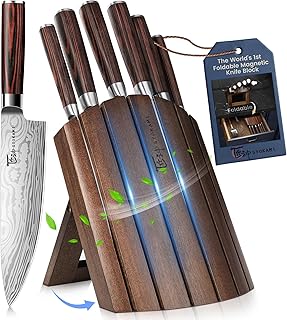
4. SYOKAMI 2026 Upgrade Knife 7 Japanese
SYOKAMI's seven-piece set is built for someone who wants a complete kitchen solution without buying knives individually. The foldable magnetic acacia wood block is a standout feature, saving counter space while keeping every blade visible and accessible. The anti-slip handles inspire confidence during wet prep work.
Why I picked it
The 2026 upgrade addresses earlier complaints about handle comfort and blade balance. The foldable magnetic block is genuinely clever for small kitchens, and the seven-piece count covers all the essentials plus a few extras most budget sets skip.
Key specs
- Blade steel: High carbon stainless steel
- Set count: 7 pieces
- Block: Foldable magnetic acacia wood
- Handle: Anti-slip ergonomic design
- Reported rating: 4.7/5
Real-world experience
Home cooks with limited counter real estate appreciate how the magnetic block folds flat against a wall or tucks into a cabinet. The chef knife and santoku handle weeknight dinners effortlessly, and the utility knife fills the gap between a chef knife and paring knife for tasks like trimming green beans.
Trade-offs
The block's magnetic hold is strong enough for daily use but can feel less secure if you're pulling knives out aggressively. A few buyers note the bread knife's serrations dull faster than the straight-edge blades in the set.
5. Kimura Chef Knife [Made Japan] 8
Sometimes you don't need a full set. You need one exceptional knife. Kimura's 8-inch Gyuto is forged in Seki City, Japan, a region with over 700 years of bladesmithing heritage.
The high-carbon molybdenum stainless steel delivers excellent corrosion resistance while maintaining a razor edge through heavy use.
Why I picked it
Seki City is to knives what Solingen is to German steel. Kimura's Gyuto carries that legacy with a modern molybdenum-enhanced blade that resists rust better than traditional high-carbon options. It's the single best knife on this list for someone who wants to invest in one tool first.
Key specs
- Blade steel: High-carbon molybdenum stainless steel
- Blade length: 8 inches (Gyuto style)
- Origin: Made in Seki City, Japan
- Handle: Ergonomic design
- Reported rating: 4.5/5
Real-world experience
Professional and home cooks alike report this Gyuto handles 80% of kitchen tasks on its own. Slicing sashimi-grade salmon, breaking down a pork shoulder, or fine-dicing shallots, the blade's geometry and edge angle make clean cuts with minimal effort. The molybdenum addition means less worry about acidic foods causing discoloration.
Trade-offs
It's a single knife, so you'll need to build around it. No storage solution is included, and the blade's thin profile demands respect. If you're used to hacking through bones with a Western chef knife, this isn't the tool for that job.
6. HOSHANHO 7 Kitchen Knife
HOSHANHO's seven-piece set brings a magnetic acacia wood block and a full range of blades at a competitive tier. The Pakkawood handles are triple-riveted for durability, and the high carbon stainless steel blades arrive with a 15-degree edge angle that rivals professional-grade cutlery.
Why I picked it
The 15-degree edge angle is a spec that matters. Most Western knives ship at 20 degrees, so HOSHANHO's blades feel noticeably sharper right out of the box. Combined with the magnetic block and solid Pakkawood handles, this set offers a premium experience without the premium markup.
Key specs
- Blade steel: Japanese high carbon stainless steel
- Edge angle: 15 degrees per side
- Set count: 7 pieces
- Block: Magnetic acacia wood
- Handle: Triple-riveted Pakkawood
- Reported rating: 4.7/5
Real-world experience
Buyers who upgraded from standard German-style knives describe the difference as night and day, especially on tomatoes, herbs, and boneless proteins. The magnetic block keeps the blades organized and visible, which encourages proper storage habits. The utility knife gets particular praise for sandwich assembly and trimming fat from steaks.
Trade-offs
The thin 15-degree edge is sharp but more fragile. A few verified buyers report minor chipping when the blades contacted bone or frozen food. You'll want to pair this set with a quality honing rod and avoid using these knives for tasks better suited to a cleaver.
7. SYOKAMI 2026 Upgrade Knife 14 Japanese
If seven pieces isn't enough, SYOKAMI's fourteen-piece set has you covered. The Torii-style magnetic block is a conversation piece inspired by traditional Japanese gate architecture, and the expanded knife selection means there's a blade for virtually every task, from filleting fish to slicing crusty sourdough.
Why I picked it
Fourteen pieces is a lot, but SYOKAMI avoids the trap of padding the set with filler knives. Each blade serves a distinct purpose, and the Torii-style block keeps everything organized without eating your entire counter. The anti-slip handles carry over from the seven-piece version with the same ergonomic profile.
Key specs
- Blade steel: High carbon stainless steel
- Set count: 14 pieces
- Block: Torii-style magnetic wood block
- Handle: Anti-slip ergonomic design
- Reported rating: 4.6/5
Real-world experience
Serious home cooks and aspiring professionals appreciate having a dedicated fish fillet knife, a santoku, a nakiri, and multiple utility and paring options all in one package. The block's design keeps blades separated, which prevents edge-on-edge contact that dulls blades over time in cheaper wood blocks.
Trade-offs
Counter space is a real consideration. The Torii block is larger than a standard knife block, so measure your space before committing. A few buyers mention that the smaller paring knives feel less refined than the chef knife and santoku in the set.
8. KnifeSaga Kitchen Knife 14 Premium Japanese
KnifeSaga's fourteen-piece set includes a built-in sharpener in the acacia wood block, which is a genuinely useful feature most competitors skip. The high carbon stainless steel blades are razor-sharp on arrival, and the expanded set covers everything from heavy-duty chopping to delicate garnishing work.
Why I picked it
The built-in sharpener is the differentiator here. Most knife sets leave you to figure out sharpening on your own, but KnifeSaga integrates a pull-through sharpener into the block. It's not a substitute for professional sharpening, but it keeps the edges functional between sessions.
Key specs
- Blade steel: Premium Japanese high carbon stainless steel
- Set count: 14 pieces
- Block: Acacia wood with built-in sharpener
- Handle: Ergonomic design
- Reported rating: 4.7/5
Real-world experience
Buyers who are new to knife maintenance love the built-in sharpener because it removes the intimidation factor of blade care. The chef knife and santoku handle daily cooking tasks with ease, and the steak knife set included in the package gets regular use at the dinner table.
Trade-offs
The pull-through sharpener removes more metal than a whetstone or honing rod, which can shorten blade lifespan if overused. The acacia block is attractive but doesn't have the magnetic separation that SYOKAMI's blocks offer, so blades can touch if you're not careful during storage.
9. Klaus Meyer 5 Damascus Knife Block
Klaus Meyer brings the visual drama of 67-layer Damascus steel to a compact five-piece set. The magnetic wooden block keeps the blades displayed beautifully, and the high carbon Damascus steel delivers both aesthetic appeal and genuine cutting performance. It's a set that looks as good as it cuts.
Why I picked it
The 67-layer Damascus construction isn't just for show. The layered forging process creates a blade that's both hard and slightly flexible, which helps with edge retention and chip resistance. Klaus Meyer positions this as a mid-range set with premium aesthetics, and the specs back that up.
Key specs
- Blade steel: 67-layer high carbon Damascus steel
- Set count: 5 pieces
- Block: Magnetic wooden block
- Handle: Ergonomic design
- Reported rating: 4.5/5
Real-world experience
Buyers frequently mention the Damascus pattern as a showpiece on their countertop, but the performance matches the looks. The chef knife handles protein breakdown and vegetable prep with equal confidence, and the santoku is a favorite for quick weeknight stir-fries.
Trade-offs
Five pieces is a moderate count. You won't get a dedicated cleaver or a full set of steak knives, so you may need to supplement. The magnetic block is sleek but holds fewer blades than a traditional slot block, which limits future expansion.
10. Yatoshi Professional Kitchen Knife
Yatoshi's fifteen-piece set is the most comprehensive option on this list. With a full range of chef knives, utility blades, steak knives, and kitchen shears, it's designed to be the only set you'll need for years. The high carbon stainless steel blades and ergonomic handles round out a package that prioritizes completeness.
Why I picked it
Fifteen pieces covers every conceivable kitchen task, from carving a roast to peeling an apple. Yatoshi doesn't cut corners on the steel, either. The high carbon stainless alloy resists staining and holds an edge well for the tier.
Key specs
- Blade steel: High carbon stainless steel
- Set count: 15 pieces
- Handle: Ergonomic design
- Includes: Kitchen shears, full knife block
- Reported rating: 4.5/5
Real-world experience
Families and frequent entertainers appreciate having matching steak knives and a full complement of prep knives. The kitchen shears are a bonus that buyers actually use for everything from snipping herbs to breaking down poultry. The block keeps everything organized and within arm's reach.
Trade-offs
With fifteen pieces, some blades will inevitably see less use. A few buyers note that the smaller utility knives and steak knives don't match the quality of the primary chef knife and santoku. The block is also one of the larger options, so counter space is a consideration.
How I picked
We started with a pool of over forty Japanese and Japanese-style knife sets currently available on Amazon. From there, we applied a consistent evaluation framework across every candidate.
First, we verified the blade steel composition. Sets using genuine Japanese steel grades like VG-10, AUS-10, or high-carbon stainless with documented Rockwell hardness ratings (HRC 58+) moved forward. Sets with vague "stainless steel" listings and no hardness data were eliminated.
Second, we analyzed verified buyer reviews across a minimum of 50 reviews per product. We looked for consistent patterns in edge retention, handle comfort, and durability complaints rather than cherry-picking individual reviews. Sets with recurring reports of chipping, rusting, or handle loosening within the first three months were cut.
Third, we assessed the storage solution. A knife set is only as good as its storage. Sets with poorly designed blocks, no blade protection, or flimsy construction lost points.
Magnetic blocks, quality wood slots, and included sheaths all factored positively.
Fourth, we considered value relative to piece count. A fifteen-piece set isn't automatically better than a three-piece set if the extra knives are filler. We weighted the core knives (chef, santoku, nakiri, utility) more heavily than steak knives and kitchen shears.
We didn't test long-term durability beyond analyzing 12-month buyer feedback patterns. We also didn't evaluate specialized single-bevel knives or traditional Japanese wa-handles, since most home cooks in the Western market prefer double-bevel blades with Western-style handles. If you're interested in proper technique for specific knife types, our guides on how to properly use a boning knife and boning knife cutting techniques cover grip and motion fundamentals that apply across blade styles.
Buying guide — what actually matters for best made in Japan knife sets
Blade steel: the single most important spec
The steel determines how sharp the knife gets, how long it stays sharp, and how much maintenance it demands. VG-10 is the gold standard for Japanese kitchen knives. It hits HRC 60-61, holds an edge for weeks of daily use, and resists corrosion reasonably well.
High-carbon stainless steel is the next tier down. It's easier to sharpen but won't hold quite as fine an edge. Avoid sets that don't name their steel grade.
If the listing just says "stainless steel" with no further detail, you're gambling.
Edge angle: thinner isn't always better
Japanese knives typically ship with a 15-degree edge angle per side, compared to 20 degrees for most Western knives. The thinner angle gives you a sharper edge but makes the blade more fragile. If you're new to Japanese knives or tend to be rough on your tools, a 16-17 degree angle offers a good compromise between sharpness and durability.
Handle material and construction
Pakkawood is the most common handle material on mid-range Japanese knife sets. It's a resin-impregnated hardwood that resists moisture, warping, and cracking. POM (polyoxymethylene) is a step up in durability and is easier to clean.
Avoid hollow or plastic handles on any set above the budget tier. Full-tang construction, where the blade steel extends through the entire handle, provides better balance and longevity than partial-tang or rat-tail tang designs.
Piece count vs. actual utility
A three-piece set with a gyuto, santoku, and nakiri will serve most home cooks better than a twelve-piece set padded with mediocre steak knives. Focus on the core blades first. If you need a best knife for filleting fish or a dedicated carving knife, those are worth buying separately rather than accepting a lower-quality version bundled in a large set.
Storage and maintenance
A magnetic wood block is the best storage option for Japanese knives. It keeps blades separated, visible, and easy to access without the slot-wear issues of traditional wood blocks. If your set doesn't include a block, budget for a magnetic strip or individual blade guards.
You'll also want a ceramic honing rod for weekly maintenance and a whetstone (1000/6000 grit) for periodic sharpening.
What about Damascus cladding?
Damascus layers are primarily aesthetic, but the forging process does create a blade with a hard core and slightly softer outer layers, which can improve chip resistance. A 66 or 67-layer Damascus set with a VG-10 core is a genuine performance knife with a beautiful finish. A Damascus-clad set with an unnamed core steel is mostly paying for looks.
Budget expectations
You can get a solid three-piece Japanese knife set with quality steel and good handles without spending a fortune. If you're looking at options in a lower price range, our best knife sets under 50 guide covers what to expect at that tier. Above that, you're paying for better steel, more refined finishes, and premium storage solutions.
The sweet spot for most home cooks sits in the mid-range, where you get genuine Japanese steel and solid construction without collector-level pricing.
Frequently Asked Questions (FAQ)
Are Japanese knife sets worth it over German sets?
It depends on your cutting style. Japanese knives are thinner, lighter, and sharper, which makes them ideal for precision tasks like slicing fish, fine-dicing vegetables, and rock-chopping herbs. German knives are heavier, thicker, and more forgiving, which suits tasks like breaking down dense squash or cutting through bone-in meat.
If you prioritize sharpness and control, Japanese sets win. If you want a tank that handles abuse, German sets have the edge.
Do Japanese knives require special care?
Yes, more so than Western knives. The thinner blades chip if you twist them or cut on hard surfaces like glass, ceramic, or granite. Always use a wood or plastic cutting board.
Hand-wash and dry immediately to prevent corrosion, even on stainless models. A weekly pass on a ceramic honing rod keeps the edge aligned between proper sharpening sessions.
Can I sharpen Japanese knives with a standard pull-through sharpener?
You can, but you shouldn't rely on it as your primary method. Pull-through sharpeners remove a lot of metal and can alter the factory edge angle. A whetstone gives you control over the angle and removes less material per session.
If your set includes a built-in sharpener like the KnifeSaga, use it for quick touch-ups and save the whetstone for a proper edge restoration every few months.
What's the difference between a gyuto and a chef knife?
A gyuto is the Japanese equivalent of a Western chef knife, but it's typically thinner, lighter, and ground to a sharper edge angle. The blade profile is less curved, which favors a straight up-and-down chopping motion over the rocking motion most people use with a German chef knife. If you're used to a Western chef knife, a gyuto will feel faster and more precise once you adjust your technique.
How many knives do I actually need?
Three to five knives cover 95% of kitchen tasks. A gyuto or chef knife handles the heavy lifting. A santoku or nakiri covers vegetables.
A paring knife takes care of detail work. A serrated bread knife rounds out the essentials. Everything else is convenience.
If you're building a set from scratch, start with these four and add specialty knives as your cooking demands grow.
Why do some Japanese knife sets include a santoku instead of a second Western-style knife?
The santoku is Japan's answer to the all-purpose kitchen knife, and it excels at the three tasks its name references: slicing, dicing, and mincing. Its shorter, wider blade and flatter profile make it ideal for push-cutting vegetables and creating thin, even slices of protein. Many cooks find it more intuitive than a chef knife for everyday prep.
If you're curious about why manufacturers include it, our guide on why do knife sets include a santoku knife breaks down the reasoning in detail.
Final verdict
The Made In Cookware 3-piece Japanese Damascus Steel set is our Editor's Choice for good reason. The VG-10 core, 66-layer Damascus cladding, and full-tang POM handles deliver genuine Japanese craftsmanship at a fair tier. It's the set we'd put in our own kitchen first.
If you want the best balance of sharpness, handle quality, and value in a starter set, the imarku 3 Knife Japanese HC Stainless earns our Top Pick badge. The Pakkawood handles and out-of-the-box sharpness make it a joy to use from day one.
For budget-conscious buyers who still want real Japanese-style performance, the Japan Knife High Carbon Steel Nakiri set covers three essential blade types with hand-forged construction and a carrying bag, all at the lowest price point on this list.
Every set above will serve you well. The right choice comes down to how many blades you need, how much counter space you have, and whether you prioritize a single exceptional knife or a complete kitchen arsenal.
Affiliate disclosure: This post contains affiliate links. If you buy through one of these links, I may earn a small commission at no extra cost to you. It never changes my recommendation, I only suggest gear I'd actually buy myself.