
What Knives Do You Need in a Kitchen? A Simple Guide to Every Essential Blade
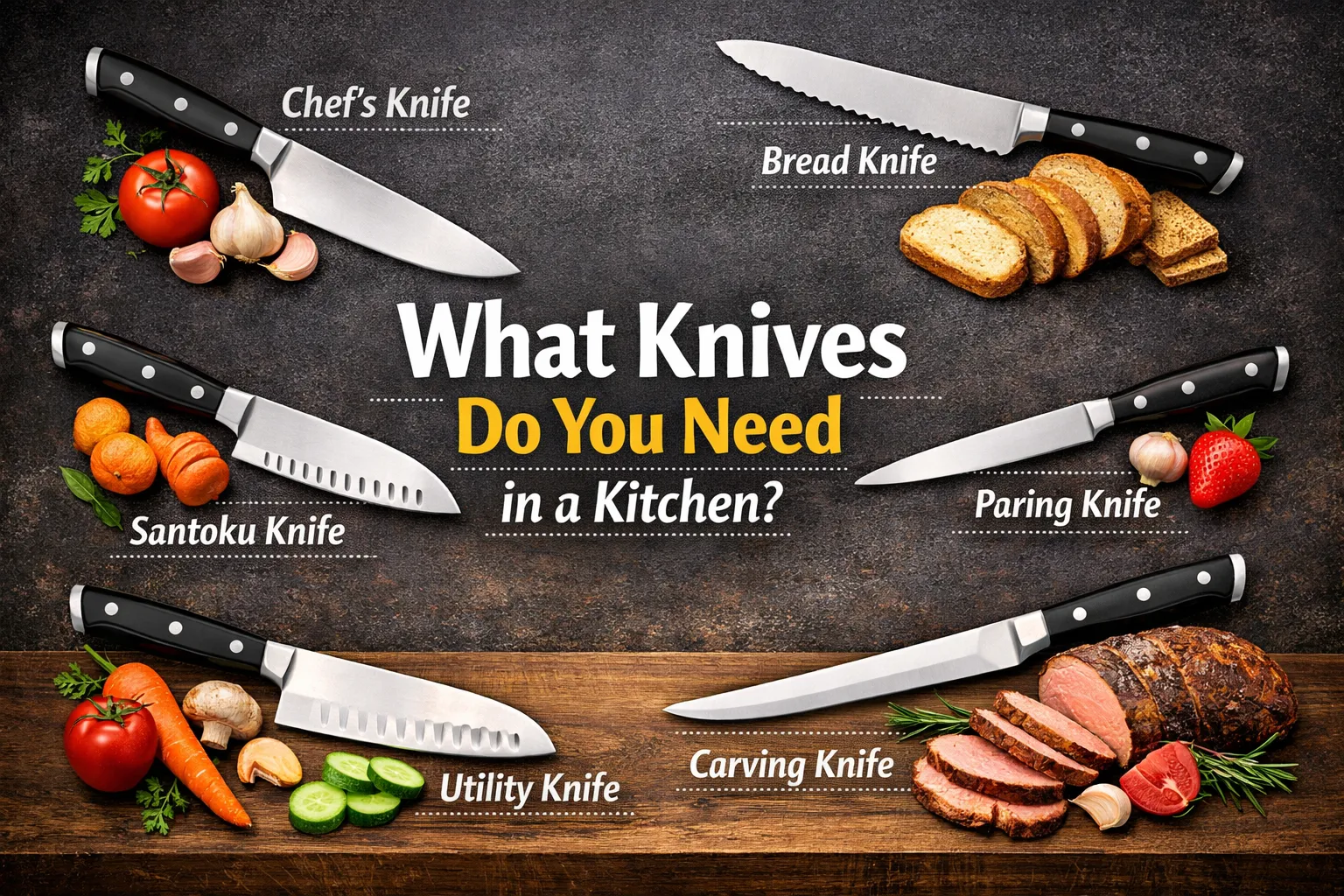
The knives you need in a kitchen are a chef’s knife, a paring knife, and a bread knife. These three cover almost every cooking task — chopping, peeling, and slicing. Once you have these three, you can add specialty knives like a boning knife or santoku as your cooking grows. Most home cooks never need more than five knives total.
I remember standing in a kitchen store, completely overwhelmed. There were 47 different knives on the wall. Bread knives. Fillet knives. Cheese knives. Tomato knives. I walked out empty-handed and confused.
That was before I spent years cooking and learning what actually matters. I’m Michael Alex Rahman, and I’ve tested dozens of knives at home and in professional kitchens. The truth is simple: most home cooks need three knives, not forty-seven.
Here I’ll walk you through exactly what each knife does, when you actually need it, and when to skip it entirely. By the end, you’ll know precisely what to buy — and what to ignore.
- Every kitchen needs just three knives: a chef’s knife, a paring knife, and a bread knife.
- A chef’s knife is the most versatile blade — it handles 80% of all kitchen cutting tasks.
- Do not buy a full block set. You’ll overpay for knives you will never use.
- Sharp knives are safer than dull ones — a dull knife slips; a sharp knife cuts clean.
- Japanese and German knives both work well — they just feel and cut differently.
The 3 Kitchen Knives Every Home Cook Actually Needs
You need a chef’s knife, a paring knife, and a bread knife. Together, these three blades handle nearly every task in any home kitchen — from slicing roasts to peeling apples to cutting a crusty sourdough loaf. Start here before buying anything else.
1. Chef’s Knife: The Most Important Knife in Your Kitchen
The chef’s knife is your kitchen workhorse. It is the single most important blade you will ever own. Use it for chopping vegetables, mincing garlic, slicing raw chicken, dicing onions, and crushing herbs. It does all of this, and it does it well.
A standard chef’s knife runs 8 inches long, which is the sweet spot for most home cooks. If you have smaller hands, a 6-inch version gives you more control. If you cook large batches regularly, a 10-inch blade moves faster.
The blade is long, slightly curved, and pointed at the tip. That curve is intentional — it lets you rock the blade forward and backward in a smooth motion, which speeds up chopping considerably.
Hold the blade between your thumb and index finger — not the handle. This grip gives you far more control and reduces hand fatigue during long prep sessions.
Wüsthof (a German knife brand with over 200 years of history) and Victorinox (the Swiss company famous for making Swiss Army knives) both make excellent chef’s knives in the $30–$150 range. Either is a smart first choice.
If you had to own just one knife, the chef’s knife is it. Full stop. Now let’s look at what else you need.
2. Paring Knife: Small Blade, Unlimited Uses
A paring knife is small — usually 3 to 4 inches long — but do not underestimate it. This is the blade you reach for when you need precision. Peeling a mango. Coring a strawberry. Deveining shrimp. Scoring chicken skin before roasting. These are paring knife jobs.
The blade looks like a miniature chef’s knife — short, pointed, and slightly curved. That shape makes it easy to maneuver around curved surfaces like apples or potatoes. You would struggle doing that with a larger blade.
Paring knives run under $20 for a great option. Zwilling (another respected German cutlery brand) makes a paring knife that our Test Kitchen recommends regularly. You do not need to spend much here.
3. Bread Knife: The One Knife You Cannot Fake With Anything Else
A bread knife has a long, serrated blade — usually 9 to 10 inches. Those serrations do something no other blade can: they saw through a hard crust without crushing the soft interior beneath it.
Try slicing a fresh baguette with a smooth chef’s knife and you will squash it flat. The bread knife prevents that. It uses a gentle back-and-forth motion instead of downward pressure.
Bread knives also work beautifully on tomatoes, pineapples, and even layer cakes. Any food with a tough exterior and soft interior benefits from the serrated edge. This is not a specialty knife — it earns its place every single week.
Never put quality knives in the dishwasher. The heat and detergent dull the blade fast and can damage the handle. Always hand-wash and dry immediately.
With these three knives, you can handle 95% of everything a home recipe will ever ask of you. But once you have the basics down, a few extra blades can make life noticeably easier.
Should You Buy a Knife Block Set or Individual Knives?
Buy individual knives, not a block set. Block sets look impressive, but you typically overpay for five or six knives you will use once a year — or never. The chef’s knife in a budget block set is often lower quality than a standalone knife at the same price point.
Start with the three essential knives above. Buy the best quality you can afford for each one. A great chef’s knife at $80 is worth far more in your kitchen than a 15-piece set at $80 split across fifteen mediocre blades.
Block sets offer convenience but lower quality per knife. Buying individually costs more upfront per blade, but each knife is meaningfully better. For most home cooks, three high-quality individual knives outperform a twelve-piece block set bought at the same total price.
Victorinox Fibrox Pro 8-Inch Chef’s Knife
This is the best value chef’s knife available — razor sharp out of the box, comfortable in any hand size, and built to last years with proper care. It’s a go-to recommendation for new home cooks and experienced ones who want a reliable everyday blade.
Japanese vs German Chef’s Knives: Which One Is Right for You?
Japanese chef’s knives and German chef’s knives both cut food. But they feel and behave quite differently in your hand. Choosing between them comes down to what you cook and how you like to work.
| Feature | German-Style (e.g., Wüsthof) | Japanese-Style (e.g., Shun) |
|---|---|---|
| Blade angle | 20–22 degrees (each side) | 10–15 degrees (sharper edge) |
| Weight | Heavier, more robust | Lighter, more nimble |
| Best for | Rocking chop, heavy tasks | Precision slicing, push cuts |
| Durability | Very durable, forgiving | Harder steel, can chip if misused |
| Maintenance | Easier to sharpen at home | Best sharpened by a professional |
If you cook a lot of meat and vegetables and want a tough, reliable blade that forgives rough treatment — go German. If you love precision cuts, sashimi, thin vegetable slices, and do not mind being more careful — a Japanese knife from Shun or a blade crafted in Seki City, Japan is worth exploring.
Most home cooks do best with a German-style knife to start. You can always add a Japanese blade later once you understand what your cooking style needs.
Extra Knives That Are Actually Worth Buying (And When to Add Them)
Once you have your three essentials, a few specialty knives genuinely earn their place. The key word is genuinely — buy these only if your cooking habits call for them.
Santoku Knife: A Smart Alternative to the Chef’s Knife
A santoku is a Japanese all-purpose knife, usually 6 to 7 inches long. The name means “three virtues” — it handles meat, fish, and vegetables. It has a flatter blade profile than a chef’s knife, which suits a straight up-and-down cutting motion more than a rocking chop.
If you find an 8-inch chef’s knife feels too large or heavy, a santoku makes an excellent alternative. Many cooks keep both — the chef’s knife for big jobs, the santoku for detail work and fast vegetable prep.
Boning Knife: Essential Only If You Break Down Whole Cuts of Meat
A boning knife has a thin, narrow, slightly flexible blade — usually 5 to 6 inches. It is designed specifically to separate meat from bone. Use it for breaking down a whole chicken, deboning a leg of lamb, or removing the skin from a fish fillet.
If you rarely buy bone-in proteins, skip this knife entirely. Your chef’s knife handles most meat tasks just fine. Wüsthof makes a well-reviewed 6-inch boning knife if you do need one.
Carving / Slicing Knife: For Roasts and Holiday Meals
A carving knife is long — usually 10 to 12 inches — with a thin, narrow blade. It is built for one job: slicing large roasted meats like turkey, brisket, or prime rib into clean, even pieces without tearing.
You only really need this if you roast large cuts of meat regularly. For most households, it earns its space around the holidays. The rest of the year, your chef’s knife does the job.
Utility Knife: The Middle Child of Kitchen Knives
A utility knife sits between a chef’s knife and a paring knife — usually 5 to 6 inches long. It handles the tasks that are too fiddly for a chef’s knife but too large for a paring knife: slicing cheese, trimming herbs, cutting sandwiches.
It is useful, but not essential. If budget is a concern, your paring knife and chef’s knife cover its role between them.
A great rule of thumb: only buy a new knife when you find yourself thinking “there should be a better blade for this job.” That moment of frustration is your signal. Not a sale. Not a pretty knife block display.
What Knives Do Professional Chefs Actually Use?
Professional chefs rely on a handful of trusted blades, not a wall of specialty knives. In fine dining restaurants, cooks bring their own personal knives to work — and most carry three to five knives at most.
A chef’s knife is always at the top of the list. Gordon Ramsay (the Michelin-starred chef and TV personality) has publicly stated that a sharp chef’s knife is the only truly essential tool in any kitchen. He recommends learning to use it well rather than reaching for specialty blades as shortcuts.
After the chef’s knife, professionals typically carry a paring knife, a boning knife (if they work with meat), and a slicing knife for service. That is it. The average home cook needs even less.
How to Keep Your Kitchen Knives Sharp and Safe
A sharp knife is a safe knife. This sounds counterintuitive, but it is true. A dull blade requires extra force to cut through food. That extra force is what causes the blade to slip — and then it cuts your hand instead of the onion. A sharp knife glides cleanly with minimal pressure.
- Hand-wash knives after every use — never the dishwasher.
- Dry immediately with a clean cloth — do not let blades air dry on a rack.
- Hone the blade with a honing steel every few uses to realign the edge.
- Sharpen the blade every 3–6 months depending on how often you cook.
- Store knives on a magnetic strip or in a knife block — never loose in a drawer.
Honing and sharpening are two different things. Honing realigns the existing edge; sharpening removes steel to create a new edge. You hone often. You sharpen less often. Both matter.
A honing steel (also called a sharpening rod) costs under $20 and makes a real difference in how your knives perform day to day. Use it before or after each cooking session. You will feel the improvement immediately.
Not sure if your knife is sharp enough? Try this: hold a sheet of newspaper and drag the blade through it at an angle. A sharp knife slices cleanly. A dull knife tears and crumples the paper.
For sharpening, you can use a whetstone (best results, takes practice), an electric sharpener (quick and easy, works well for most home cooks), or take knives to a professional sharpener. Many cookware stores offer this service for a few dollars per blade.
How to Choose the Right Blade Length for Your Cooking Style
Blade length changes how a knife feels and performs. Choosing the right length for your hand size and cooking habits makes a real difference in comfort and speed.
- 6-inch chef’s knife: Best for smaller hands, smaller cutting boards, and detail work. Lighter and easier to maneuver.
- 8-inch chef’s knife: The most popular length for home cooks. Versatile for most tasks and fits most hand sizes.
- 10-inch chef’s knife: Best for cooks who prep large quantities. More efficient with long, sweeping cuts. Requires more board space.
When in doubt, go with 8 inches. It is the standard for a reason. If you get the chance, hold the knife before buying. The best knife is the one that feels natural in your hand — not the one with the most impressive reviews.
The Serious Eats knife guide and the Wirecutter chef’s knife reviews are two of the best independent resources for comparing specific knife models before you buy.
Common Kitchen Knife Mistakes to Avoid
Most people make at least one of these mistakes. Knowing them in advance saves you money and keeps your knives performing well for years.
- Buying a knife block set before buying individual essentials. Sets look complete, but quality suffers across the board.
- Putting knives in the dishwasher. Heat and detergent damage the blade edge and handle materials.
- Storing knives loose in a drawer. Blades knock together and dull fast. Use a magnetic strip or block.
- Ignoring sharpening until the knife is useless. Regular honing prevents you from ever reaching that point.
- Cutting on glass, ceramic, or stone surfaces. These materials destroy blade edges instantly. Use wood or plastic cutting boards.
- Using one knife for every task. A chef’s knife is not ideal for peeling fruit or slicing bread — that is why the other two knives exist.
Frequently Asked Questions
What knives do you actually need in the kitchen?
You need three kitchen knives to handle nearly every cooking task: a chef’s knife (8 inches), a paring knife (3–4 inches), and a serrated bread knife (9–10 inches). These three cover chopping, precision work, and slicing breads and crusty-skinned produce. Everything else is optional.
What is the most important knife to have in a kitchen?
The chef’s knife is the most important kitchen knife. It handles 80% of all food prep tasks — chopping, dicing, mincing, slicing, and even light meat work. If you could only own one knife, a high-quality 8-inch chef’s knife is the one to choose.
What are the 3 knives every kitchen should have?
Every kitchen should have a chef’s knife, a paring knife, and a bread knife. Together these three knives handle virtually any task a home recipe calls for. Start with these before buying any specialty blades.
What knife do professional chefs use most?
Professional chefs use a chef’s knife more than any other blade. It is the foundation of kitchen work in both home and restaurant kitchens. Most chefs also carry a paring knife and, depending on their role, a boning or slicing knife.
Do you really need a santoku knife if you have a chef’s knife?
No, you do not need a santoku if you already own a good chef’s knife. They perform similar tasks, just with a different cutting motion. A santoku suits cooks who prefer straight up-and-down cuts over a rocking chop. It’s a useful addition but not an essential one.
How often should you sharpen kitchen knives?
Sharpen kitchen knives every 3 to 6 months depending on how often you cook. Between sharpenings, hone the blade with a honing steel before or after each use to maintain the edge. Honing is not sharpening — it simply realigns the edge so the knife keeps performing well.
Wrapping Up: Build Your Kitchen Knife Collection the Right Way
Here’s the honest summary: three knives are all most home cooks ever truly need. A solid 8-inch chef’s knife, a small paring knife, and a serrated bread knife will carry you through years of cooking without limitation.
Buy quality over quantity. A single well-made chef’s knife from Wüsthof or Victorinox outperforms an entire budget block set. Take care of your blades — hone them often, sharpen them seasonally, and never let them rattle loose in a drawer.
Once you have the essentials, add specialty knives only when your cooking genuinely calls for them. You’ll know when that moment arrives.
I’m Michael Alex Rahman, and I hope this guide cuts through the noise and gives you exactly what you need to outfit your kitchen with confidence. Now go cook something great.
{
“@context”: “https://schema.org”,
“@type”: “FAQPage”,
“mainEntity”: [
{
“@type”: “Question”,
“name”: “What knives do you actually need in the kitchen?”,
“acceptedAnswer”: {
“@type”: “Answer”,
“text”: “You need three kitchen knives to handle nearly every cooking task: a chef’s knife (8 inches), a paring knife (3–4 inches), and a serrated bread knife (9–10 inches). These three cover chopping, precision work, and slicing breads and crusty-skinned produce. Everything else is optional.”
}
},
{
“@type”: “Question”,
“name”: “What is the most important knife to have in a kitchen?”,
“acceptedAnswer”: {
“@type”: “Answer”,
“text”: “The chef’s knife is the most important kitchen knife. It handles 80% of all food prep tasks — chopping, dicing, mincing, slicing, and even light meat work. If you could only own one knife, a high-quality 8-inch chef’s knife is the one to choose.”
}
},
{
“@type”: “Question”,
“name”: “What are the 3 knives every kitchen should have?”,
“acceptedAnswer”: {
“@type”: “Answer”,
“text”: “Every kitchen should have a chef’s knife, a paring knife, and a bread knife. Together these three knives handle virtually any task a home recipe calls for. Start with these before buying any specialty blades.”
}
},
{
“@type”: “Question”,
“name”: “What knife do professional chefs use most?”,
“acceptedAnswer”: {
“@type”: “Answer”,
“text”: “Professional chefs use a chef’s knife more than any other blade. It is the foundation of kitchen work in both home and restaurant kitchens. Most chefs also carry a paring knife and, depending on their role, a boning or slicing knife.”
}
},
{
“@type”: “Question”,
“name”: “Do you really need a santoku knife if you have a chef’s knife?”,
“acceptedAnswer”: {
“@type”: “Answer”,
“text”: “No, you do not need a santoku if you already own a good chef’s knife. They perform similar tasks, just with a different cutting motion. A santoku suits cooks who prefer straight up-and-down cuts over a rocking chop. It’s a useful addition but not an essential one.”
}
},
{
“@type”: “Question”,
“name”: “How often should you sharpen kitchen knives?”,
“acceptedAnswer”: {
“@type”: “Answer”,
“text”: “Sharpen kitchen knives every 3 to 6 months depending on how often you cook. Between sharpenings, hone the blade with a honing steel before or after each use to maintain the edge. Honing is not sharpening — it simply realigns the edge so the knife keeps performing well.”
}
}
]
}