
What Knives Do Chefs Commonly Use? The Essential Kitchen Knife Guide
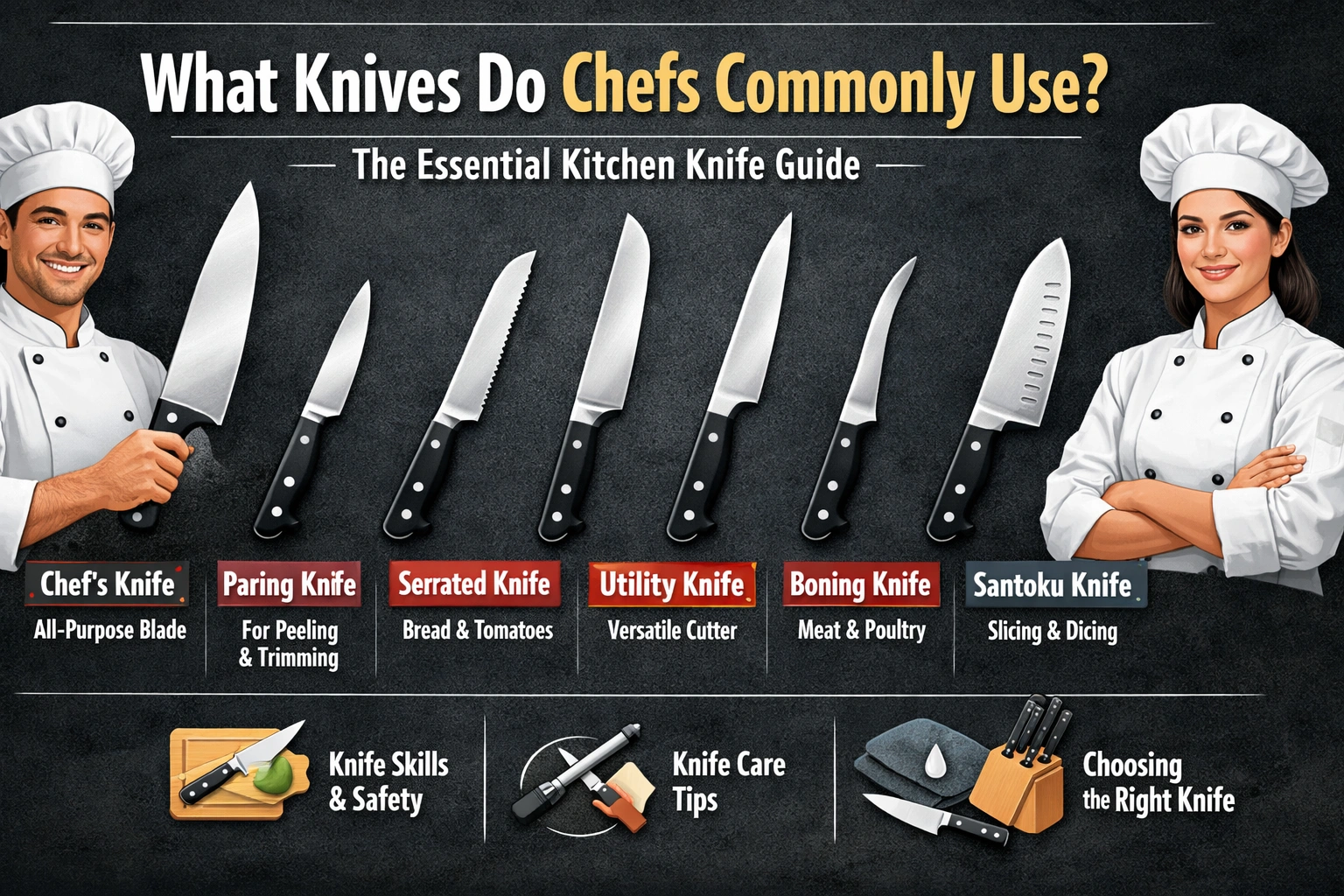
Chefs commonly use 5 essential knives: the chef’s knife (used for about 80% of all kitchen tasks), the paring knife for precision work, a serrated bread knife, a boning knife for meat, and a utility knife for mid-size jobs. Most professional kitchens also rely on a honing steel to keep blades sharp. Start with a quality 8-inch chef’s knife — it handles nearly everything.
I still remember the first time I walked into a professional kitchen. There were knives everywhere — hanging on magnetic strips, tucked in knife rolls, lined up on cutting boards. I thought, “Do you really need all of these?”
I’m Michael Alex Rahman, and I’ve spent years cooking, testing gear, and writing about kitchen tools. The truth is, most chefs rely on just a handful of knives every single day. The rest? Specialty tools for specific jobs.
Whether you’re a home cook who wants to cook like a pro or you’re just curious what a professional chef’s knife bag actually contains — this guide covers everything. We’ll look at every essential blade, what it does best, and how to pick the right one for your kitchen.
Let’s cut to it.
- The chef’s knife is the most important knife in any kitchen — it handles around 80% of all cutting tasks.
- Most professional chefs rely on 5-7 core knives, not a full 15-piece block set.
- Japanese and Western knives differ in steel hardness, angle, and cutting style — both work well depending on technique.
- A sharp knife is a safe knife — always keep your blades honed between uses.
- You do not need expensive knives to cook well — a good $50 chef’s knife beats a dull $300 one every time.
What Is the Most Important Knife a Chef Uses Every Day?
The chef’s knife is the single most important knife in any professional kitchen. It handles chopping, slicing, dicing, mincing, and even breaking down poultry. Most chefs reach for it first and use it for the vast majority of their prep work throughout a shift.
A standard chef’s knife has a blade between 8 and 10 inches long. The blade is slightly curved, which allows you to use a rocking motion when chopping. It feels weighty and balanced in the hand. Once you use a good one, it’s hard to go back.
Why is it so versatile? The length gives you reach for large ingredients like watermelons or whole chickens. The curve lets you chop quickly without lifting the whole blade off the board. And the tip is sharp enough for detail work like scoring fish or trimming fat.
If you only buy one knife in your life, buy a good chef’s knife. It is the painter’s brush, the carpenter’s hammer — the one tool you cannot do without.
An 8-inch chef’s knife is the most popular size for a reason. It balances reach and control. If you have small hands or work in a cramped kitchen, try a 6-inch model first before committing to a longer blade.
The 7 Knives Chefs Actually Use Most Often
Professional chefs do not use all 15 knives in a block set. They use the same 6 to 7 core blades repeatedly. Here is each one, what it does, and why chefs love it.
1. Chef’s Knife — The All-Purpose Workhorse
The chef’s knife does it all. Chop carrots, slice chicken breast, mince garlic, dice onions, julienne herbs — this blade handles it with ease. Most chefs in the United States use an 8-inch blade made from high-carbon stainless steel.
Popular brands include Wüsthof (a German knife company founded in 1814 in Solingen), Victorinox (the Swiss company famous for its Swiss Army knives), and Global (a Japanese brand known for its seamless stainless steel design). These are the names you’ll find in most professional kitchens across the country.
2. Paring Knife — Precision in a Small Package
The paring knife is the second most important blade in a chef’s kit. With a blade just 3 to 4 inches long, it excels at tasks requiring control — peeling apples, segmenting citrus, deveining shrimp, coring tomatoes, and removing seeds from bell peppers.
Think of it as the chef’s knife for small, delicate work. When a big blade is too clumsy, the paring knife steps in. It is compact, responsive, and surprisingly powerful in the right hands.
3. Serrated Bread Knife — Not Just for Bread
The serrated bread knife slices through crusty loaves without crushing them. But smart chefs also use it on tomatoes, cakes, pineapples, and anything with a tough exterior and soft interior. The serrated teeth grip the surface and glide through cleanly.
Most bread knives are 8 to 10 inches long. The extra length is important — it lets you slice across the full width of a large sourdough loaf in one smooth stroke.
Never use a serrated bread knife on delicate proteins like fish or thin vegetables. The teeth will tear instead of slice. Always use the right blade for the right job — it affects both the final result and your safety.
4. Boning Knife — Built for Meat and Fish
A boning knife has a long, narrow, often slightly flexible blade designed for one thing: separating meat from bone. Chefs use it to break down whole chickens, debone leg of lamb, and trim silver skin from beef tenderloin. The thin blade fits into tight spaces that a wider chef’s knife simply cannot reach.
Flexible boning knives work better for fish and poultry. Stiffer boning knives handle beef and pork more effectively. If you buy whole cuts of meat or whole fish, this blade pays for itself fast.
5. Utility Knife — The Middle Ground
The utility knife lives between the paring knife and the chef’s knife in both size and use. With a blade of 5 to 7 inches, it handles mid-size tasks that feel awkward with either of the others. Slicing sandwiches, cutting cheese, trimming vegetables — the utility knife fills in the gaps.
Some utility knives have a serrated edge, which makes them especially good at cutting rolls, bagels, and small bread items without a full bread knife.
6. Santoku Knife — Japan’s Answer to the Chef’s Knife
The santoku knife is a Japanese-style blade that has surged in popularity in American kitchens. “Santoku” means “three virtues” in Japanese, referring to its skill at slicing, dicing, and mincing. It has a shorter, flatter blade than a Western chef’s knife — usually around 6 to 7 inches — and works beautifully with a straight up-and-down chopping motion rather than a rocking one.
Japanese knife brands like Shun and MAC Knife are well known for their santoku blades. These knives use harder steel than most Western knives, which means they hold a sharper edge for longer — but they also need more careful maintenance and should be sharpened with a whetstone rather than a honing rod.
7. Honing Steel — Not a Knife, But Just as Important
A honing steel is not a knife — but it belongs in every chef’s kit. It straightens the microscopic edge of a blade between sharpenings. You should use it every time before you cook. Without regular honing, even the best knives go dull fast.
Honing does not remove metal the way sharpening does. It simply realigns the edge. Use a sharpening stone or pull-through sharpener once or twice a year for full sharpening. Use the honing steel every single session to maintain that edge in between.
The 7 knives chefs use most are: (1) Chef’s knife, (2) Paring knife, (3) Serrated bread knife, (4) Boning knife, (5) Utility knife, (6) Santoku knife, and (7) Honing steel. You do not need all seven at once — start with a great chef’s knife and paring knife, then build from there.
Japanese vs Western Chef Knives: Which Do Professional Chefs Prefer?
Both Japanese and Western chef knives are widely used by professionals. The choice comes down to cutting style, maintenance preference, and what feels right in the hand. Neither type is objectively better — they are different tools for different approaches.
| Feature | Western Knife | Japanese Knife |
|---|---|---|
| Steel Hardness | Softer (55-58 HRC) | Harder (60-66 HRC) |
| Blade Angle | 20-25° per side | 10-15° per side |
| Cutting Style | Rocking motion | Push/pull slicing |
| Edge Retention | Good | Excellent |
| Maintenance | Easier (honing rod works) | Needs whetstone |
| Durability | More chip-resistant | More brittle |
| Best For | Heavy-duty chopping | Precision slicing |
Many professional chefs in the USA grew up with brands like Zwilling J.A. Henckels (a German cutlery brand with roots going back to 1731) and Wüsthof. These Western knives are heavier, more forgiving, and easy to maintain with a honing steel. They are excellent for high-volume chopping in busy kitchens.
Japanese knives, on the other hand, offer razor-thin edges and incredible precision. Steel types like VG10, Aogami (Blue Steel), and SG2 are prized for holding a sharp edge through long prep sessions. Japanese knife brands like Shun, MAC Knife, and Miyabi are increasingly popular in fine dining restaurants across the country.
The short answer: if you chop a lot and want low maintenance, go Western. If you value razor sharpness and enjoy knife care, go Japanese.
What Specialty Knives Do Chefs Use for Specific Tasks?
Beyond the core kit, many chefs also keep specialty blades on hand for specific situations. These are not everyday tools — but when you need them, nothing else works as well.
Nakiri Knife — The Vegetable Specialist
The nakiri knife is a Japanese-style vegetable cleaver with a rectangular blade and a straight edge. It is designed specifically for plant-based prep — slicing, dicing, and julienning vegetables with clean, even cuts. The flat blade makes full contact with the cutting board on every stroke, which gives you uniform cuts without any rocking or twisting.
Chefs who work in plant-forward or Japanese cuisine kitchens often keep a nakiri alongside their standard chef’s knife. It is especially popular for root vegetables, leafy greens, and herbs.
Fillet Knife — Essential for Fish Prep
A fillet knife has a long, thin, highly flexible blade. It is designed specifically for removing skin from fish and working through soft flesh to create clean fillets. The flexibility lets the blade glide along bones and under skin without tearing the delicate meat.
Any restaurant or home cook who works regularly with whole fish needs a good fillet knife. Unlike thicker blades that can shred fish, the fillet knife moves precisely through the flesh and leaves you with clean, beautiful fillets every time.
Cleaver — Power Over Precision
The cleaver is a heavy, wide-bladed knife built for tough jobs — chopping through bones, breaking down large cuts of meat, and handling hard vegetables like squash and winter melons. It is more of a mallet than a scalpel. Two styles exist: the Western cleaver (thick and heavy, built for bones) and the Chinese cleaver (thinner, used more like an all-purpose chef’s knife in Asian cooking traditions).
Most home kitchens do not need a cleaver. But in a professional butcher-style kitchen or Asian-inspired restaurant, it is indispensable.
Slicing / Carving Knife — For Sunday Roasts and Holiday Meals
A slicing knife (also called a carving knife) has a long, narrow blade designed to cut thin, even slices from large roasts, whole turkeys, and holiday hams. The long blade allows you to slice across wide pieces of meat in a single stroke, which gives you cleaner cuts with less tearing.
Here is the truth most knife guides skip: You do not need more knives. You need sharper knives. A well-maintained $40 Victorinox chef’s knife will outperform a dull $200 blade every single day. Invest in a good whetstone or honing steel before you spend more money on more knives.
How Do Chefs Keep Their Knives Sharp? The Right Maintenance Routine
Sharp knives are safer and more effective than dull ones. A dull blade requires more force, which leads to slipping and accidents. Here is exactly how professional chefs maintain their knives.
- Hone before every use. Run the blade along a honing steel at a 15-20 degree angle, 5-6 strokes per side. This realigns the edge and keeps it sharp between sharpenings.
- Wash by hand only. Never put good knives in the dishwasher. Heat, detergent, and vibration dull blades and damage handles fast.
- Dry immediately after washing. Water causes rust on carbon steel and can degrade some handles over time.
- Store properly. Use a magnetic knife strip, a knife block, or individual blade guards. Never toss knives loose in a drawer — it damages the edge and is dangerous.
- Sharpen 1-2 times per year. Use a whetstone for the best results. Pull-through sharpeners work in a pinch but remove more metal and shorten the knife’s life.
According to Serious Eats, most home cooks never sharpen their knives at all — which means they are working with dull blades for years without realizing it. A quick hone before each use takes 30 seconds and makes a dramatic difference.
What Should You Look for When Buying a Chef’s Knife?
Buying a chef’s knife does not have to be complicated. Focus on these key factors and you will make the right choice.
- Blade length: 8 inches is the standard. Larger hands or larger ingredients? Go 9-10 inches. Smaller kitchen or hands? Try 6 inches first.
- Steel type: High-carbon stainless steel is the best all-around choice. It holds an edge well and resists rust. Pure carbon steel stays sharper longer but requires more care.
- Handle style: Western handles are ergonomic and grippy. Japanese wa handles are lightweight and offer fine control. Hold it before you buy if you can.
- Balance: Pick up the knife and hold it at the bolster (where the blade meets the handle). It should feel balanced, not front-heavy or back-heavy.
- Full tang: The blade metal should run all the way through the handle. This is called full tang construction, and it makes the knife stronger and more durable.
- Price range: You can get an excellent professional-grade chef’s knife for $50-$100. Spending more gets you better materials and craftsmanship — but diminishing returns set in fast above $150.
According to America’s Test Kitchen, the Victorinox Fibrox Pro 8-inch chef’s knife has been their top-rated pick for home cooks for years running, and it costs under $50. It is the knife most culinary schools hand to beginner students.
Victorinox Fibrox Pro Chef’s Knife, 8 Inch – Swiss Army Kitchen Knife, High Carbon Stainless Steel Blade, Non-Slip Fibrox Handle, Dishwasher Safe, Black
The Victorinox Fibrox Pro is the chef’s knife most culinary schools and professional chefs recommend to beginners and pros alike — it’s razor-sharp, perfectly balanced, and built to last for years of heavy daily use.
Do Chefs Use the Same Knives at Home as They Do at Work?
Often, yes — but not always. Many chefs keep a personal knife roll that travels between home and work. These are their trusted blades they have built a feel for over years. At work, they might supplement with house knives for heavy tasks like breaking down bones. At home, they typically rely on just 2-3 knives for everyday cooking.
When a professional chef cooks dinner at home, they usually grab the same tools they reach for first at the restaurant: chef’s knife, paring knife, and a bread knife. The truth is that most home cooks need far fewer knives than they think.
If you want to build a chef-level knife collection without overspending, start with three knives: an 8-inch chef’s knife, a 3.5-inch paring knife, and an 8-10 inch serrated bread knife. Those three blades will cover 95% of everything you will ever cook at home.
What Knives Do Michelin Star Chefs Use?
Michelin-starred chefs tend to invest in high-end Japanese knives, though Western knives remain common in fine kitchens. Many elite chefs use custom or artisan blades from Japanese knife makers, particularly from the knife-making towns of Sakai (in Osaka Prefecture) and Seki City (in Gifu Prefecture), both considered the capitals of Japanese knife craft.
Common high-end knives found in Michelin kitchens include the gyuto (the Japanese equivalent of a chef’s knife), the yanagiba (a long, single-bevel slicer used for sushi and sashimi), and the deba (a thick, single-bevel knife used for breaking down whole fish). These are specialized tools that require skilled technique to use properly.
For most home cooks, these knives are beautiful — but unnecessary. A Wüsthof Classic or Victorinox Fibrox Pro will serve you just as well as anything costing ten times as much, as long as you keep it sharp. See Chubo Knives’ expert guide for a deeper look at professional knife selection.
Conclusion
After all my years working with kitchen knives, the biggest lesson I have learned is simple: fewer, sharper, better-maintained knives beat a full block of mediocre ones every time.
Start with a great chef’s knife. Add a paring knife and a bread knife. Keep them sharp. From there, add specialty knives only when a real cooking task demands it — not because the block has empty slots.
I’m Michael Alex Rahman, and I hope this guide helps you build the knife kit that actually works for how you cook. A well-chosen knife is a tool for life.
Frequently Asked Questions
What is the most important knife a chef owns?
The chef’s knife is the single most important knife in any kitchen. It handles roughly 80% of all prep work including chopping, slicing, dicing, and mincing. Most professionals use an 8-inch chef’s knife as their primary tool every single day.
How many knives does a professional chef actually need?
Most professional chefs work with a core set of 5 to 7 knives: a chef’s knife, paring knife, bread knife, boning knife, utility knife, and a honing steel. Specialty knives like a santoku, nakiri, or fillet knife are added based on cooking style. You do not need a 15-piece block set.
What is the difference between a Japanese and Western chef’s knife?
Japanese knives use harder steel, have a thinner and sharper edge, and work best with a straight up-and-down slicing motion. Western knives are softer, more durable, and designed for a rocking chop. Japanese knives hold an edge longer but require more careful maintenance, including whetstone sharpening.
How often should a chef sharpen their knives?
Most chefs sharpen their knives with a whetstone once or twice a year. Between sharpenings, they hone the blade with a honing steel before every single use. Honing realigns the blade edge and extends the time between full sharpenings significantly.
Is the Victorinox Fibrox a good professional chef’s knife?
Yes — the Victorinox Fibrox Pro is one of the most recommended chef’s knives by culinary schools, professional chefs, and independent testers alike. It offers excellent sharpness, balance, and durability at under $50, making it one of the best values in kitchen knives available today.
Can you use a chef’s knife for everything?
A chef’s knife handles the majority of kitchen tasks, but it is not ideal for everything. Use a paring knife for precise detail work on small ingredients, a bread knife for anything with a hard crust, and a boning knife for separating meat from bone. Each blade is designed to do specific things better than a chef’s knife can.
{
“@context”: “https://schema.org”,
“@type”: “FAQPage”,
“mainEntity”: [
{
“@type”: “Question”,
“name”: “What is the most important knife a chef owns?”,
“acceptedAnswer”: {
“@type”: “Answer”,
“text”: “The chef’s knife is the single most important knife in any kitchen. It handles roughly 80% of all prep work including chopping, slicing, dicing, and mincing. Most professionals use an 8-inch chef’s knife as their primary tool every single day.”
}
},
{
“@type”: “Question”,
“name”: “How many knives does a professional chef actually need?”,
“acceptedAnswer”: {
“@type”: “Answer”,
“text”: “Most professional chefs work with a core set of 5 to 7 knives: a chef’s knife, paring knife, bread knife, boning knife, utility knife, and a honing steel. Specialty knives like a santoku, nakiri, or fillet knife are added based on cooking style. You do not need a 15-piece block set.”
}
},
{
“@type”: “Question”,
“name”: “What is the difference between a Japanese and Western chef’s knife?”,
“acceptedAnswer”: {
“@type”: “Answer”,
“text”: “Japanese knives use harder steel, have a thinner and sharper edge, and work best with a straight up-and-down slicing motion. Western knives are softer, more durable, and designed for a rocking chop. Japanese knives hold an edge longer but require more careful maintenance, including whetstone sharpening.”
}
},
{
“@type”: “Question”,
“name”: “How often should a chef sharpen their knives?”,
“acceptedAnswer”: {
“@type”: “Answer”,
“text”: “Most chefs sharpen their knives with a whetstone once or twice a year. Between sharpenings, they hone the blade with a honing steel before every single use. Honing realigns the blade edge and extends the time between full sharpenings significantly.”
}
},
{
“@type”: “Question”,
“name”: “Is the Victorinox Fibrox a good professional chef’s knife?”,
“acceptedAnswer”: {
“@type”: “Answer”,
“text”: “Yes — the Victorinox Fibrox Pro is one of the most recommended chef’s knives by culinary schools, professional chefs, and independent testers alike. It offers excellent sharpness, balance, and durability at under $50, making it one of the best values in kitchen knives available today.”
}
},
{
“@type”: “Question”,
“name”: “Can you use a chef’s knife for everything?”,
“acceptedAnswer”: {
“@type”: “Answer”,
“text”: “A chef’s knife handles the majority of kitchen tasks, but it is not ideal for everything. Use a paring knife for precise detail work on small ingredients, a bread knife for anything with a hard crust, and a boning knife for separating meat from bone. Each blade is designed to do specific things better than a chef’s knife can.”
}
}
]
}