
What Makes a Knife Set Practical for Home Cooking? The Real Answer
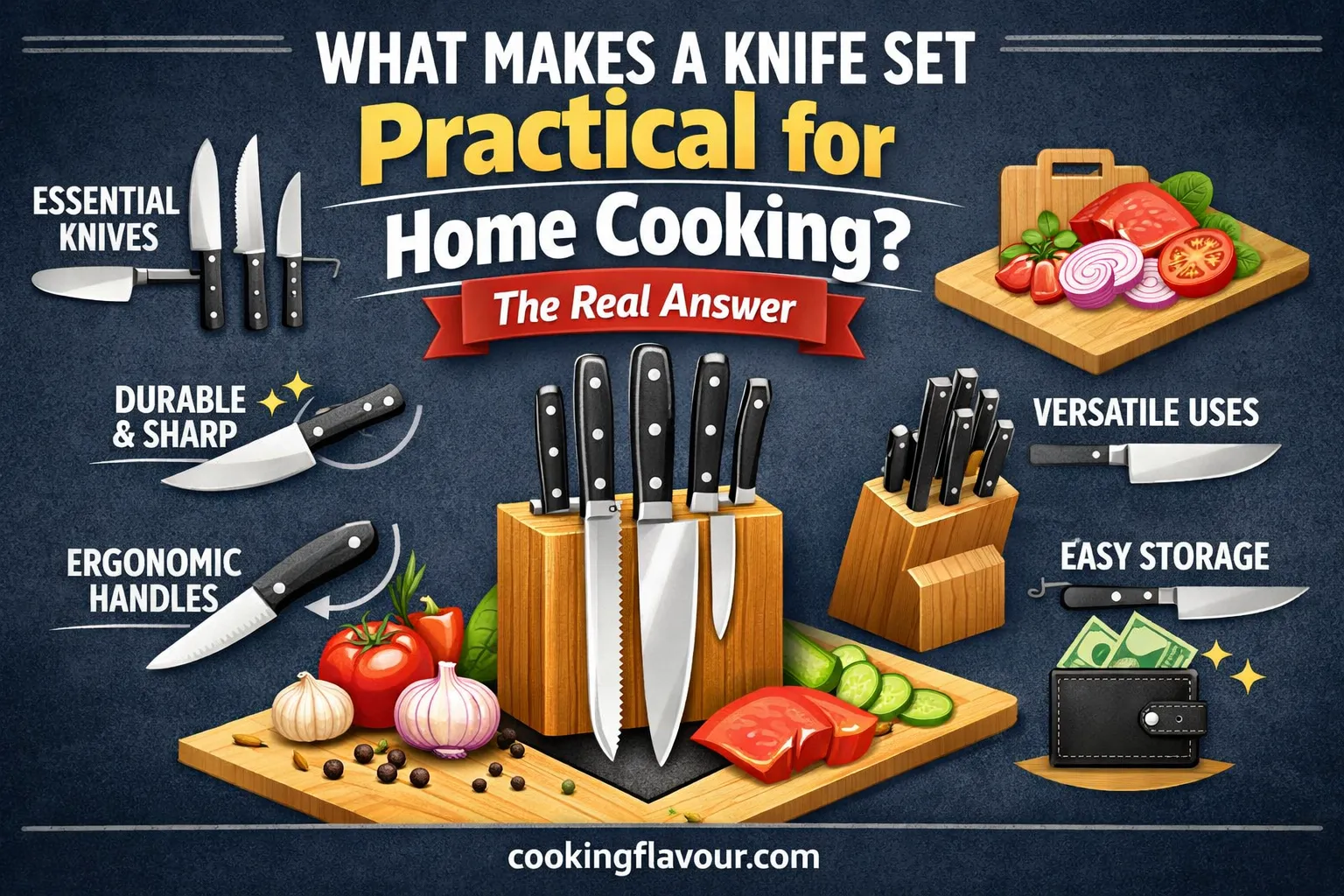
A practical knife set for home cooking needs just three core knives: a chef’s knife, a paring knife, and a serrated bread knife. These three blades handle 90% of everything you slice, chop, dice, or carve at home. You do not need 15 knives. You need sharp, well-balanced blades you reach for every single day.
I am Michael Alex Rahman, a home cooking enthusiast and kitchen gear reviewer who has spent years testing cutlery for everyday use. I remember the first knife set I ever bought. It was a 14-piece block stuffed with blades I never touched. The tomato slicer collected dust. The cheese knife sat forgotten. And I kept reaching for the same two or three knives every single time I cooked.
That experience taught me something most knife marketing ignores: more knives do not make a set more practical. The right knives do.
Brands like Zwilling J.A. Henckels and Wüsthof — both rooted in Solingen, Germany’s legendary cutlery tradition — have built their reputations on exactly this principle. Quality over quantity. Balance over bulk.
In this guide, I’ll walk you through everything that actually makes a knife set useful in a real home kitchen. We’ll cover blade types, steel quality, handle design, storage, and the one mistake most buyers make. Let’s get into it.
- A practical home knife set needs only 3 core knives: chef’s, paring, and serrated bread knife.
- High-carbon stainless steel blades stay sharp longer and resist rust better than basic steel.
- Forged knives outlast stamped knives and offer better balance for daily cooking tasks.
- Ergonomic handles reduce hand fatigue and make cutting safer over long prep sessions.
- Proper storage — a knife block, magnetic strip, or blade guards — protects sharpness and safety.
What Knives Should Every Home Cook Have?
Every home cook needs three knives: an 8-inch chef’s knife, a 3-4 inch paring knife, and a serrated bread knife. That’s it. These three blades cover chopping, dicing, peeling, slicing, and cutting through crusty bread — every core task in a home kitchen.
James Beard Award-winning chef Tony Messina puts it simply. He says a home cook needs a good chef’s knife first and foremost, plus a paring knife and a serrated utility knife. Three blades. No more required.
Here’s what each knife actually does:
| Knife Type | Best For | Blade Length |
|---|---|---|
| Chef’s Knife | Chopping, slicing, dicing, mincing herbs | 8 inches |
| Paring Knife | Peeling, trimming, small precise cuts | 3-4 inches |
| Serrated Bread Knife | Bread, tomatoes, soft-skinned produce | 8-10 inches |
Once you have these three working well, everything else in a knife set is a bonus — useful, but never essential for a home cook.
If you are building your kitchen from scratch, buy a 3-piece set first. Use it for 6 months. Only after that, buy additional knives you actually noticed you were missing.
Once you know which knives you need, the next question is: what separates a good set from a bad one? Blade steel is the answer — and it matters more than most buyers realize.
What Makes a Good Kitchen Knife? Blade Steel and Build Quality
A good kitchen knife starts with high-carbon stainless steel — a blade material that stays sharp longer, resists rust, and handles daily use without chipping. The steel grade, hardness, and forging method determine how long your knives perform and how easy they are to maintain.
High-Carbon Stainless Steel vs Basic Steel
High-carbon stainless steel combines the best of both worlds. The carbon content keeps the blade hard and sharp. The stainless properties resist corrosion and staining.
Basic stainless steel knives are cheap but dull fast. They’re soft and flex under pressure. High-carbon blades keep their edge through heavy daily use — slicing onions, butterflying chicken, chopping root vegetables.
Zwilling J.A. Henckels — a German brand that has been making knives since 1731 — uses a proprietary steel formula perfected over centuries. Their FRIODUR ice-hardening process makes blades harder, more corrosion resistant, and longer-lasting than standard steel knives.
Forged vs Stamped Knives: Which Lasts Longer?
Forged knives are cut from a single piece of steel and shaped under heat and pressure. Stamped knives are punched out of a flat steel sheet like a cookie cutter. The difference in quality is significant.
- Forged knives are denser, heavier, better balanced, and last decades with proper care.
- Stamped knives are lighter and cheaper but flex more and lose sharpness faster.
Most expert knife testers and professional chefs recommend forged blades for everyday home cooking. The upfront cost is higher, but a forged knife outlasts three or four stamped replacements.
For home cooking, look for high-carbon stainless steel blades with a forged one-piece construction. These knives cost more upfront but rarely need replacement. Avoid very cheap stamped steel sets — they dull within months and require constant resharpening.
Steel quality is just one side of the equation. How the knife feels in your hand is equally important — especially when you cook for 30-60 minutes at a stretch.
How Important Is Handle Design for a Home Kitchen Knife Set?
Handle design is critical for safety and comfort. A poorly balanced knife tires your hand, causes grip slip, and makes cutting less accurate. The right handle fits your grip, distributes weight evenly, and keeps your wrist relaxed during extended meal prep.
What to Look for in a Knife Handle
The best handles for home cooks are ergonomic, slightly contoured, and made from durable materials like reinforced polypropylene or stabilized wood. They should feel firm but not harsh in your palm.
Wüsthof — another cornerstone German brand with roots in Solingen — designs handles with a full bolster that balances the blade weight. This full-tang construction means the steel runs the full length of the handle, which dramatically improves balance.
Key handle features to look for:
- Full tang — steel runs through the entire handle for balance and strength
- Ergonomic shape — fits the natural curve of your grip
- Non-slip surface — safe when hands are wet or oily
- Seamless bolster — no gaps where food debris collects
A dull knife is more dangerous than a sharp one. A dull blade requires more force, and when it slips — which it will — the result can be a serious cut. Always keep your knives sharp and store them safely so the edges stay protected.
Once you understand blade steel and handle design, it helps to know the difference between the two main knife styles — because they affect how a set performs in your kitchen.
German vs Japanese Knife Sets: Which Is More Practical for Home Cooking?
German knives are thicker, more durable, and better for heavy chopping. Japanese knives are thinner, harder, and better for precise slicing. For most home cooks, a German-style set is more practical because it handles variety, resists chipping, and is easier to sharpen at home.
German (Western) Style Knives
German knives typically have a 15-20 degree blade angle, a curved edge, and a heavier build. The curve is designed for rocking cuts — the natural chopping motion most home cooks use. Brands like Zwilling and Wüsthof are made in Solingen, Germany, and define this style worldwide.
German steel is slightly softer (around 56-58 on the Rockwell hardness scale), which means it’s easier to sharpen at home with a standard honing steel or whetstone.
Japanese Style Knives
Japanese knives are ground to a 10-15 degree angle on each side — a thinner, sharper edge. The steel is harder (60+ Rockwell), which means it holds an edge longer but chips more easily when used on hard foods like frozen items or bone.
Japanese knives reward careful use and proper technique. They’re excellent for thin slicing and delicate work but demand more maintenance knowledge.
| Style | Edge Angle | Best For | Maintenance |
|---|---|---|---|
| German | 15-20° | Chopping, general use, durable tasks | Easy — honing steel works well |
| Japanese | 10-15° | Precise slicing, delicate prep work | Requires skill — whetstone preferred |
My recommendation for most home cooks: start with German-style knives. They forgive small technique errors, handle a wide range of kitchen tasks, and stay sharp longer under everyday conditions.
The right knife style is ultimately about personal preference and how you cook. German knives suit the majority of home kitchens. If you enjoy precise slicing and are willing to maintain a harder blade, Japanese knives are worth exploring after you build your core set.
Choosing the right steel and style matters — but there’s one more factor that separates a truly practical set from an overpriced one: the number of knives included.
How Many Knives Do You Actually Need in a Home Kitchen Set?
Most home cooks need 3-4 knives maximum. A chef’s knife, paring knife, and serrated bread knife cover nearly every daily task. A fourth knife — a utility knife or santoku — adds versatility for those who cook frequently and want options.
Large sets of 10, 12, or 15 knives often include redundant blades. A tomato knife, a cheese knife, a carving knife, and a boning knife are nice to have for specific tasks. But most home cooks reach for the same 2-3 knives every day regardless of how many are in the block.
A 2024 survey from Serious Eats found that experienced home cooks overwhelmingly prefer fewer, high-quality knives over large sets of average blades.
- Start with an 8-inch chef’s knife — this is your most-used blade, always.
- Add a 3-4 inch paring knife for precision work like peeling and trimming.
- Add a serrated bread knife for bread, tomatoes, and soft produce.
- After 3-6 months of cooking, identify what you are missing — then buy that one knife.
- Never buy a full 12-piece set just to fill a block. Buy what you actually use.
Now that you know which knives you need and what to look for, here is a product that earns its place in a practical home kitchen.
Zwilling J.A. Henckels 3-Piece Four Star Starter Set
This set gives you exactly what a home cook needs — a precision-forged 8-inch chef’s knife, a paring knife, and a serrated utility knife — all made from Zwilling’s ice-hardened FRIODUR steel that stays sharper longer with everyday use.
Is It Better to Buy a Knife Set or Individual Knives?
For most home cooks, a small curated knife set offers better value than buying individual knives one at a time. A good 3-piece set from one brand ensures matching steel quality, consistent handle design, and better storage solutions. It also costs less than buying three individual knives of the same quality separately.
That said, buying individual knives makes sense if you already have some and want to fill specific gaps. It also works well for cooks who prefer mixing Japanese and German styles for different tasks.
The key rule: only buy what you will actually use. A three-knife set you reach for daily beats a 15-knife block where most blades collect dust.
When comparing sets, check the warranty. Top brands like Zwilling and Wüsthof offer lifetime warranties on their knives. That is a strong sign of quality — and a real sign of practical value for home use.
What Is the Best Way to Store Kitchen Knives at Home?
The best knife storage options for home kitchens are a wooden knife block, a magnetic knife strip, or individual blade guards. Proper storage protects blade edges, prevents accidents, and keeps knives accessible during cooking. Avoid tossing knives into a drawer — it damages the edge and risks injury.
Knife Storage Options Compared
- Knife block — Classic and countertop-friendly. Protects blades. Takes counter space.
- Magnetic knife strip — Saves counter space. Displays knives visibly. Easy access.
- In-drawer knife organizer — Hidden storage. Blades need guards to prevent dulling.
- Blade guards / sheaths — Portable and protective. Great for drawer storage or travel.
I personally use a magnetic strip mounted on the kitchen wall. It saves counter space, keeps knives visible, and makes grabbing the right knife in the middle of cooking fast and easy.
How Do You Keep Kitchen Knives Sharp Between Uses?
Keep kitchen knives sharp by honing them with a honing steel before or after each use and sharpening them on a whetstone or pull-through sharpener every 1-3 months, depending on use. Honing realigns the blade edge without removing steel. Sharpening removes steel to rebuild a dulled edge.
Honing vs Sharpening: What Is the Difference?
Most home cooks confuse honing with sharpening. They are different processes with different purposes.
Honing — done with a honing steel — straightens and realigns the microscopic edge of a blade. It does not make a dull knife sharp again. It keeps a sharp knife sharp between full sharpenings.
Sharpening — done with a whetstone, electric sharpener, or pull-through sharpener — removes tiny amounts of steel to create a new edge. Do this when honing no longer restores the cutting feel.
According to America’s Test Kitchen, most home cooks should hone their knives every 2-3 uses and sharpen them 2-4 times per year depending on how often they cook.
Never put quality knives in the dishwasher. The high heat, harsh detergents, and movement damage blade edges and degrade handles. Hand-wash your knives with warm soapy water and dry them immediately. This single habit extends knife life by years.
What Makes an Expensive Knife Set Worth the Investment for Home Use?
An expensive knife set is worth the cost when it uses high-carbon steel, forged construction, and ergonomic handles that hold up through years of daily use. Quality knives like those from Zwilling or Wüsthof rarely need replacement, making them cheaper long-term than replacing budget sets every few years.
The true cost comparison looks like this: a cheap 15-piece stamped steel set at $40 may need replacing every 2-3 years. A quality 3-piece forged set at $150-$200 can last 10-20 years with basic maintenance. Over time, the quality set is cheaper — and sharper, and safer, and more enjoyable to cook with.
As Food & Wine has noted, a well-made chef’s knife is one of the best long-term investments a home cook can make.
A practical knife set for home cooking is not about having the most knives — it is about having the right ones. Three high-quality forged knives in high-carbon stainless steel, with ergonomic handles and proper storage, outperform a 15-piece set of cheap stamped blades every single time. Buy less. Buy better. Cook more confidently.
Conclusion
After testing and researching kitchen cutlery for years, my view has not changed: the most practical knife set is the smallest one that covers all your cooking needs.
Start with three knives. Choose forged high-carbon stainless steel. Look for ergonomic handles and trusted brands like Zwilling or Wüsthof. Store them properly. Hone them regularly. And skip the 15-piece block that sounds impressive but leaves you using the same two knives anyway.
I’m Michael Alex Rahman, and if there is one thing I want you to take away from this guide, it is this: a sharp, well-made chef’s knife changes how you cook. It makes prep faster, safer, and honestly more enjoyable. Invest in quality, keep it maintained, and it will serve you for decades.
Start simple. Cook better.
Frequently Asked Questions
What knives should every home cook have?
Every home cook needs three knives: an 8-inch chef’s knife, a paring knife, and a serrated bread knife. These three cover chopping, peeling, slicing, and cutting through crusty bread. Any additional knives are optional upgrades, not essentials.
How many knives do you actually need in a kitchen?
Most home cooks need 3 to 4 knives. The core three — chef’s, paring, and bread knife — handle the vast majority of daily cooking tasks. A utility knife or santoku is a practical fourth addition for cooks who prep heavily.
What is the most important knife in a kitchen?
The chef’s knife is the most important knife in any kitchen. An 8-inch chef’s knife handles chopping, slicing, dicing, and mincing. It is the blade you will reach for most often and the one worth spending the most money on.
Is it better to buy a knife set or individual knives?
For most home cooks, a small curated set of 3 to 5 knives offers the best value. Sets from quality brands ensure matching steel and handle consistency. Buying individual knives works better if you already own some knives and want to fill specific gaps.
What makes a kitchen knife set practical for everyday use?
A practical knife set includes only the knives you actually use, made from high-carbon stainless steel with forged construction. Ergonomic handles, proper sharpness, and good storage complete the package. Practicality means fewer, better knives — not more knives collecting dust.
How do you maintain a knife set so it stays sharp?
Hone your knives before or after each use with a honing steel. Sharpen them 2-4 times a year using a whetstone or pull-through sharpener. Always hand-wash and dry immediately — never use a dishwasher. Proper storage on a magnetic strip or in a knife block also preserves edge quality.