
What Comes in a Knife Set? Every Knife Explained
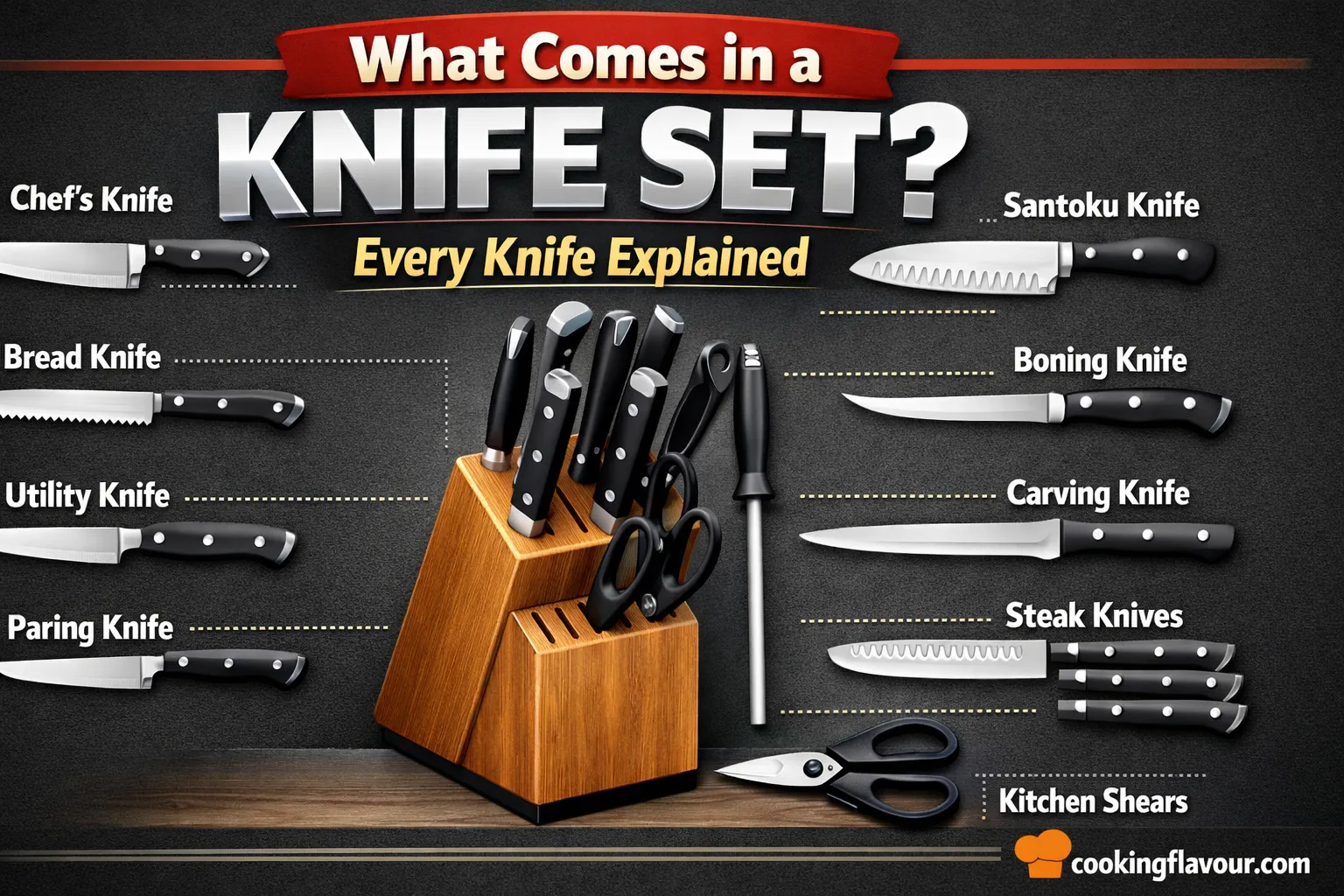
A knife set typically includes a chef’s knife, a bread knife, a paring knife, a utility knife, kitchen shears, a honing steel, and a knife block for storage. Most sets range from 5 to 20 pieces. The exact contents depend on the brand, price, and style. Some sets skip the block and use blade guards instead.
You’ve decided to upgrade your kitchen. You search “knife set” and suddenly you’re staring at 14-piece this and 20-piece that. Which knives actually matter? Which ones will just collect dust?
I’m Michael, and I’ve tested dozens of knife sets over the years — from budget blocks to professional-grade German steel. Here’s what I’ve learned: most people use 3 to 4 knives for 90% of their cooking. But knowing what every knife does helps you pick the right set. Let me break this down for you.
- Most knife sets include a chef’s knife, bread knife, paring knife, utility knife, shears, honing steel, and a block.
- The chef’s knife does 70% of your cutting — it’s the most important piece in any set.
- German steel (like Henckels or Wüsthof) is durable and forgiving; Japanese steel is sharper but requires more care.
- A 15-piece set doesn’t mean 15 knives — it often counts every steak knife, the shears, the block, and the honing rod separately.
- Store knives on a magnetic strip or in a block — never loose in a drawer.
What Knives Are Actually Included in a Standard Knife Set?
Here’s the short answer: a standard knife set usually includes 5 to 8 core knives, plus accessories. Let’s go through each one.
The Chef’s Knife (8 Inches) — The Most Important One
The chef’s knife is the backbone of any set. It handles chopping, slicing, dicing, and mincing. Most come in 8-inch or 10-inch lengths. An 8-inch chef’s knife works for most home cooks. It’s the knife you’ll reach for every single day.
Zwilling J.A. Henckels (a German cutlery brand founded in 1731) makes one of the most popular chef’s knives on the market. Their blades are made from high-carbon stainless steel and hold an edge well. According to Michelin-starred chef Silvio Salmoiraghi, Henckels is reliable, reasonably priced, and highly versatile.
If you only own one knife, make it an 8-inch chef’s knife. It handles 70% of all kitchen tasks on its own.
The Bread Knife (8 to 10 Inches) — Serrated for a Reason
A bread knife has a long serrated blade. That serration lets it saw through crusty bread without crushing the soft inside. You can also use it to slice tomatoes, citrus fruits, and sponge cake. Most sets include a 9-inch or 10-inch serrated bread knife.
Don’t use a straight-edge knife on bread. It’ll crush the loaf instead of cutting it cleanly.
The Paring Knife (3 to 4 Inches) — For Precision Work
A paring knife is small — usually 3 to 4 inches long. It’s built for detail work: peeling apples, coring strawberries, trimming fat, and slicing garlic. Both Victorinox (a Swiss brand known for their Swiss Army knives) and Rick Mace, executive chef of Tropical Smokehouse in West Palm Beach, recommend Victorinox paring knives for their sharpness and control.
The Utility Knife (5 to 6 Inches) — The In-Between Knife
The utility knife sits between the chef’s knife and the paring knife in size. It works well for slicing sandwiches, cutting medium-sized vegetables, and breaking down chicken. Some sets include a serrated utility knife, which is even more versatile.
The Santoku Knife (5 to 7 Inches) — The Japanese Alternative
The santoku is a Japanese-style knife with a shorter, flatter blade than a chef’s knife. It excels at slicing, dicing, and mincing. The word santoku means “three virtues” in Japanese — referring to its ability to cut fish, meat, and vegetables. Many mid-range sets include a santoku as a secondary all-purpose knife.
The Boning Knife (5 to 6 Inches) — For Meat Work
A boning knife has a narrow, flexible blade. It’s designed to separate meat from bone — ideal for chicken, fish, and pork. If you cook a lot of whole cuts of meat, this knife saves time and reduces waste. Not all sets include it, but premium 15-piece sets usually do.
The Carving or Slicing Knife (9 to 12 Inches) — For Roasts and Turkey
A carving knife is long and thin. It’s made for slicing large roasts, turkey, ham, and brisket. It produces clean, even cuts. You won’t use it every day, but when Thanksgiving comes around, you’ll be glad it’s there.
The 7 core knives in most standard sets: chef’s knife, bread knife, paring knife, utility knife, santoku, boning knife, and carving knife. Not every set includes all seven. Budget sets stick to the first four. Premium sets include all of them plus steak knives.
What Non-Knife Items Come in a Knife Set?
A knife set isn’t just knives. The piece count often includes accessories. Here’s what you’ll typically find alongside the blades.
The Honing Steel — Not a Sharpener
Most people think the honing steel sharpens knives. It doesn’t. It realigns the blade’s edge between sharpenings. Use it before each cooking session. This keeps your knife cutting straight and true. A honing steel is essential for maintaining an edge between professional sharpenings.
Don’t confuse honing with sharpening. A honing steel doesn’t remove metal — it straightens the edge. You still need to sharpen your knives every 6 to 12 months with a whetstone or sharpener.
Kitchen Shears — More Useful Than You Think
Quality kitchen shears cut herbs, pizza, chicken wings, and packaging. They’re one of the most underrated tools in any knife block. Look for shears that come apart for easy cleaning. Most knife sets in the 10-piece range and above include a pair.
The Knife Block — Storage That Protects Your Blades
The knife block holds everything together. It keeps blades from dulling against each other in a drawer. Most blocks are made from wood — acacia wood and beech are the most common choices. Some blocks have universal slots that accept any knife size.
An alternative to a block is a magnetic knife strip. It mounts to your wall, saves counter space, and displays your knives. Many chefs prefer it because it’s more hygienic and easier to clean than a slotted wood block.
Steak Knives — Often Counted in the Piece Total
Many “15-piece” or “20-piece” sets get their high piece count partly from steak knives. A set of 6 steak knives can add 6 to the total count instantly. Steak knives come in serrated or straight-edge versions. Serrated steak knives stay sharp longer but can’t be easily re-sharpened. Straight-edge steak knives give cleaner cuts on premium beef.
How Many Pieces Does a Knife Set Actually Contain?
Here’s a breakdown of what piece counts usually mean in practice.
| Piece Count | Typical Contents | Best For |
|---|---|---|
| 5 to 6 Piece | Chef’s knife, bread knife, paring knife, utility knife, honing steel, block | First knife set, apartment kitchens |
| 10 to 12 Piece | Above + santoku, boning knife, kitchen shears, 4 steak knives | Home cooks who cook daily |
| 15 to 17 Piece | Above + carving knife, 6 steak knives, sharpener, full block | Families, entertaining, serious cooks |
| 20 Piece | All of the above + extra specialty knives + full steak knife set | Full kitchen outfitting, gifts |
German Steel vs. Japanese Steel — Which Knife Set Should You Choose?
The biggest decision in choosing a knife set comes down to steel type. Let’s look at both.
German Steel Knife Sets
German steel — like the kind used by Wüsthof (founded in Solingen, Germany in 1814) and Zwilling J.A. Henckels — is softer at around 56 to 58 HRC (Rockwell Hardness). That makes it more durable and chip-resistant. It also means you can resharpen it more easily at home. German blades have a slight curve to the belly, making them great for the rocking motion of chopping.
Japanese Steel Knife Sets
Japanese steel — used in brands like Global and Shun — is harder, usually 60 to 67 HRC. That means a sharper, thinner edge. But it’s more brittle and can chip if you use it roughly. Japanese knives require more careful maintenance. They shine at slicing fish, vegetables, and thin proteins.
If you’re a home cook who wants a set that handles everything without much fuss, go German steel. If you’re a detail-oriented cook who loves razor precision and doesn’t mind extra care, go Japanese. Both are excellent — the difference is in your cooking style.
What’s the Best Knife Set to Buy Right Now?
The HENCKELS Statement 15-Piece Knife Set with Block is one of the most consistent performers on Amazon. It’s a top-rated set from the Zwilling J.A. Henckels brand — made with German engineering, high-carbon stainless steel, and a full block. It includes everything a home kitchen needs.
HENCKELS Statement Premium Quality 15-Piece Knife Set with Block, Natural, Razor-Sharp, German Engineered Informed by 100+ Years of Mastery, Lightweight and Strong, Dishwasher Safe
This 15-piece set from Henckels gives you all the core knives — chef’s, bread, paring, utility, santoku, boning, carving, steak knives, shears, honing rod, and block — built from precision German steel with over a century of craftsmanship behind it.
How to Take Care of Your Knife Set
A great knife set lasts decades — but only if you treat it right. Here’s how.
- Hand-wash your knives with warm soapy water — the dishwasher dulls blades and damages handles over time.
- Dry blades immediately after washing — moisture causes rust on carbon steel.
- Hone your chef’s knife with the honing steel before each use session.
- Sharpen your knives with a whetstone or pull-through sharpener every 6 to 12 months.
- Store knives in the block or on a magnetic strip — never loose in a drawer.
John Adler, head chef at Blue Apron, puts it well: rusting, chipped knives can be dangerous. A dull knife requires more force and causes more accidents than a sharp one.
Use a cutting board made from wood or plastic — not glass or ceramic. Hard surfaces destroy knife edges within weeks.
Do You Actually Need a Full Knife Set?
Here’s a question worth asking. Many pro chefs and knife experts say no — you don’t need 20 pieces. They recommend building a small, high-quality collection instead.
The minimum effective knife kit for a home cook looks like this:
- 1 quality chef’s knife — handles 70% of all tasks
- 1 serrated bread knife — for bread and soft produce
- 1 paring knife — for detail work and peeling
That’s it. These three knives handle almost everything. A knife set makes sense when you want a matching collection, a wood block for storage, and the full range of tools ready to go. For most families, a 10 to 15 piece set hits the sweet spot between completeness and value.
Before buying a large set, check what knives are actually included versus what counts toward the “piece” number. Steak knives, shears, and the block often make up 6 to 8 pieces of a “15-piece” set.
What’s the Difference Between Forged and Stamped Knives?
This one surprises most people. Forged knives are made from a single piece of steel heated and shaped by a hammer or press. They’re heavier, have a bolster (the thick band between blade and handle), and hold an edge longer. Stamped knives are cut from a sheet of steel like a cookie cutter. They’re lighter and cheaper. Both can be sharp — but forged knives last longer and feel more balanced in the hand.
German brands like Wüsthof and Henckels are known for their forged construction. According to Nothing But Knives, advances in metallurgy have made even mid-range forged sets significantly better than they were 20 years ago.
What Is a Full Tang Knife and Why Does It Matter?
The tang is the part of the blade that extends into the handle. A full tang runs the entire length of the handle and is usually visible along the spine. Full tang knives are stronger, better balanced, and more durable. Half tang or partial tang knives can loosen over time, especially with heavy use.
When buying a knife set, look for “full tang” in the product description. It’s a sign of quality construction. Most reputable brands — Henckels, Wüsthof, Victorinox, and Cutluxe — build their sets with full tang blades.
Conclusion
A standard knife set gives you the chef’s knife, bread knife, paring knife, utility knife, honing steel, kitchen shears, and a storage block — everything a home cook needs. Premium sets add the santoku, boning knife, carving knife, and steak knives. The most important piece in any set is always the chef’s knife. Choose German steel for durability and ease of maintenance. Keep your knives hand-washed, dried immediately, and stored in a block or on a magnetic strip. That’s all it takes to keep them sharp for decades. I’m Michael, and I hope this guide helps you pick the right set for your kitchen.
Frequently Asked Questions
What knives come in a basic knife set?
A basic knife set typically includes a chef’s knife, a bread knife, a paring knife, a utility knife, a honing steel, and a knife block. Some 5-piece sets skip the honing steel and include only the four core knives plus the block.
How many knives do I actually need?
Most home cooks need just three knives: a chef’s knife, a bread knife, and a paring knife. These three cover 90% of all kitchen tasks. A full knife set is useful if you want matching cutlery, a storage block, and specialty knives like a boning or carving knife.
What does “15-piece knife set” mean?
A 15-piece knife set counts every item individually — including the block, honing steel, kitchen shears, and each steak knife. You might get 7 to 8 actual cutting knives plus 6 steak knives plus 2 accessories, which adds up to 15 or more pieces.
Is German or Japanese steel better for a knife set?
German steel is more durable, chip-resistant, and easier to maintain at home — making it better for everyday use. Japanese steel is harder, sharper, and thinner but requires more careful handling. For most home cooks, German steel is the smarter choice.
What is a honing steel and how do I use it?
A honing steel realigns the microscopic edge of your blade between sharpenings. Hold the steel vertically, place the blade at a 15 to 20 degree angle, and slide it down in a smooth stroke. Use it before or after every cooking session to keep your knife performing at its best.
Can you put knife sets in the dishwasher?
Most manufacturers advise against it, even for “dishwasher safe” sets. The high heat and harsh detergents accelerate blade dulling and can crack or loosen wooden handles over time. Hand-washing with warm soapy water and drying immediately is always the safer choice.
What’s the difference between a forged and stamped knife?
Forged knives are shaped from a single piece of heated steel — they’re heavier, more balanced, and hold an edge longer. Stamped knives are cut from flat steel sheets — they’re lighter and less expensive but wear faster. For long-term value, choose a forged knife set.
{
“@context”: “https://schema.org”,
“@type”: “FAQPage”,
“mainEntity”: [
{
“@type”: “Question”,
“name”: “What knives come in a basic knife set?”,
“acceptedAnswer”: {
“@type”: “Answer”,
“text”: “A basic knife set typically includes a chef’s knife, a bread knife, a paring knife, a utility knife, a honing steel, and a knife block. Some 5-piece sets skip the honing steel and include only the four core knives plus the block.”
}
},
{
“@type”: “Question”,
“name”: “How many knives do I actually need?”,
“acceptedAnswer”: {
“@type”: “Answer”,
“text”: “Most home cooks need just three knives: a chef’s knife, a bread knife, and a paring knife. These three cover 90% of all kitchen tasks. A full knife set is useful if you want matching cutlery, a storage block, and specialty knives like a boning or carving knife.”
}
},
{
“@type”: “Question”,
“name”: “What does ’15-piece knife set’ mean?”,
“acceptedAnswer”: {
“@type”: “Answer”,
“text”: “A 15-piece knife set counts every item individually — including the block, honing steel, kitchen shears, and each steak knife. You might get 7 to 8 actual cutting knives plus 6 steak knives plus 2 accessories, which adds up to 15 or more pieces.”
}
},
{
“@type”: “Question”,
“name”: “Is German or Japanese steel better for a knife set?”,
“acceptedAnswer”: {
“@type”: “Answer”,
“text”: “German steel is more durable, chip-resistant, and easier to maintain at home — making it better for everyday use. Japanese steel is harder, sharper, and thinner but requires more careful handling. For most home cooks, German steel is the smarter choice.”
}
},
{
“@type”: “Question”,
“name”: “What is a honing steel and how do I use it?”,
“acceptedAnswer”: {
“@type”: “Answer”,
“text”: “A honing steel realigns the microscopic edge of your blade between sharpenings. Hold the steel vertically, place the blade at a 15 to 20 degree angle, and slide it down in a smooth stroke. Use it before or after every cooking session to keep your knife performing at its best.”
}
},
{
“@type”: “Question”,
“name”: “Can you put knife sets in the dishwasher?”,
“acceptedAnswer”: {
“@type”: “Answer”,
“text”: “Most manufacturers advise against it, even for ‘dishwasher safe’ sets. The high heat and harsh detergents accelerate blade dulling and can crack or loosen wooden handles over time. Hand-washing with warm soapy water and drying immediately is always the safer choice.”
}
},
{
“@type”: “Question”,
“name”: “What’s the difference between a forged and stamped knife?”,
“acceptedAnswer”: {
“@type”: “Answer”,
“text”: “Forged knives are shaped from a single piece of heated steel — they’re heavier, more balanced, and hold an edge longer. Stamped knives are cut from flat steel sheets — they’re lighter and less expensive but wear faster. For long-term value, choose a forged knife set.”
}
}
]
}