
What Knives Are Included in a Standard Kitchen Set? (Complete Guide)
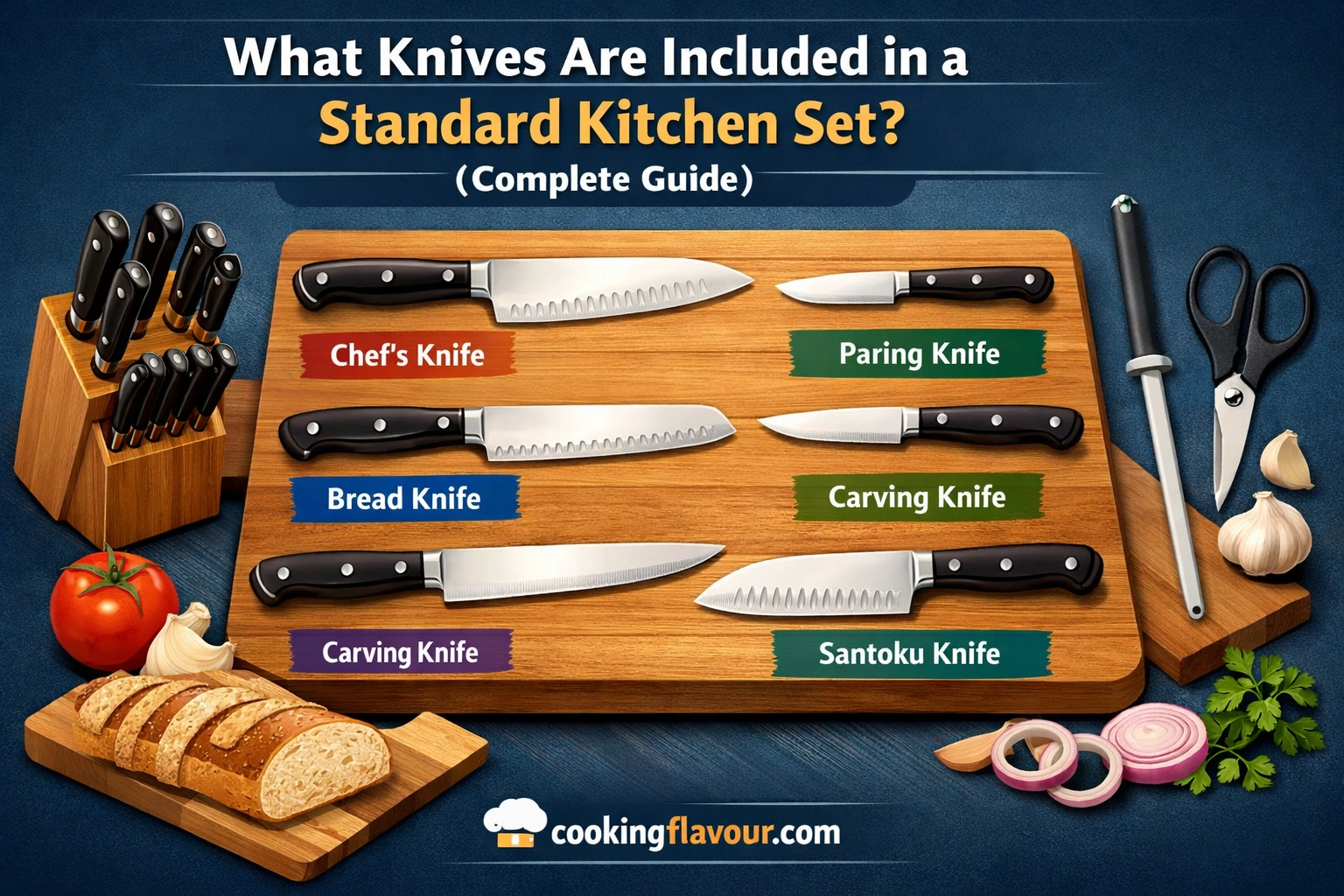
A standard kitchen knife set includes a chef’s knife, a paring knife, and a bread knife. Most sets also add a utility knife, a santoku knife, and a honing steel. Larger sets (10 to 15 pieces) include steak knives, kitchen shears, and a knife block. You need these 3 to 5 core knives to handle almost every cooking task at home.
You just decided to upgrade your kitchen. Maybe your old knives are dull, or you’re setting up your first home. Either way, you’re staring at knife sets on shelves and wondering — what do you actually need?
I’m Michael, and I’ve spent years cooking daily and testing kitchen tools. Here’s what I’ve learned: most people buy too many knives. A smart set covers every task without the clutter. Let me break down exactly what comes in a standard kitchen knife set — and which knives you’ll actually use.
- Every standard kitchen set includes a chef’s knife, paring knife, and bread knife.
- A utility knife and santoku knife appear in most mid-size sets (7 to 10 pieces).
- A honing steel, kitchen shears, and knife block are common extras in larger sets.
- Steak knives (usually 6 pieces) are standard in 12 to 15-piece sets.
- You only need 3 to 5 knives to handle 95% of home cooking tasks.
What Is a Standard Kitchen Knife Set?
A standard kitchen knife set is a curated collection of blades designed to cover the most common cutting tasks in a home kitchen. Sets range from 3-piece basics to 21-piece complete collections. The word “standard” usually refers to a 5 to 15-piece set that comes with a storage block.
The three core knives found in virtually every set are the chef’s knife, paring knife, and bread knife. Everything else — santoku, utility, boning, steak knives — is a bonus. James Beard Award-winning chef Tony Messina confirmed this in 2025: all you truly need are a chef’s knife, a paring knife, and a serrated utility knife.
Now let’s look at each knife in detail, starting with the most important one.
The Chef’s Knife: The Most Important Knife in Any Set
The chef’s knife is the workhorse of every kitchen. It handles chopping, slicing, dicing, and mincing. Most sets include an 8-inch chef’s knife, though some premium sets go to 10 inches.
This knife has a wide, curved blade that rocks on the cutting board. That rocking motion lets you chop herbs and vegetables fast. It also handles meat, fish, and large fruits like watermelon with ease.
German brands like Zwilling J.A. Henckels (founded in Solingen, Germany in 1731) and Wusthof produce some of the most respected chef’s knives on the market. Their blades use high-carbon stainless steel, which holds a sharp edge and resists rust. Japanese brands like Shun and Global offer thinner, lighter blades that excel at precision slicing.
If you can only own one knife, make it an 8-inch chef’s knife. It handles 70% of everything you’ll ever cut in a kitchen.
What Does a Paring Knife Do and Why Is It in Every Set?
A paring knife is small — typically 3 to 3.5 inches. It handles tasks too precise for a chef’s knife: peeling apples, deveining shrimp, trimming fat, and segmenting citrus.
It’s the knife you hold in your hand rather than use on a cutting board. The short blade gives you control for detail work. Most sets include one paring knife, but some 15-piece sets include two — a standard one and a bird’s beak style for curved cuts.
Swiss brand Victorinox — the maker of the famous Swiss Army knife — produces one of the most respected paring knives at any price point. Their Fibrox handle provides a non-slip grip even when your hands are wet.
Why Every Kitchen Set Needs a Bread Knife
A bread knife has a long, serrated edge — usually 8 to 10 inches. The serrations grip and saw through hard crusts without crushing soft interiors. You can’t do this with a smooth blade.
But bread knives do more than slice bread. They cut tomatoes cleanly, slice layer cakes without tearing, and work through pineapples. The serrated edge is self-sharpening in a sense — it stays effective longer than a smooth blade because each point works independently.
Most standard sets include an 8-inch serrated bread knife. Premium sets may offer a 10-inch version or an offset handle design that keeps your knuckles off the cutting board.
What Is a Santoku Knife and Is It in Standard Sets?
A santoku knife is a Japanese-style all-purpose blade. The name means “three virtues” in Japanese — referring to meat, fish, and vegetables. It’s typically 5 to 7 inches with a flat edge and a slightly curved tip.
It appears in most 7-piece and larger sets. The santoku is narrower and lighter than a German chef’s knife. Many home cooks prefer it for vegetable prep because it slices thin, even cuts. It lacks the curved belly of a chef’s knife, so rocking chopping doesn’t work — but push cutting does.
Many sets include both a chef’s knife and a santoku. That gives you the best of both styles in one collection.
If you prefer lighter knives and do a lot of vegetable prep, the santoku may become your go-to blade instead of the chef’s knife. Both belong in a well-rounded set.
What Is a Utility Knife Used For?
A utility knife fills the gap between a chef’s knife and a paring knife. It’s typically 5 to 6 inches long — big enough for medium tasks but nimble enough for detailed work.
Use a utility knife for slicing sandwiches, trimming chicken breasts, cutting cheese, or chopping herbs. Some utility knives have a partially serrated edge, making them useful for tomatoes and soft fruits.
Most mid-size sets (7 to 10 pieces) include a utility knife. Budget sets sometimes skip it, but you’ll reach for it regularly once you have it.
Does a Standard Set Include a Boning Knife?
A boning knife appears in premium and large sets — typically 15 to 21 pieces. It has a thin, flexible 6-inch blade designed to separate meat from bone. The flexibility lets it bend around joints and follow contours closely.
Most home cooks don’t need one. If you regularly break down whole chickens or debone fish, it’s indispensable. If you mostly cook portioned cuts, it’ll sit unused in the block.
Brands like Wusthof (a German cutlery manufacturer based in Solingen since 1814) include boning knives in their higher-tier sets like the Classic Ikon series.
What Steak Knives Come in a Kitchen Knife Set?
Sets of 12 to 15 pieces almost always include 6 steak knives at 4.5 inches. These serrated or semi-serrated knives cut cooked meat at the table without tearing. They’re essential for family meals and dinner parties.
Steak knives account for much of the “piece count” in large sets. A “15-piece set” might include 6 steak knives, making the actual unique-blade count closer to 9. Know what you’re buying before assuming a larger number means more useful knives.
Don’t judge a knife set by piece count alone. A 15-piece set might include 6 steak knives and 2 pairs of shears, leaving you with fewer unique cooking knives than a quality 7-piece set.
What Else Comes in a Kitchen Knife Set? (Beyond the Blades)
Most kitchen knife sets include extras beyond the blades themselves. Here’s what you’ll typically find:
- Honing steel — An 8-inch steel rod that realigns the blade edge. Use it before every cooking session. It doesn’t sharpen the knife; it maintains the edge between sharpenings.
- Kitchen shears — All-purpose scissors for cutting herbs, breaking down poultry, opening packaging, and more. Some sets include two pairs.
- Knife block — A wooden storage stand that holds knives safely and keeps edges protected. Some modern blocks have built-in sharpeners.
- Knife sharpener — Some sets include a pull-through or electric sharpener. Built-in sharpeners in the block base are common in sets from McCook and Astercook.
How Many Knives Do You Actually Need?
Honestly? Three. A chef’s knife, a paring knife, and a bread knife cover almost every daily task. Professional chefs repeat this constantly.
Here’s the practical breakdown by cooking style:
| Cook Type | Recommended Set Size | Must-Have Knives |
|---|---|---|
| Beginner / Minimal cook | 3 to 5 pieces | Chef’s, paring, bread |
| Regular home cook | 7 to 10 pieces | Add santoku, utility, shears |
| Enthusiast / Entertainer | 12 to 15 pieces | Add steak knives, boning knife |
| Serious or pro cook | Build custom collection | Individual quality pieces |
German vs Japanese Kitchen Knife Sets: What’s the Difference?
This is one of the most common decisions buyers face. Here’s a plain-English comparison.
German-style knives (Wusthof, Zwilling, Henckels) are heavier, with a thicker blade and a full bolster. They’re forgiving — great for heavy chopping, rock-cutting technique, and everyday use. They’re easier to sharpen and less prone to chipping.
Japanese-style knives (Shun, Global, MAC) are lighter and thinner. The blade angle is typically 15 degrees versus 20 degrees on German knives — giving them a sharper edge. They excel at slicing raw fish, paper-thin vegetables, and precision work. They’re more delicate and need careful handling.
Most home cooks are happiest with a German-style set. Enthusiasts often own both for different tasks.
The best knife set isn’t the most expensive one. It’s the set you’ll actually maintain, sharpen, and use every day. A quality 5-piece set beats a neglected 15-piece collection every time.
What Blade Material Should You Look for in a Kitchen Set?
The best kitchen knife sets use high-carbon stainless steel. This material balances sharpness, edge retention, and rust resistance. Look for this term in the product description.
- High-carbon stainless steel — Best all-around. Sharp, rust-resistant, durable. Used by Wusthof, Zwilling, and Victorinox.
- German steel — Marketing term that usually means high-carbon stainless. Common in mid-range sets.
- X30Cr13 steel — Budget Japanese steel grade. Decent edge but loses sharpness faster than higher-grade alloys.
- VG-10 steel — Premium Japanese steel. Holds an exceptional edge. Found in Shun and high-end Damascus sets.
- Damascus steel — A layered steel with a distinctive wavy pattern. Combines beauty with performance. Found in premium Japanese sets.
For most home cooks, high-carbon stainless steel is all you need. Full-tang construction (where the blade extends through the handle) is a sign of quality. Triple-riveted handles indicate durability.
How to Care for Your Kitchen Knife Set
- Hand wash knives immediately after use — never put them in a dishwasher.
- Dry blades completely before storing — moisture causes rust even on stainless steel.
- Hone your chef’s knife before each use with the included honing steel.
- Sharpen blades with a whetstone or quality sharpener every 2 to 3 months.
- Store knives in a block, on a magnetic strip, or in blade guards — never loose in a drawer.
- Use a wooden or plastic cutting board — glass and stone boards destroy blade edges fast.
The dishwasher is a knife killer. High heat, harsh detergents, and rattling against other items dull blades fast and damage handles. Always hand wash and dry your knives immediately.
Top-Rated Kitchen Knife Sets Worth Considering
Based on testing and expert reviews from 2025, these sets consistently top the rankings:
- Zwilling Professional S 7-Piece — Best overall for new cooks. High-carbon steel, balanced weight, and a versatile selection.
- Victorinox Classic 8-Piece — Best value. The Swiss Army knife company’s non-slip Fibrox handles make these a favorite in culinary schools.
- Wusthof Classic Ikon 10-Piece — Premium German set for serious home cooks. Built to outlast a lifetime of daily use.
- McCook 15-Piece with Built-in Sharpener — Best all-in-one value. Amazon’s top-selling block knife set in 2025, with a rubberwood block that includes an integrated sharpener.
You can check reviews and price comparisons on Nothing But Knives and TechGearLab for hands-on testing data.
McCook® Knife Sets, German Stainless Steel Kitchen Knife Block Sets with Built-in Sharpener
This #1 best-selling set on Amazon includes 15 pieces — 8″ chef knife, slicing knife, santoku, utility, paring knife, 6 steak knives, shears, and a rubberwood block with a built-in sharpener to keep every blade ready.
A standard kitchen knife set includes: chef’s knife (8″), bread knife (8-10″), paring knife (3-3.5″), and often a santoku (5-7″) and utility knife (5-6″). Larger sets add steak knives, a honing steel, kitchen shears, and a knife block. You need just 3 to 5 knives for daily home cooking. Choose high-carbon stainless steel, full-tang construction, and a set that fits your actual cooking style — not the biggest piece count.
The right kitchen knife set makes cooking faster, safer, and more enjoyable. Start with the core three knives. Add a santoku and utility knife as your skills grow. And always — always — keep your knives sharp. A dull knife is more dangerous than a sharp one, because it slips instead of cuts. That’s the single most important rule in any kitchen.
Thanks for reading — Michael here, and I hope this guide helps you choose the set that actually serves your kitchen well for years to come.
Frequently Asked Questions
What knives are included in a standard kitchen set?
A standard kitchen knife set includes a chef’s knife, a paring knife, and a bread knife as the core three. Most mid-size sets (7 to 10 pieces) also include a santoku knife, a utility knife, a honing steel, and kitchen shears. Larger sets add steak knives and sometimes a boning knife.
How many knives do I actually need in a kitchen set?
You need 3 to 5 knives to handle almost all home cooking. A chef’s knife, paring knife, and bread knife cover 90% of tasks. Adding a utility knife and santoku covers nearly everything else. More knives only help if you regularly cook specific foods that require them.
What is the most important knife in a kitchen set?
The chef’s knife is the most important. An 8-inch chef’s knife handles chopping, slicing, dicing, and mincing — the core tasks in daily cooking. Every professional chef and cooking expert agrees it’s the one knife no kitchen should be without.
What’s the difference between a chef’s knife and a santoku knife?
A chef’s knife has a curved belly and a pointed tip, designed for rock-chopping technique on a board. A santoku knife has a flatter edge and a rounded tip, designed for push-cuts and thin slicing. Chef’s knives are typically heavier and German-style; santoku knives are Japanese-style and lighter.
Is a 15-piece knife set better than a 7-piece?
Not necessarily. A 15-piece set often includes 6 steak knives and 2 pairs of shears, so the actual cooking blade count is similar to a 7-piece set. Evaluate what specific knives are included — not the total piece count. A 7-piece set with quality blades beats a 15-piece set with filler.
Should kitchen knives be dishwasher safe?
Even if labeled dishwasher-safe, hand washing is always better for kitchen knives. The heat, moisture, and detergents in a dishwasher dull blades and damage handles over time. Wash, dry, and store knives immediately after use to extend their lifespan.
What does full tang mean on a kitchen knife?
Full tang means the blade’s metal extends the full length of the handle, all the way to the end. This makes the knife more durable and better balanced than a partial-tang design. Full-tang knives are a reliable quality indicator in any kitchen set.
{
“@context”: “https://schema.org”,
“@type”: “FAQPage”,
“mainEntity”: [
{
“@type”: “Question”,
“name”: “What knives are included in a standard kitchen set?”,
“acceptedAnswer”: {
“@type”: “Answer”,
“text”: “A standard kitchen knife set includes a chef’s knife, a paring knife, and a bread knife as the core three. Most mid-size sets (7 to 10 pieces) also include a santoku knife, a utility knife, a honing steel, and kitchen shears. Larger sets add steak knives and sometimes a boning knife.”
}
},
{
“@type”: “Question”,
“name”: “How many knives do I actually need in a kitchen set?”,
“acceptedAnswer”: {
“@type”: “Answer”,
“text”: “You need 3 to 5 knives to handle almost all home cooking. A chef’s knife, paring knife, and bread knife cover 90% of tasks. Adding a utility knife and santoku covers nearly everything else.”
}
},
{
“@type”: “Question”,
“name”: “What is the most important knife in a kitchen set?”,
“acceptedAnswer”: {
“@type”: “Answer”,
“text”: “The chef’s knife is the most important. An 8-inch chef’s knife handles chopping, slicing, dicing, and mincing — the core tasks in daily cooking.”
}
},
{
“@type”: “Question”,
“name”: “What’s the difference between a chef’s knife and a santoku knife?”,
“acceptedAnswer”: {
“@type”: “Answer”,
“text”: “A chef’s knife has a curved belly and a pointed tip, designed for rock-chopping technique on a board. A santoku knife has a flatter edge and a rounded tip, designed for push-cuts and thin slicing. Chef’s knives are typically heavier and German-style; santoku knives are Japanese-style and lighter.”
}
},
{
“@type”: “Question”,
“name”: “Is a 15-piece knife set better than a 7-piece?”,
“acceptedAnswer”: {
“@type”: “Answer”,
“text”: “Not necessarily. A 15-piece set often includes 6 steak knives and 2 pairs of shears, so the actual cooking blade count is similar to a 7-piece set. Evaluate what specific knives are included — not the total piece count.”
}
},
{
“@type”: “Question”,
“name”: “Should kitchen knives be dishwasher safe?”,
“acceptedAnswer”: {
“@type”: “Answer”,
“text”: “Even if labeled dishwasher-safe, hand washing is always better for kitchen knives. The heat, moisture, and detergents in a dishwasher dull blades and damage handles over time.”
}
},
{
“@type”: “Question”,
“name”: “What does full tang mean on a kitchen knife?”,
“acceptedAnswer”: {
“@type”: “Answer”,
“text”: “Full tang means the blade’s metal extends the full length of the handle, all the way to the end. This makes the knife more durable and better balanced than a partial-tang design. Full-tang knives are a reliable quality indicator in any kitchen set.”
}
}
]
}